My Cart
Your Cart 0

    Your cart is empty.

  • Total (Amount) ₹0.00
NCERT Exemplar · Class 11 · Physics

Chapter 7: System of Particles and Rotational Motion

Practice each question, then open the answer or worked solution.

Questions

28 questions
Q7.21Written answer

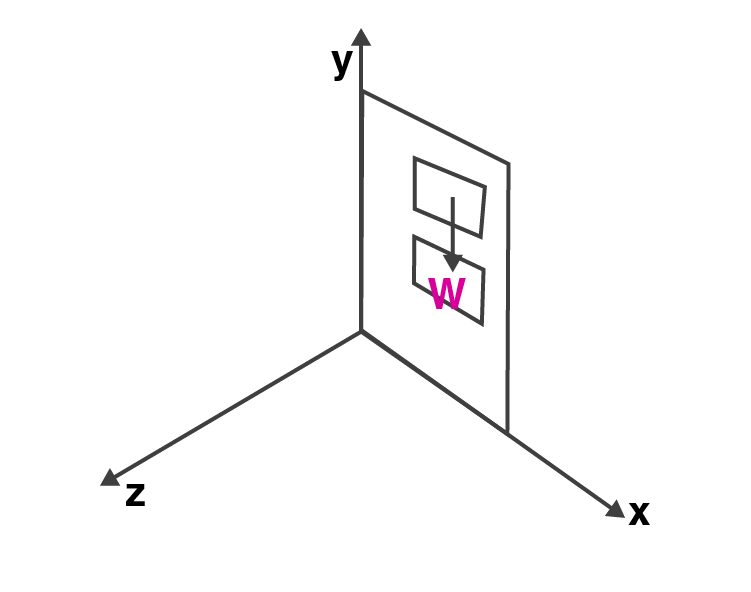
A door is hinged at one end and is free to rotate about a vertical axis. Does its weight cause any torque about this axis? Give a reason for your answer.
Exemplar Solutions Class 11 Physics Class 7 - 10

Show solutionHide solution
Worked solution
Exemplar Solutions Class 11 Physics Class 7 - 11

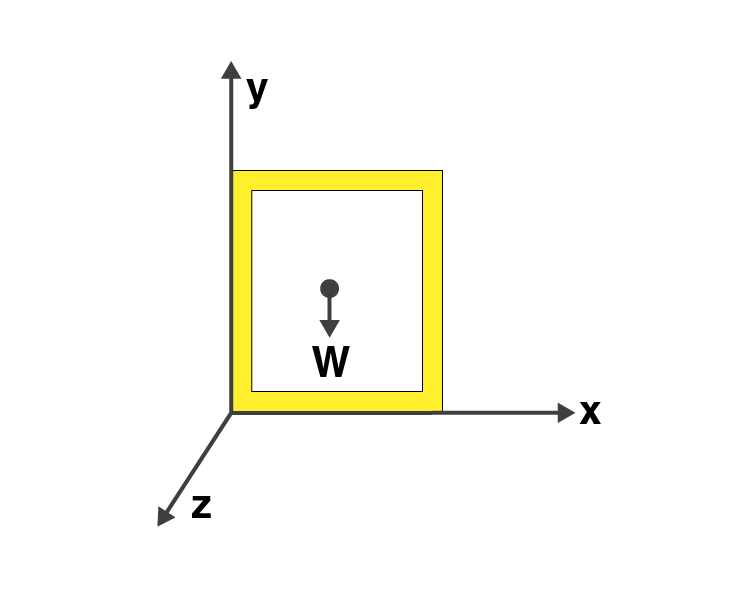
The axis of the door is in the y-axis and the door is in the x-y plane. The door rotates in the positive as well as negative z-axis as the force is applied in the z-axis. The gravity acting on the door is in the direction of –y-axis. Therefore, the weight of the door cannot rotate the door along the y-axis.
Q7.22Written answer

(n-1) equal point masses each of mass m are placed at the vertices of a regular n-polygon. The vacant vertex has a position vector concerning the centre of the polygon. Find the position vector of the centre of mass.

Show solutionHide solution
Worked solution

Given,

Exemplar Solution Physics Class 11 Chapter 7 Img 22

Where,

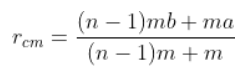
rcm is the place where mass m is placed at the nth vertex

rcm = 0

Exemplar Solution Physics Class 11 Chapter 7 Img 23

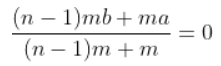
(n-1)mb + ma = 0

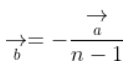
b = -ma/(n-1)m

Exemplar Solution Physics Class 11 Chapter 7 Img 24

Where,
Exemplar Solution Physics Class 11 Chapter 7 Img 25is the position vector. Also, the negative sign indicates that the centre of mass lies on the other side of the nth vertex.
Long Answers
Q7.23Written answer

Find the centre of mass of a uniform

a) half-disc

b) quarter-disc

Show solutionHide solution
Worked solution

Exemplar Solutions Class 11 Physics Class 7 - 12

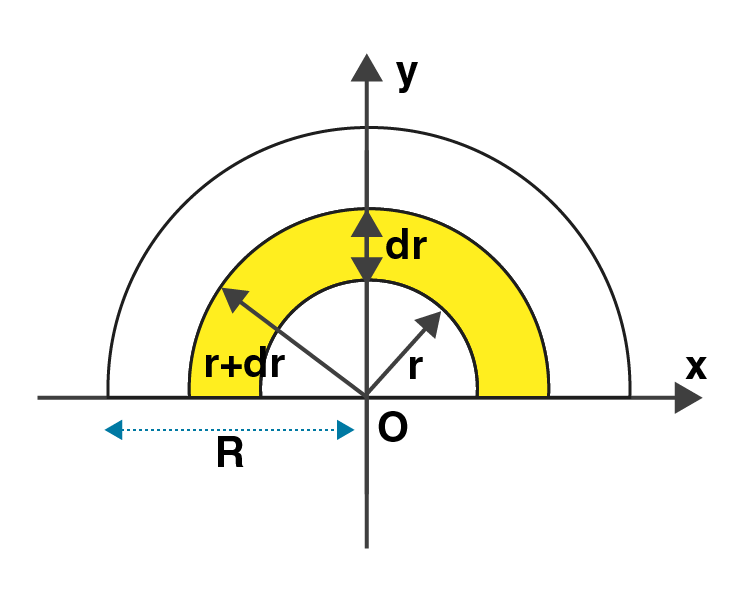
Let M be the mass of the half-disc

Area of the half-disc = πR2/2

Mass per unit area m = 2M/πR2

a) when the disc is half, the centre of mass is (0, 4R/3π)

b) when the disc is quarter, the centre of mass is (4R/3π, 4R/3π)

Q7.24Written answer

Two discs of moments of inertia I1 and I2 about their respective axes and rotating with angular speed ω1 and ω2 are brought into contact face to face with their axes of rotation coincident.

a) does the law of conservation of angular momentum apply to the situation? why?

b) find the angular speed of the two-disc system

c) calculate the loss in kinetic energy of the system in the process

d) account for this loss

Show solutionHide solution
Worked solution

a) The law of conservation of angular momentum can be applied as there is no external torque on the system and the gravitational and its normal reaction towards the external forces have net torque zero.

b) Using law of conservation of angular momentum,

Lf = Li

I1ω1 + I2 ω2

ω = I1 ω1+ I2 ω2/I1 + I2

c) Final kinetic energy = rotational + translation energy

Kf = KER +KET

∆K = -I1I2/2(I1 +I2)( ω1 – ω2)2 < 0

d) Kf < Ki as there is lose in energy during friction between the moving surfaces.

Q7.25Written answer

A disc of radius R is rotating with an angular speed ω0 about a horizontal axis. It is placed on a horizontal table. The coefficient of kinetic friction is μk.

a) what was the velocity of its centre of mass before being brought in contact with the table?

b) what happens to the linear velocity of a point on its rim when placed in contact with the table?

c) what happens to the linear speed of the centre of mass when the disc is placed in contact with the table?

d) which force is responsible for the effects in b) and c)

e) what condition should be satisfied for rolling to being?

f) calculate the time taken for the rolling to being

Show solutionHide solution
Worked solution

a) The disc was in rotational motion before bringing it in contact with the table and vcm = 0 was the rest.

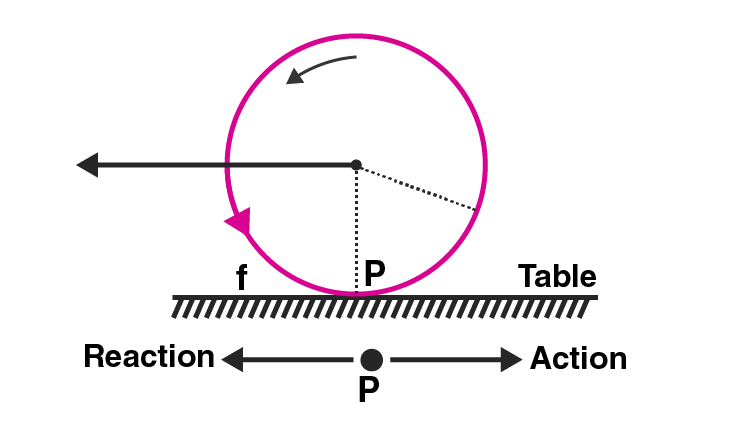
b) There is a decrease in the linear velocity of the rotating disc when it is brought in contact with the table as there is a force of friction acting on the disc.

c) According to Newton’s third law, when the rotating disc is brought in contract with the table, the linear velocity of the disc changes.

d) The figure below explains the effects of b) and c). Frictional force is responsible.

Exemplar Solutions Class 11 Physics Class 7 - 13

e) vcm = ω0R is the condition that needs to be satisfied.

f) For rolling motion to take place without the slipping of the disc, the frictional force is responsible.

Q7.26Written answer

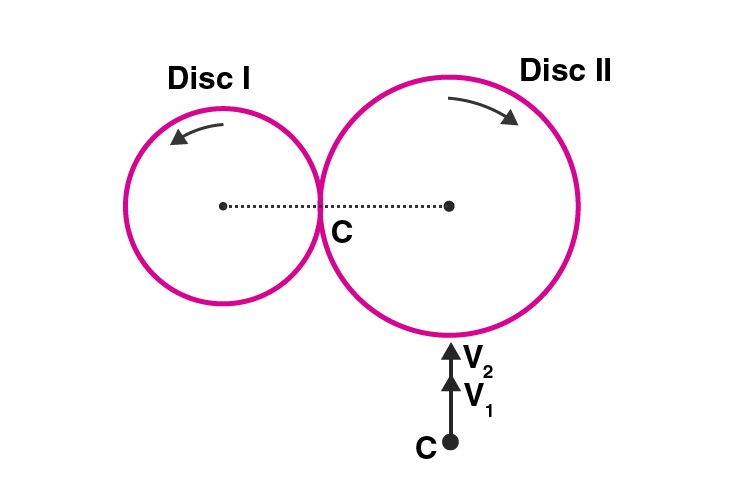
Two cylindrical hollow drums of radii R and 2R and of a common height h, are rotating with angular velocities ω (anti-clockwise) and ω (clockwise) respectively. Their axes, fixed are parallel and in a horizontal plane separated by (3R + δ). They are now brought in contact
Exemplar Solution Physics Class 11 Chapter 7 Img 26

a) show the frictional forces just after contact

b) identify forces and torques external to the system just after contact

c) what would be the ratio of final angular velocities when friction ceases?

Show solutionHide solution
Worked solution

Exemplar Solutions Class 11 Physics Class 7 - 14

a) We know that v1 = ωR

v2 = ω2R

From the figure we can see that the direction of v1 and v2 are tangentially upwards and meet at point C. Therefore, the frictional forces on the surfaces is f12 = -f21.

b) The external forces f12 and f21 are equal and opposite and is given as

f12 = -f21

f12 + f21 = 0

|f12| = |-f21| = F

Therefore, the external torque is given as

(F)(3R)

So, it can be said that the velocity of the drum got doubled that is v2 = 2v1.

c) The anticlockwise and clockwise angular velocities of the drum are ω1 and ω2 respectively. When the velocities are equal, there is no force of friction and it is given as

ω1/ ω2 = 2/1

Q7.27Written answer

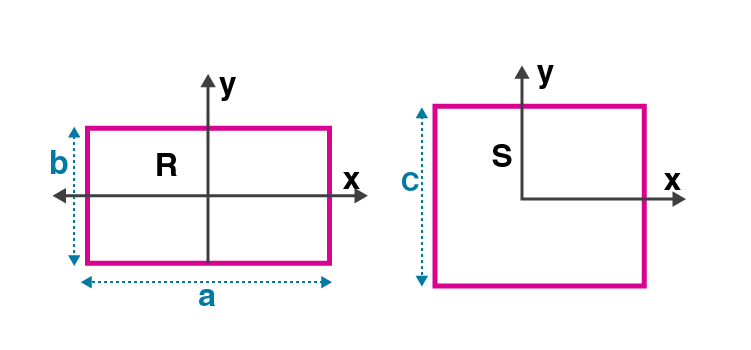
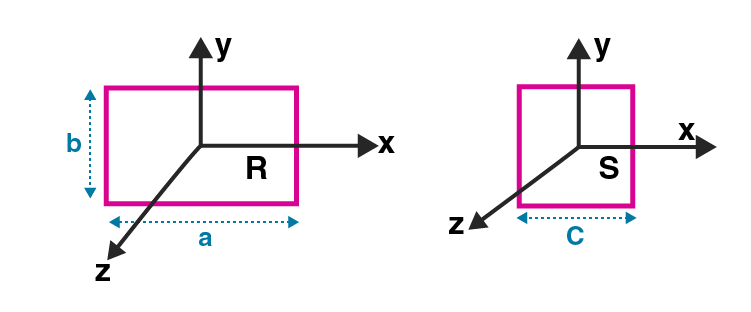
A uniform square plate S and a uniform rectangular plate R have identical areas and masses. Show that

Exemplar Solutions Class 11 Physics Class 7 - 15

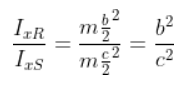
a) IxR/IxS < 1

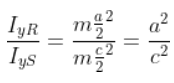
b) IyR/IyS > 1

c) IzR/IzS > 1

Show solutionHide solution
Worked solution

Exemplar Solutions Class 11 Physics Class 7 - 16

Area of square = area of rectangle

a) c2 = ab since I = mr2

Exemplar Solution Physics Class 11 Chapter 7 Img 27

Because c > b we can say that c2 > b2

Therefore, IxR/IxS < 1

b)
Exemplar Solution Physics Class 11 Chapter 7 Img 28

Therefore, IyR/IyS > 1

c) IzR – IzS = m(dR/2)2 – m(dS/2)2

Solving the above equation we can prove that IzR/IzS > 1

Q7.28Written answer

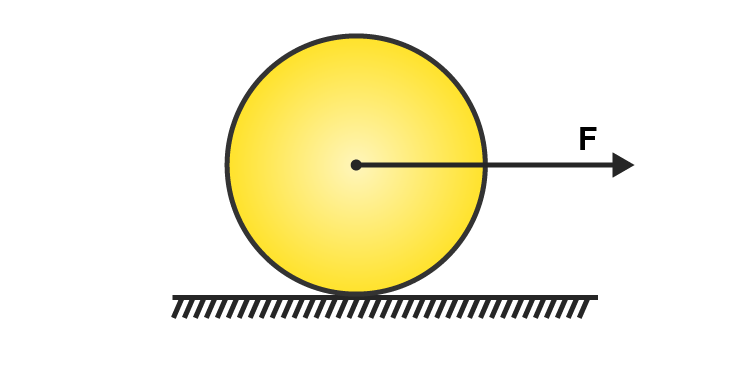
A uniform disc of radius R, is resting on a table on its rim. The coefficient of friction between disc and table is μ. Now the disc is pulled with a force F as shown in the figure. What is the maximum value of F for which the disc rolls without slipping?

Exemplar Solutions Class 11 Physics Class 7 - 17

Show solutionHide solution
Worked solution

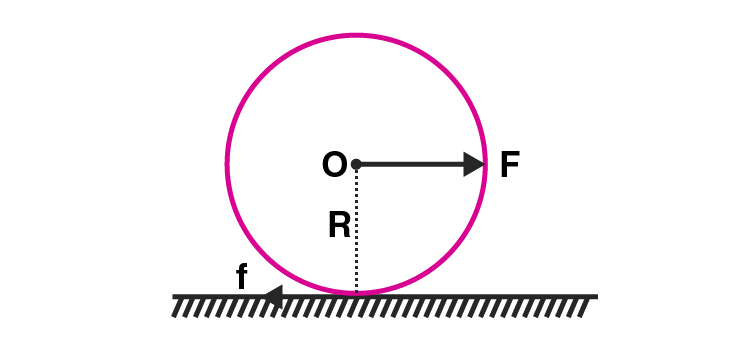
Exemplar Solutions Class 11 Physics Class 7 - 18

Let a and α be the linear and angular acceleration respectively. Then

F – f = Ma

Where M is the mass of the disc

f is the force of friction which is applied at the centre O

Torque to disc, τ = ID α

Moment of inertia of the disc, ID = 1/2 MR2

fR = 1/2 MR2.a/R

Ma = 2f

F – f = 2f

3f = F

f = F/3

F = 3μMg, which is the maximum force applied on the disc to roll it on the surface without slipping.