Q7.11Multiple choice
The net external torque on a system of particle about any axis is zero. Which of the following are compatible with it?
Show solutionHide solution
Worked solution
The correct is all the four options
Your cart is empty.
Practice each question, then open the answer or worked solution.
The net external torque on a system of particle about any axis is zero. Which of the following are compatible with it?
The correct is all the four options
Figure shows a lamina in the x-y plane. Two axes z and z’ pass perpendicular to its plane. A force F acts in the plane of lamina at point P as shown. Which of the following are true?
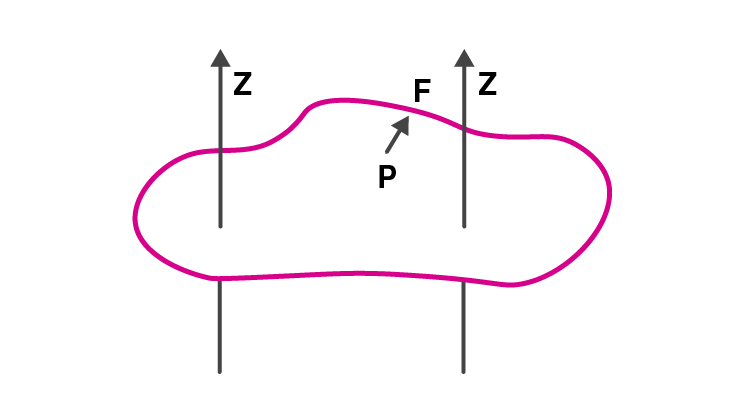
The correct answer is
b) torque τ’ caused by F about z’ axis is along

c) torque τ caused by F about the z-axis is greater in magnitude than that about the z-axis
Regarding figure, of a cube of edge a and mass n, state whether the following are true or false.
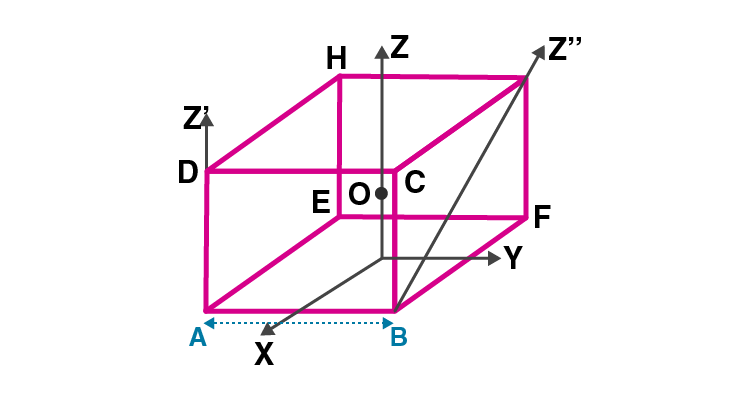
a) the moment of inertia of cube about the z-axis is Iz – Ix + Iy
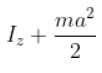
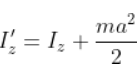
b) the moment of inertia of cube about z’ is
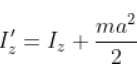
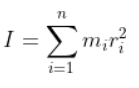
c) the moment of inertia of cube about z’’ is
d) Ix = Iy
The correct answer is
b) the moment of inertia of cube about z’ is
d) Ix = Iy
Very Short AnswersThe centre of gravity of a body on the earth coincides with its centre of mass for a ‘small’ object whereas for an ‘extended’ object it may not. What is the qualitative meaning of ‘small’ and ‘extended’ in this regard? For which of the following the two coincides? A building, a pond, a lake, a mountain?
The centre of gravity is the geometric centre whereas the centre of mass is the mass of the point where the entire mass of the body is considered. The object is said to be small when the vertical height of the object is close to the earth’s surface. If the distance between the object and the surface of the earth is large then the object is extended object.
Building and pond are considered to be small objects while a mountain and a lake are considered to be extended objects.
Why does a solid sphere have a smaller moment of inertia than a hollow cylinder of same mass and radius, about an axis passing through their axes of symmetry?
The moment of inertia is directly proportional to the square of the distance of the mass from the axis of the rotation. In a solid sphere, the distribution of mass takes place from the centre to the radius of the sphere. Whereas in a hollow cylinder, the mass is concentrated on the peripheral surface. Therefore, the moment of inertia of the hollow cylinder is more than the moment of inertia of the cylinder.
The variation of angular position θ, of a point on a rotating rigid body, with time t is shown in figure. Is the body rotating clock-wise or anti-clockwise?
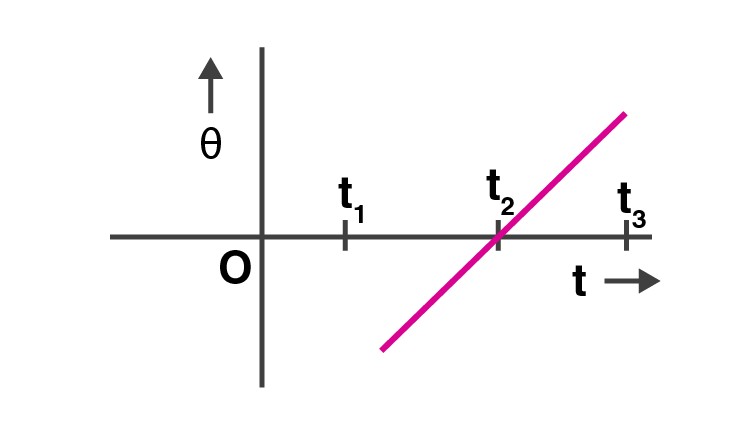
The slope of the given graph is positive, therefore the rotation is clockwise.
dθ/dt = ω
A uniform cube of mass m and side a is placed in a frictionless horizontal surface. A vertical force F is applied to the edge as shown in the figure.
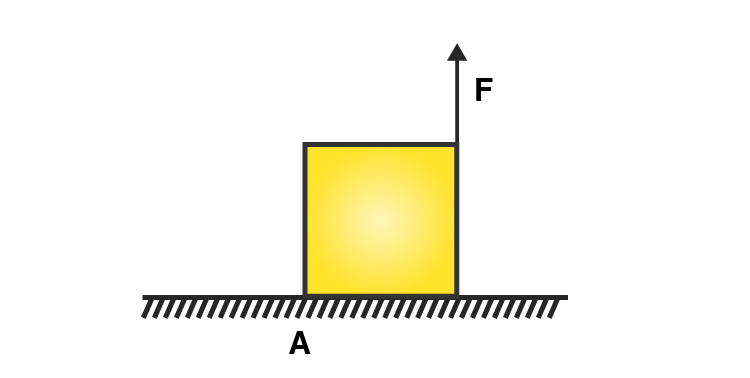
Match the following
| a) mg/4 < F < mg/2 | i) cube will move up |
| b) F > mg/2 | ii) cube will not exhibit motion |
| c) F > mg | iii) cube will begin to rotate and slip at A |
| d) F = mg/4 | iv) normal reaction effectively at a/3 from A, no motion |
a) matches with ii)
b) matches with iii)
c) matches with i)
d) matches with iv)
A uniform sphere of mass m and radius R is placed on a rough horizontal surface. The sphere is struck horizontally at a height h from the floor.
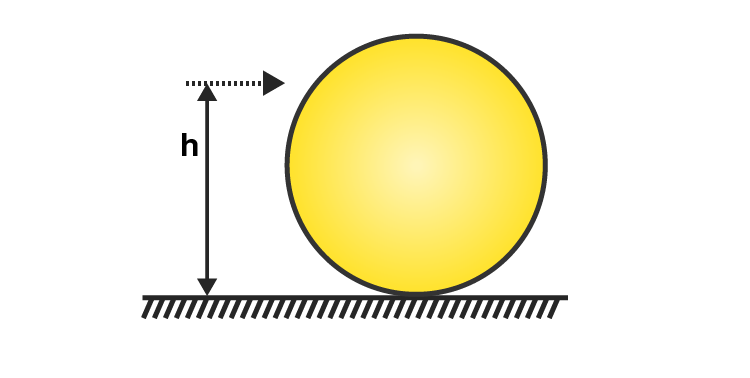
Match the following
| a) h = R/2 | i) sphere rolls without slipping with a constant velocity and no loss of energy |
| b) h = R | ii) sphere spins clockwise, loses energy by friction |
| c) h = 3R/2 | iii) sphere spins anti-clockwise, loses energy by friction |
| d) h = 7R/5 | iv) sphere has only a translational motion, loses energy by friction |
a) matches with iii)
b) matches with iv)
c) matches with ii)
d) matches with i)
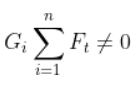
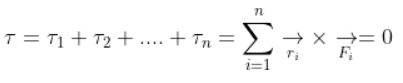
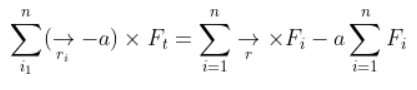
Short AnswersThe vector sum of a system of non-collinear forces acting on a rigid body is given to be non-zero. If the vector sum of all the torques due to the system of forces about a certain point is found to be zero, does this mean that it is necessarily zero about any arbitrary point?
The vector sum of the torques is zero. But the resultant force is not zero. The mathematical explanation is given as:
A wheel in uniform motion about an axis passing through its centre and perpendicular to its plane is considered to be in mechanical equilibrium because no net external force or torque is required to sustain its motion. However, the particles that constitute the wheel do experience a centripetal acceleration directed towards the centre. How do you reconcile this fact with the wheel being in equilibrium? How would you set a half-wheel into uniform motion about an axis passing through the centre of mass of the wheel and perpendicular to its plane? Will you require external forces to sustain the motion?
A wheel is a rigid elastic body with a uniform motion which is passing through its centre and is perpendicular to the plane of the wheel. Every particle of the wheel experiences a centripetal acceleration and is directed towards the axis of rotation due to elastic force. When the wheel is half, the distribution of the mass also becomes half. When the mass is half, there is no symmetry in the wheel. Therefore, the angular momentum and angular velocity does not coincide. Therefore, the external torque is required.