My Cart
Your Cart 0

    Your cart is empty.

  • Total (Amount) ₹0.00
NCERT Exemplar · Class 11 · Physics

Chapter 6: Work, Energy and Power

Practice each question, then open the answer or worked solution.

Questions

48 questions
Q6.31Written answer

Give an example of a situation in which an applied force does not result in a change in kinetic energy.

Show solutionHide solution
Worked solution

Work done during the circular motion there is no change in the kinetic energy.
Q6.32Written answer

Two bodies of unequal mass are moving in the same direction with equal kinetic energy. The two bodies are brought to rest by applying retarding force of the same magnitude. How would the distance moved by them before coming to rest compare?

Show solutionHide solution
Worked solution

KE1 = KE2

WD1 = WD2

F1s1 = F2s2

F1 = F2

s1 = s2

Q6.33Written answer

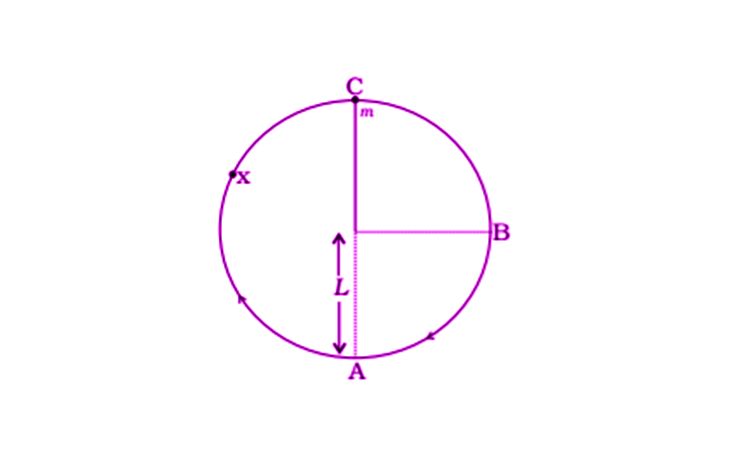
A bob of mass m suspended by a light string of length L is whirled into a vertical circle as shown in the figure. What will be the trajectory of the particle if the string is cut at

a) point B

b) point C

c) point X

Exemplar Solutions Physics Class 11 Chapter 6 - 20

Show solutionHide solution
Worked solution

a) The trajectory of the particle when the string is cut at point B is the tangential velocity will be vertically downward and the bob will move along the same path.

b) The trajectory of the particle when the string is cut at point C is the tangential velocity will be horizontal and will move in half parabolic path.

c) The trajectory of the particle when the string is cut at point X is when angle θ is formed and will move in the parabolic path till the bob reaches the highest point.

Short Answer
Q6.34Written answer

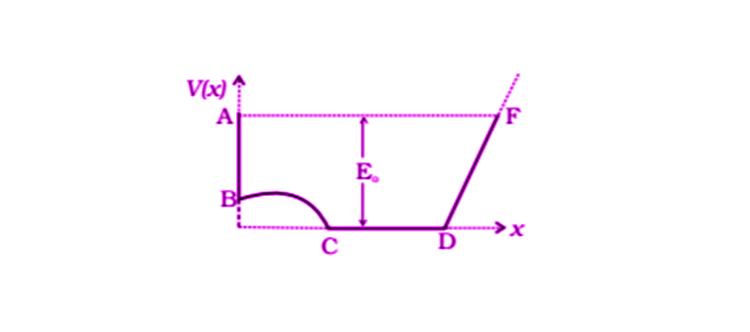
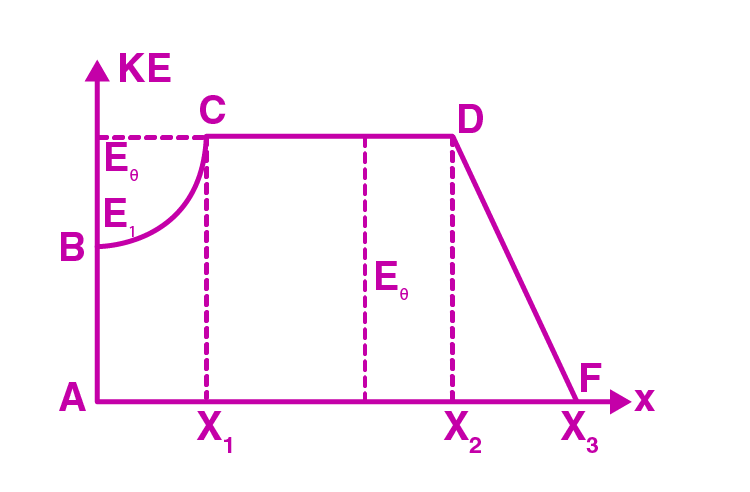
A graph of potential energy V(x) versus x is shown in the figure. A particle of energy E0 is executing motion in it. Draw graph of velocity and kinetic energy versus x for one complete cycle AFA.

Exemplar Solutions Physics Class 11 Chapter 6 - 21

Show solutionHide solution
Worked solution

From the given graph of KE versus x

x KE Point
0 0 A
0 E1 B
X1 E0 C
X2 E0 D
X3 0 F

From the below graph of velocity versus x

Exemplar Solutions Physics Class 11 Chapter 6 - 22

Point V X
A 0 0
B ±V1 0
C ±V0 X1
D ±V0 X2
E 0 X3
Q6.35Written answer

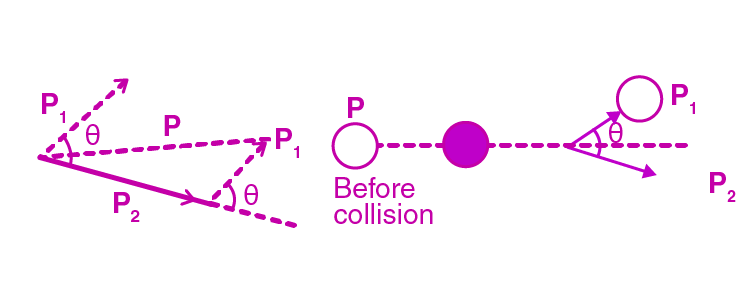
A ball of mass m, moving with speed 2v0, collides inelastically with an identical ball at rest. Show that

a) for a head-on collision, both the balls move forward

b) for a general collision, the angle between the two velocities of scattered balls is less than 90o.

Show solutionHide solution
Worked solution

a) Let v1 and v2 be the velocities of the two balls after the collision. According to the law of conservation of momentum,

mv0 = mv1 + mv2

v2 = v1 + 2ev0

e < 1

b)

Exemplar Solutions Physics Class 11 Chapter 6 - 23

According to the law of conservation of momentum,

p = p1 + p2

When the angle between the p1 and p2 is 90o, p > p1 + p2

Q6.36Written answer

Consider a one-dimensional motion of a particle with total energy E. There are four regions A, B, C, and D in which the relation between potential energy V, kinetic energy (K) and total energy is as given below:

Region A: V > E

Region B: V < E

Region C: K > E

Region D: V > K

State with reason in each case whether a particle can be found in the given region or not.

Show solutionHide solution
Worked solution

For region A, E = V + K and V > E which means that the KE is negative and this is not possible.

For region B, K = E – V and V < E which means that both the energies are greater than zero

For region C, V = E – K and K > E which means that PE is negative

For region D, K = E – V and V > K which means that PE is greater than KE

Q6.37Written answer

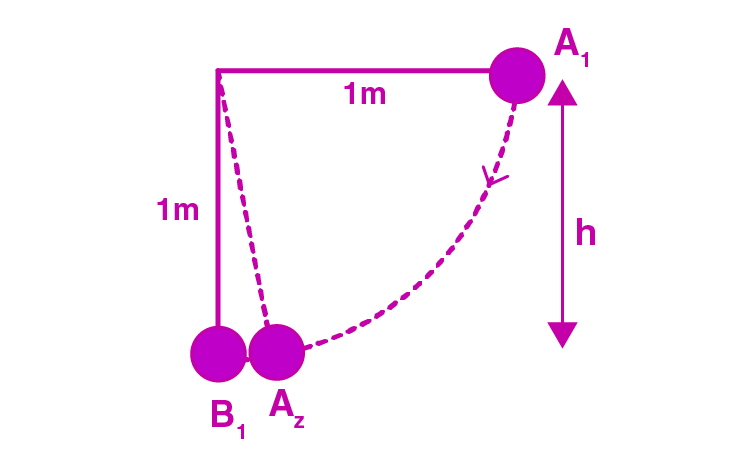
The bob A of a pendulum released from horizontal to the vertical hits another bob B of the same mass at rest on a table as shown in the figure. If the length of the pendulum is 1 m, calculate

a) the height to which bob A will rise after collision

b) the speed with which bob B starts moving.

Neglect the size of the bobs and assume the collision to be elastic.

Exemplar Solutions Physics Class 11 Chapter 6 - 24

Show solutionHide solution
Worked solution

a) There is not much rise in bob A after the collision as the PE of bob A gets converted in KE and the momentum is transferred to bob B.

b)

Exemplar Solutions Physics Class 11 Chapter 6 - 25

The speed of bob B is found using the sum of KE of bob A and KE of bob B = 4.42 m/s

Q6.38Written answer

A raindrop of mass 1.00 g falling from a height of 1 km hits the ground with a speed of 50 m/s. Calculate

a) the loss of PE of the drop

b) the gain in KE of the drop

c) is the gain in KE equal to the loss of PE. If not, why?

Show solutionHide solution
Worked solution

a) PE at the highest point = 10 J

b) Gain in KE = 1/2 mv2 = 1.250 J

c) Gain in KE is not equal to the PE

Q6.39Written answer

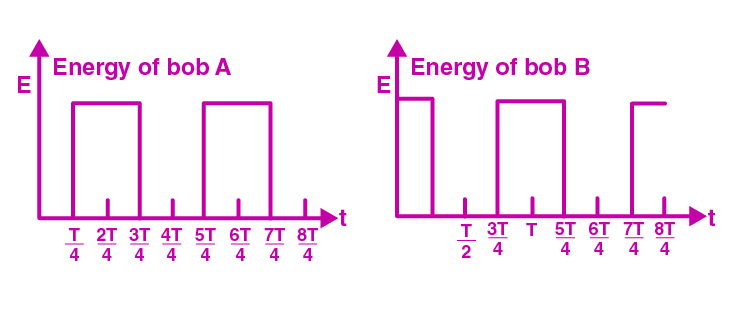
Two pendulums with identical bobs and lengths are suspended from a common support such that in rest position the two bobs are in common. One of the bobs is released after being displaced by 10o so that it collides elastically head-on with the other bob.

a) describe the motion of two bobs

b) draw a graph showing variation in energy of either pendulum with time for 0 ≤ t ≤ 2T where T is the period of each pendulum

Show solutionHide solution
Worked solution
Time t KEa PEa Ea KEb PEb Eb
0 0 0 0 0 E E
T/4 E 0 E 0 0 0
2T/4 E 0 0 0 E E
3T/4 E 0 E 0 0 0
4T/4 = T 0 0 0 0 E E

Exemplar Solutions Physics Class 11 Chapter 6 - 26

Q6.40Written answer

Suppose the average mass of raindrops is 3.0 × 10⁻⁵ kg and their average terminal velocity 9 m/s. Calculate the energy transferred by rain to each square meter of the surface at a place which receives 100 cm of rain in a year.

Show solutionHide solution
Worked solution

Energy transferred by the rain to the surface of the earth = 1/2 mv2

The velocity of the rain = 9 m/s

Mass = (volume)(density) = 1000 kg

Energy transferred by 100 cm rainfall = 1/2 mv2 = 4.05×10⁴ J