My Cart
Your Cart 0

    Your cart is empty.

  • Total (Amount) ₹0.00
NCERT Exemplar · Class 11 · Physics

Chapter 4: Motion

Practice each question, then open the answer or worked solution.

Questions

37 questions
Q4.21Written answer

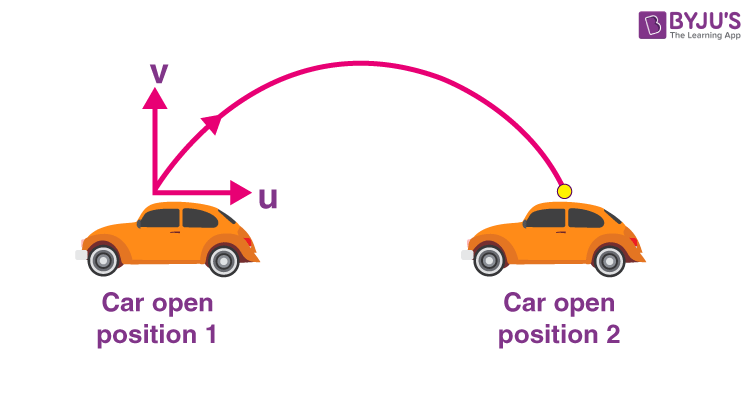
A boy travelling in an open car moving on a labelled road with constant speed tosses a ball vertically up in the air and catches it back. Sketch the motion of the ball as observed by a boy standing on the footpath. Give explanation to support your diagram.

Show solutionHide solution
Worked solution

Given,

v = vertical velocity of the ball that the boy has

u = velocity of the car which is equal to the horizontal velocity of the ball
Exemplar Solutions Class 11 Physics Chapter 4 - 8

Above is the diagram which is viewed by the observer on the footpath. The diagram is parabolic as the vertical and horizontal components of the velocities are viewed by the observer.

Exemplar Solutions Class 11 Physics Chapter 4 - 9

Above is the diagram which is viewed by the boy sitting in the same car which is moving vertically up-down and is under the action of gravity. For car and boy to catch up, the car should move with constant velocity.
Q4.22Written answer

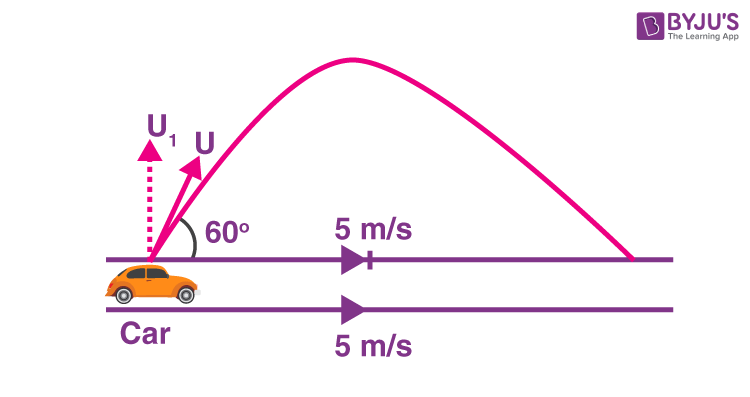
A boy throws a ball in air at 60o to the horizontal along a road with a speed of 10 m/s. Another boy sitting in a passing by car observes the ball. Sketch the motion of the ball as observed by the bot in the car, if car has a speed of 18 km/h. Give explanation to support your diagram.

Show solutionHide solution
Worked solution

Given,

u = 36 km/h = 10 m/s

ux = u cos 60o = 5 m/s

Speed of the car in the direction of motion of ball = (18)(5/18) = 5 m/s

Exemplar Solutions Class 11 Physics Chapter 4 - 10

Following is the diagram of the ball thrown by the boy when the car passes him. Both, car as well as ball are in the horizontal distances and speeds that are equal to each other. But the vertical component of velocity is

uy = u cos 30o = 5√3 m/s.

The motion of the ball according to the boy sitting in the car is in vertically up-down motion.

Exemplar Solutions Class 11 Physics Chapter 4 - 11

Q4.23Written answer

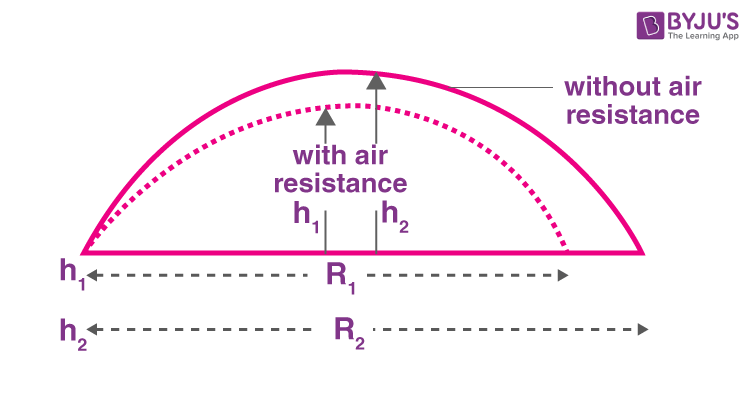
In dealing with motion of projectile in air, we ignore effect of air resistance on motion. This gives trajectory as a parabola as you have studied. What would the trajectory look like if air resistance is included? Sketch such a trajectory and explain why you have drawn it that way.

Show solutionHide solution
Worked solution

When the air resistance acting on the projectile motion is considered, the vertical and horizontal velocity decreases due to air resistance. Following is the formula which is responsible for reducing the height of the motion and this is smaller than the height which exists when there is no force of friction:

R = (u2/g) sin 2θ

Hmax = u2 sin2 θ/2g

Following is the diagram which explains that the time of flight will remain constant with and without air resistance.

Exemplar Solutions Class 11 Physics Chapter 4 - 12

Therefore, h1 < h2 and R1 < R2.

Q4.24Written answer

A fighter plane is flying horizontally at an altitude of 1.5 km with speed 720 km/h. At what angle of sight when the target is seen, should the pilot drop the bomb in order to attack the target?

Show solutionHide solution
Worked solution

Given,

u = 720 km/h = 200 m/s

Let t be the time at which pilot drops the bomb, then Q will be the point vertically above the target T.

We also know that the horizontal velocity of the bomb is equal to the velocity of the fighter plane. But the vertical component is zero. When the bomb reaches TQ, it is a free falling object with initial velocity equal to zero.

u = 0

H = 1.5 km = 10 m/s2

H = ut + 1/2 gt2

Substituting the values, we get

t = 10√3 second.

Let the distance between PQ be ut.

Therefore, PQ = 2000√3 m

tan θ = √3/4

tan θ = tan-123o42’

θ = 23o42’

Q4.25Written answer

a) Earth can be thought of as a sphere of radius 6400 km. Any object is performing circular motion around the axis of earth due to earth’s rotation. What is acceleration of object on the surface of the earth towards its centre? What is it at latitude θ? How does these accelerations compare with g = 9.8 m/s2?

b) Earth also moves in circular orbit around sun once every year with an orbital radius of 1.5 × 10¹¹m. What is the acceleration of earth towards the centre of the sun? How does this acceleration compare with g = 9.8 m/s2?

Show solutionHide solution
Worked solution

a) From the problem,

Radius of the earth, R = 6400 km = 6.4 × 10⁶ m

Time period, T = 1 day = 24 × 60 × 60 = 86400 s

Centripetal acceleration, ac = ω2R = (4π2R)/T

Substituting the vales, we get

ac = 0.034 m/s2

At equator, latitude θ = 0o

We know that,

ac/g = 0.034/9.8 = 1/288

b) Orbital radius of the earth around the sun, R = 1.5 × 10¹¹ m

Time period = 1 year = 365 days = 3.15 × 10⁷ s

Centripetal acceleration, ac = ω2R = (4π2R)/T2 = 5.97 × 10⁻³ m/s2

ac/g = 5.97 × 10⁻³/9.8 = 1/1642

Q4.26Written answer

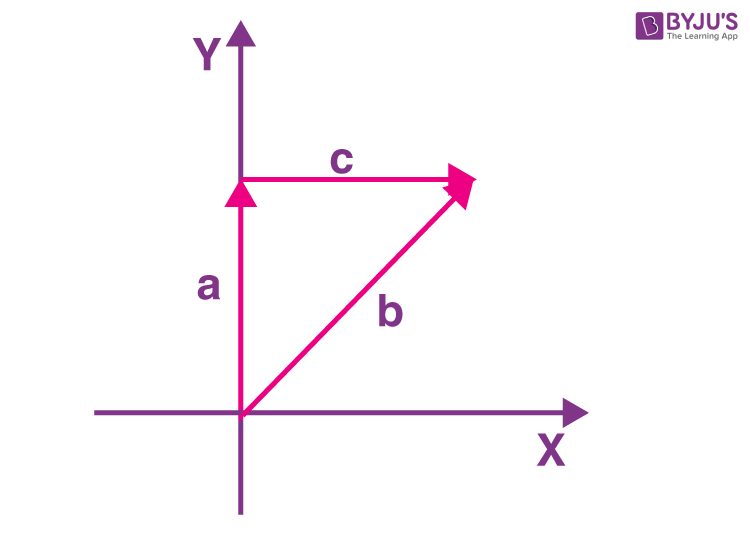
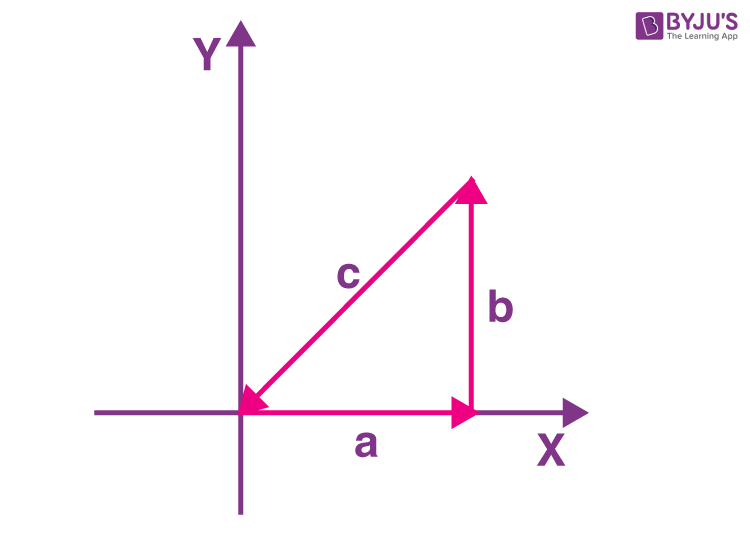
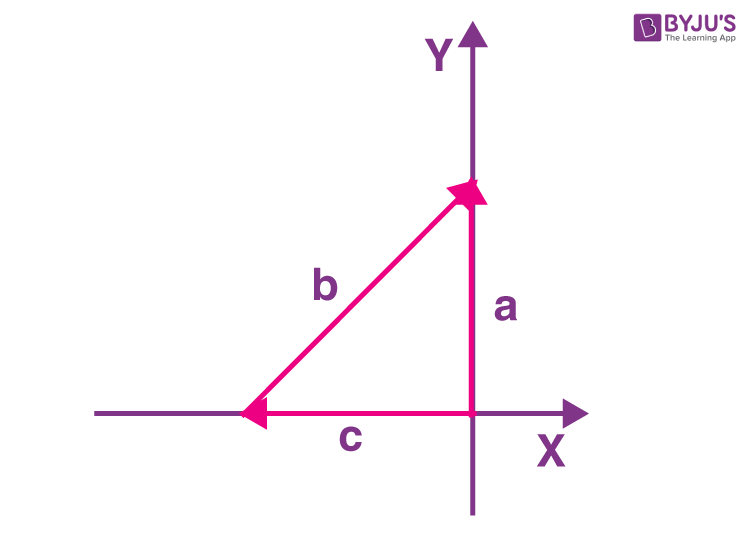
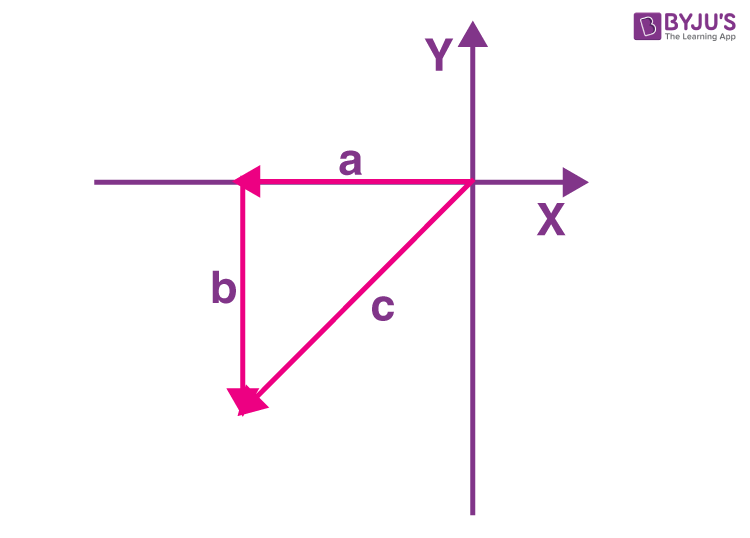
Given below in column I are the relations between vectors a, b, and c and in column II are the orientations of a, b, and c in the XY plane. Match the relation in column I to correct orientations in column II.

Column I Column II
a) a + b = c i) Exemplar Solutions Class 11 Physics Chapter 4 - 13
b) a – c = b ii) Exemplar Solutions Class 11 Physics Chapter 4 - 14
c) b – a = c iii) Exemplar Solutions Class 11 Physics Chapter 4 - 15
d) a + b + c = 0 iv) Exemplar Solutions Class 11 Physics Chapter 4 - 16
Show solutionHide solution
Worked solution

a) matches with iv)

b) matches with iii)

c) matches with i)

d) matches with ii)

Q4.27Written answer

If
Physics Class 11 Chapter 4 - 15 and
Physics Class 11 Chapter 4 - 16, then match the relations in column I with the angle between θ between A and B in column II.

Column I Column II
a) A.B = 0 i) θ = 0
b) A.B = +8 ii) θ = 90o
c) A.B = 4 iii) θ = 180o
d) A.B = -8 iv) θ = 0o
Show solutionHide solution
Worked solution

a) matches with ii)

b) matches with i)

c) matches with iv)

d) matches with iii)

Q4.28Written answer

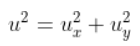
If
Physics Class 11 Chapter 4 - 17 and
Physics Class 11 Chapter 4 - 18, then match the relations in column I with the angle θ between A and B in column II.
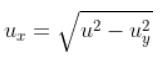
Column I Column II
a)
\(\begin{array}{l}\left | A \times B\right |=0\end{array} \)
i) θ = 30o
b)
\(\begin{array}{l}\left | A \times B\right |=8\end{array} \)
ii) θ = 45o
c)
\(\begin{array}{l}\left | A \times B\right |=4\end{array} \)
iii) θ = 90o
d)
\(\begin{array}{l}\left | A \times B\right |=4\sqrt{2}\end{array} \)
iv) θ = 0o
Show solutionHide solution
Worked solution

a) matches with iv)

b) matches with iii)

c) matches with i)

d) matches with ii)

Long Answers
Q4.29Written answer

A hill is 500 m high. Supplies are to be sent across the hill using a canon that can hurl packets at a speed of 125 m/s over the hill. The canon is located at a distance of 800 m from the foot of hill and can be moved on the ground at a speed of 2 m/s so that its distance from the hill can be adjusted. What is the shortest time in which a packet can reach on the ground across the hill? Take g = 10 m/s2.

Show solutionHide solution
Worked solution

Given,

Speed of packets = 125 m/s

Height of the hill = 500 m

Distance between the canon and the foot of the hill, d = 800 m

The vertical component of the velocity should be minimum so that the time taken to cross the hill will be the shortest.

uy = √2gh ≥ √(2)(10)(500) ≥ 100 m/s

But,

Physics Class 11 Chapter 4 - 19

Therefore, horizontal component of the initial velocity,

Physics Class 11 Chapter 4 - 20

ux = 75 m/s

Time taken by the packet to reach the top of the hill,

Physics Class 11 Chapter 4 - 21

t = 10s

Time taken to reach the ground from the top of the hill = t’ = t = 10s

Horizontal distance covered in 10s = (75)(10) = 750 m

Therefore, time taken by canon = 50/2 = 25 s

Therefore, total time taken by a packet to reach the ground = 25 + 10 + 10 = 45 s.

Q4.30Written answer

A gun can fire shells with maximum speed v0 and the maximum horizontal range that can be achieved is
Physics Class 11 Chapter 4 - 22. If a target farther away by distance ∆x has to be hit with the same gun, show that it could be achieved by raising the gun to a height at least h = ∆x[1+∆x/R]
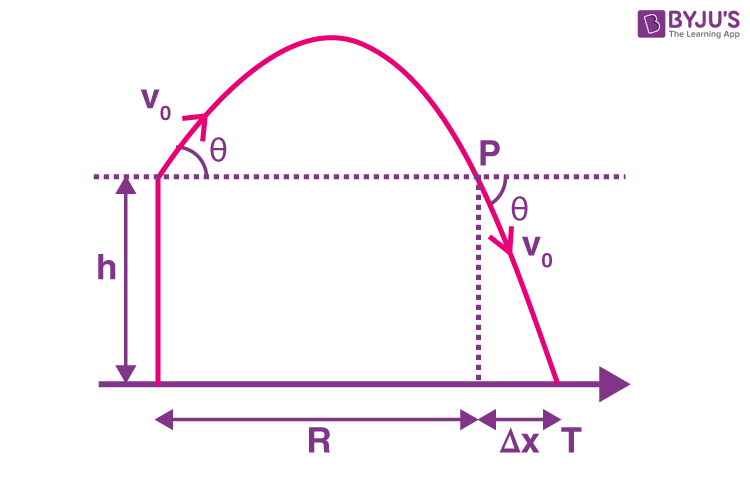
Exemplar Solutions Class 11 Physics Chapter 4 - 18

Show solutionHide solution
Worked solution

Physics Class 11 Chapter 4 - 23

Which is the maximum range of projectile

Therefore, the angle of projection, θ = 45o

The gun is placed at a height h so that it can hit the target

The vertical downward direction is taken as negative

Horizontal component of initial velocity = vo cos θ

Vertical component of initial velocity = v0 sin θ

Displacement along y-axis, -h = (vo sin θ)t + 1/2 (-g)t2

Displacement along x-axis, t = (R + ∆x)/vo cos θ

Substituting all the equations, we get

h = ∆x (1+ ∆x/R)