My Cart
Your Cart 0

    Your cart is empty.

  • Total (Amount) ₹0.00
NCERT Exemplar · Class 11 · Physics

Chapter 4: Motion

Practice each question, then open the answer or worked solution.

Questions

37 questions
Q4.11Multiple choice

Two particles are projected in air with speed v0, at angles θ1 and θ2 to the horizontal, respectively. If the height reached by the first particle is greater than that of the second, then tick the right choices

Show answerHide answer
Correct option: A
Show solutionHide solution
Worked solution

The correct answer is a) angle of project: q1 > q2 and b) time of flight: T1 > T2
Q4.12Written answer

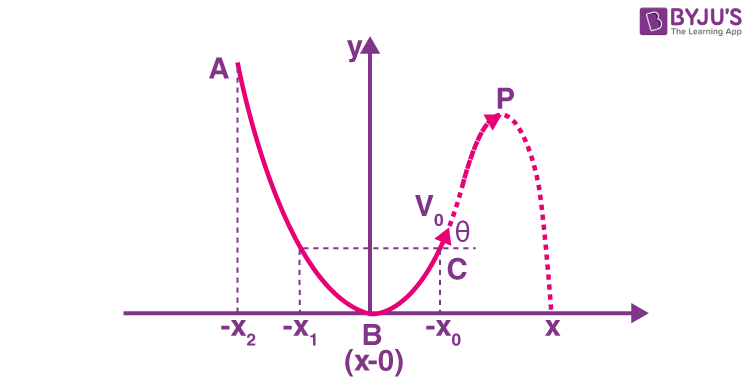
A particle slides down a frictionless parabolic track starting from rest at point A. Point B is at the vertex of parabola and point C is at a height less than that of point A. After C, the particle moves freely in air as a projectile. If the particle reaches highest point at P, then

Exemplar Solutions Class 11 Physics Chapter 4 - 2

a) KE at P = KE at B

b) height at P = height at A

c) total energy at P = total energy at A

d) time of travel from A to B = time of travel from B to P

Show solutionHide solution
Worked solution

The correct answer is c) total energy at P = total energy at A

Q4.13Multiple choice

Following are four different relations about displacement, velocity, and acceleration for the motion of a particle in general. Choose the incorrect one (s):

Show answerHide answer
Correct option: A
Show solutionHide solution
Worked solution

The correct answer is a) vav = 1/2 [v(t1) + v(t2)] and c) r = 1/2 [v(t2)-v(t1)](t2-t1)

Q4.14Multiple choice

For a particle performing uniform circular motion, choose the correct statement from the following:

Show answerHide answer
Correct option: A
Show solutionHide solution
Worked solution

The correct answer is a) magnitude of particle velocity (speed) remains constant, b) particle velocity remains directed perpendicular to radius vector and c) direction of acceleration keeps changing as particle moves

Q4.15Written answer

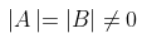
For two vectors A and B,
Physics Class 11 Chapter 4 - 8 is always true when

a)
Physics Class 11 Chapter 4 - 9

b)
Physics Class 11 Chapter 4 - 10

c)
Physics Class 11 Chapter 4 - 11 and A and B are parallel or antiparallel

d) when either
Physics Class 11 Chapter 4 - 12 is zero

Show solutionHide solution
Worked solution

The correct answer is b)
Physics Class 11 Chapter 4 - 13and d) when either
Physics Class 11 Chapter 4 - 14is zero

Very Short Answers
Q4.16Written answer

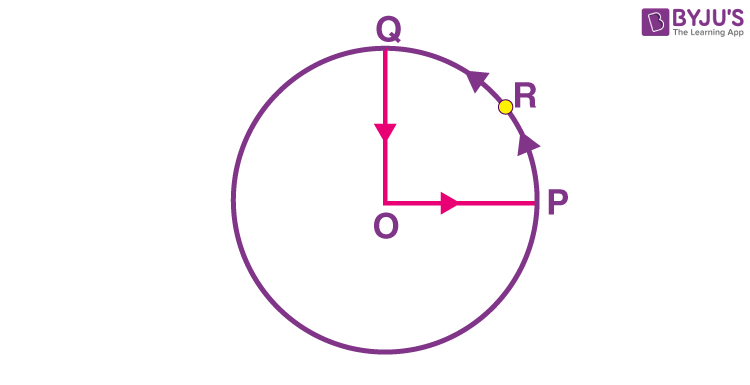
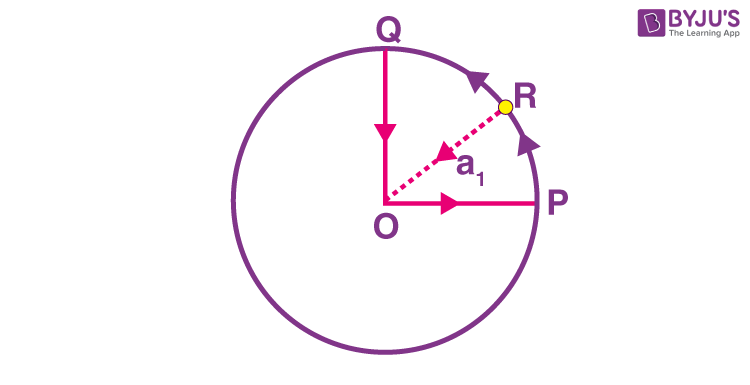
A cyclist starts from centre O of a circular park of radius 1 km and moves along the path OPRQO as shown in the figure. If he maintains constant speed of 10 m/s, what is his acceleration at point R in magnitude and direction?

Exemplar Solutions Class 11 Physics Chapter 4 - 3

Show solutionHide solution
Worked solution

The radius of the circular path is 1 km with O as the centre and at distance R.

Speed with which the cyclist is moving is 10 m/s.

Therefore, it can be said that the motion is uniform circular motion at R.

Therefore, R = 1000 m

v = 10 m/s

Therefore, acceleration, ac = v2/R = 0.1 m/s2 along RO.

Exemplar Solutions Class 11 Physics Chapter 4 - 4

Q4.17Written answer

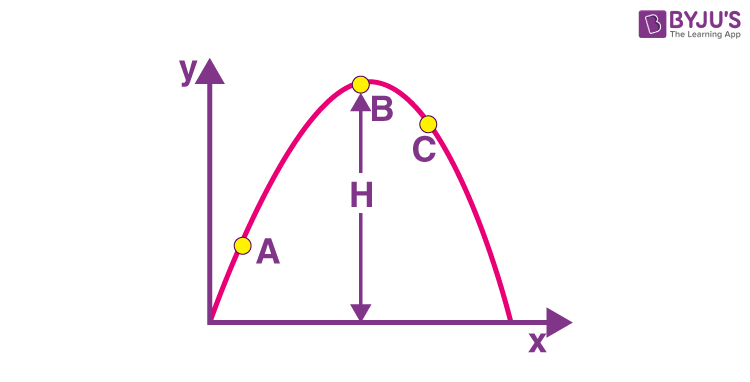
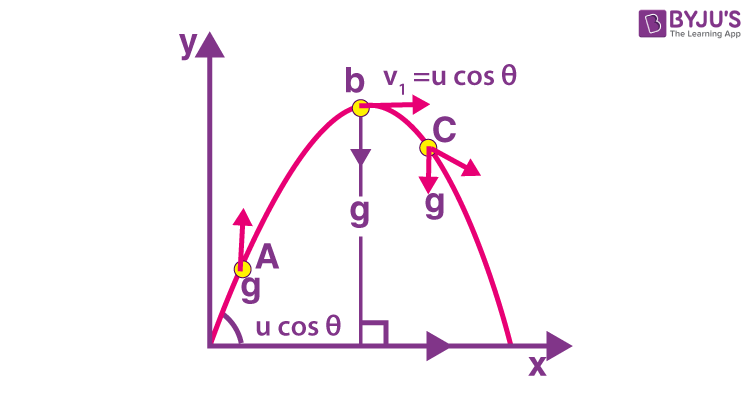
A particle is projected in air at some angle to the horizontal, moves along parabola as shown in the figure, where x and y indicate horizontal and vertical directions respectively. Show in the diagram, direction of velocity and acceleration at points A, B, and C.

Exemplar Solutions Class 11 Physics Chapter 4 - 5

Show solutionHide solution
Worked solution

The projectile motion is either parabolic or part of it. The velocity is always tangential to the direction of velocities of A, B and C. At point B, the maximum height is reached by the trajectory. Therefore, the vertical component Bvy = 0 and horizontal component is u cos θ.

We know that the direction of acceleration is in the direction of force acting on the body. Therefore, here the direction of acceleration is in the direction of gravitational force and is always vertically downward which is equal to the acceleration due to gravity.

Exemplar Solutions Class 11 Physics Chapter 4 - 6

Q4.18Written answer

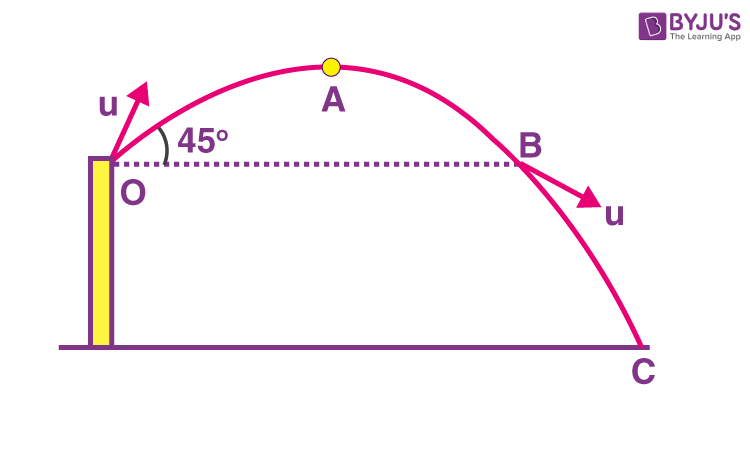
A ball is thrown from a roof top at an angle of 45o above the horizontal. It hits the ground a few seconds later. At what point during its motion, does the ball have

a) greatest speed

b) smallest speed

c) greatest acceleration?

Explain

Show solutionHide solution
Worked solution

a) Let us assume that the ball is projected from the point O at an angle 45o. From O to A there is an increase in the height of the ball such that the KE of the ball decreases. The height from point A to B decreases making the speed increase and now it is equal to the initial speed when the ball was at point O. This is because O and B are in the same horizontal line. From point B to C, again the speed increases as the height has reduced.

Therefore, the greatest speed is at C as vy maximum and vx = u/√2.

Exemplar Solutions Class 11 Physics Chapter 4 - 7

b) The smallest speed will be at point A as the height at this point is the highest and vy = 0 as the horizontal speed is the only constant value ie; u/√2

c) The greatest acceleration is acceleration due to gravity as only gravitational force is acting on the ball and in downward direction.

Q4.19Written answer

A football is kicked into the air vertically upwards. What is its

a) acceleration

b) velocity at the highest point

Show solutionHide solution
Worked solution

a) The acceleration of the football will be downward when it is kicked upwards as only gravitational force is acting on it.

b) The football will have its highest velocity when vy = 0.

Q4.20Written answer

A, B, and C are three non-collinear, non co-planar vectors. What can you say about direction of A(B×C)?

Show solutionHide solution
Worked solution

The direction of product of vectors B and C is perpendicular to the plane that contains vector B and C which is based on the Right hand grip rule.

The direction of vector A(B×C) is perpendicular to vector A and is in the plane which contains vectors B and C and is again based on the Right hand grip rule.

Short Answers