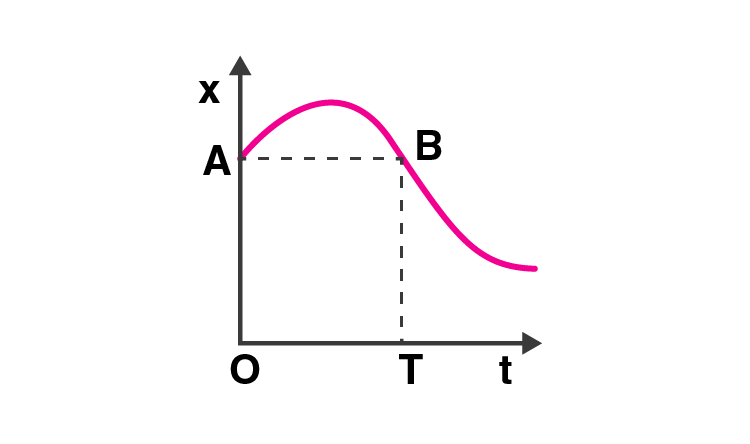
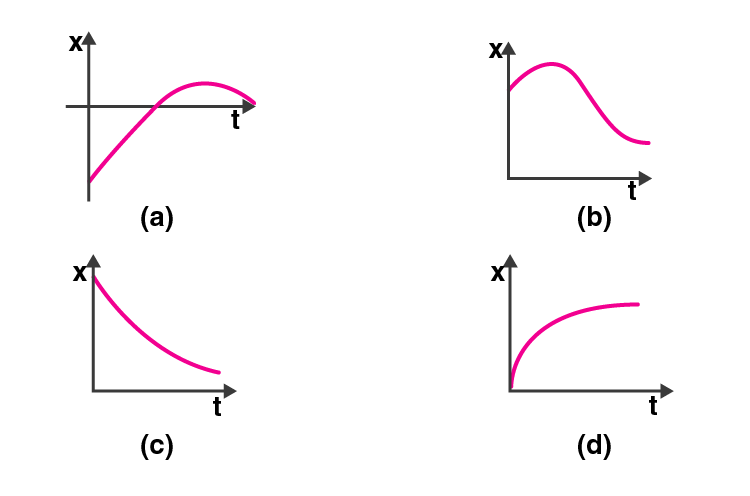
Among the four graphs, there is only one graph for which average velocity over the time interval (0,T) can vanish for a suitably chosen T. Which one is it?
Show solutionHide solution
The correct answer is b)

Your cart is empty.
Practice each question, then open the answer or worked solution.
Among the four graphs, there is only one graph for which average velocity over the time interval (0,T) can vanish for a suitably chosen T. Which one is it?

The correct answer is b)

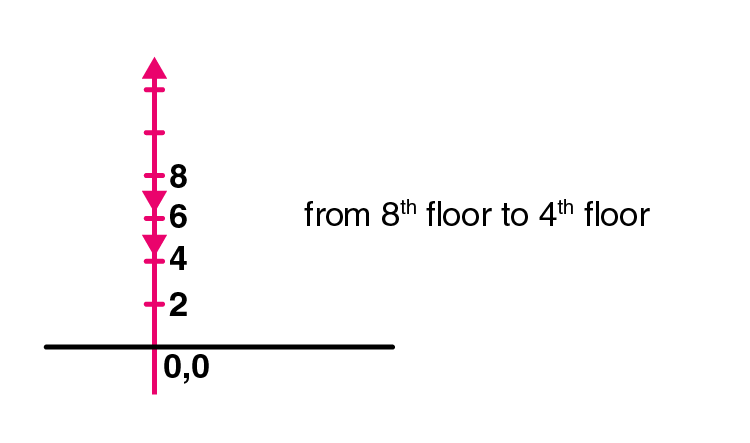
A lift is coming from 8th floor and is just about to reach 4th floor. Taking ground floor as origin and positive direction upwards for all quantities, which one of the following is correct?
The correct answer is a) x<0, v<0, a<0
The value of x and v becomes negative as the lift is moving from 8th floor to the 4th floor whereas acceleration is acting in the upwards and stays positive. This is explained with the help of following diagram:

In one-dimensional motion, instantaneous speed v satisfies 0≤v<v0.
a) the displacement in time T must always take non-negative values
b) the displacement x in time T satisfies: v0T<x<v0T
c) the acceleration is always a non-negative number
d) the motion has no turning points
The correct answer is b) the displacement in time T must always take non-negative values
A vehicle travels half the distance L with speed V1 and the other half with speed V2, then its average speed is
a) (V1+V2)/2
b) (2V1+V2)/(V1+V2)
c) (2V1V2)/(V1+V2)
d) L(V1+V2)/V1V2
The correct answer is c) (2V1V2)/(V1+V2)
The displacement of a particle is given by x = (t-2)2 where x is in metres and t is seconds. The distance covered by the particle in first 4 seconds is
a) 4 m
b) 8 m
c) 12 m
d) 16 m
The correct answer is b) 8 m
At a metro station, a girl walks up a stationary escalator in time t1. If she remains stationary on the escalator, then the escalator take her up in time t2. The time taken by her to walk up on the moving escalator will be
a) (t1 + t2)/2
b) t1t2/(t2 – t1)
c) t1t2/(t2 + t1)
d) t1 – t2
The correct answer is c) t1t2/(t2 + t1)
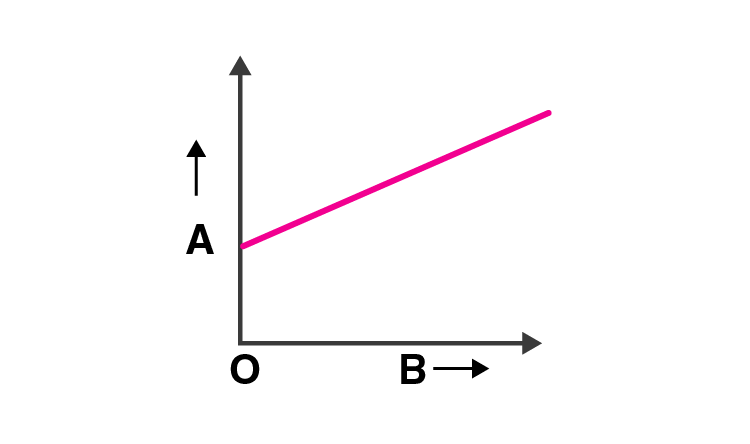
Multiple Choice Questions IIThe variation of quantity A with quantity B, plotted in figure describes the motion of a particle in a straight line.

a) quantity B may represent time
b) quantity A is velocity if motion is uniform
c) quantity A is displacement if motion is uniform
d) quantity A is velocity if motion is uniformly accelerated
The correct answer is a) quantity B may represent time, c) quantity A is displacement if motion is uniform and d) quantity A is velocity if motion is uniformly accelerated
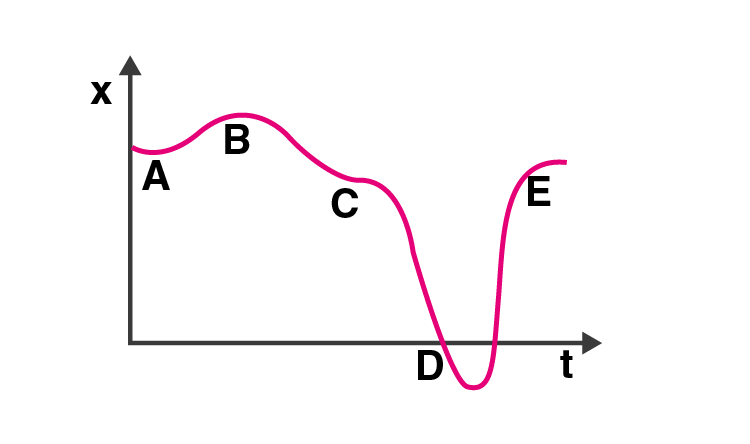
A graph of x versus t is shown in the figure. Choose correct alternatives from below.

e) the speed at D exceeds that at E
The correct answer is a) the particle was released from rest at t=0, c) at C, the velocity and the acceleration vanish and e) the speed at D exceeds that at E
For the one-dimensional motion, describe by x = t – sint
a) x(t)>0 for all t>0
b) v(t)>0 for all t>0
c) a(t)>0 for all t>0
d) v(t) lies between 0 and 2
The correct answer is a) x(t)>0 for all t>0 and d) v(t) lies between 0 and 2
A spring with one end attached to a mass and the other to a rigid support is stretched and released.
a) magnitude of acceleration, when just released is maximum
b) magnitude of acceleration, when at equilibrium position is maximum
c) speed is maximum when mass is at equilibrium position
d) magnitude of displacement is always maximum whenever speed is minimum
The correct answer is a) magnitude of acceleration, when just released is maximum and c) speed is maximum when mass is at equilibrium position