My Cart
Your Cart 0

    Your cart is empty.

  • Total (Amount) ₹0.00
NCERT Exemplar · Class 11 · Physics

Chapter 13: Kinetic Theory

Practice each question, then open the answer or worked solution.

Questions

31 questions
Q13.11Written answer

Ina diatomic molecules, the rotational energy at a given temperature

a) obeys Maxwell’s distribution

b) have the same value for all molecules

c) equals the translational kinetic energy for each molecule

d) is 2/3rd the translational kinetic energy for each molecule

Show solutionHide solution
Worked solution

The correct answer is

a) obeys Maxwell’s distribution

d) is 2/3rd the translational kinetic energy for each molecule
Q13.12Written answer

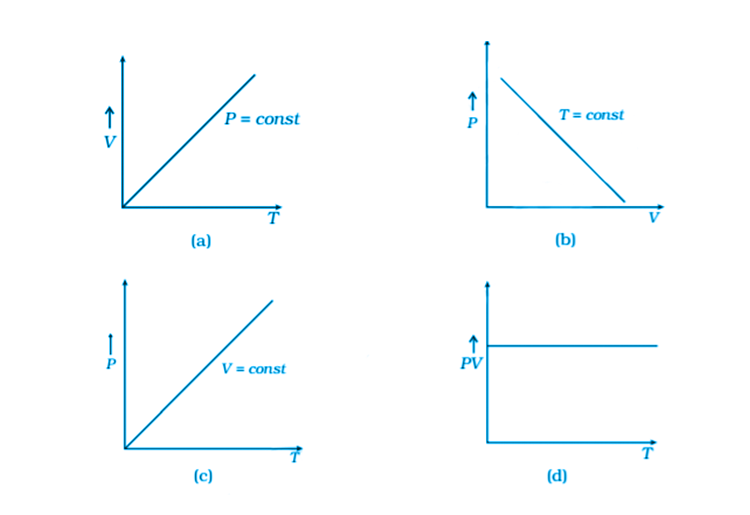
Which of the following diagrams depicts ideal gas behaviour?

Exemplar Solutions Physics Class 11 Chapter 13 - 6

Show solutionHide solution
Worked solution

The correct answer is

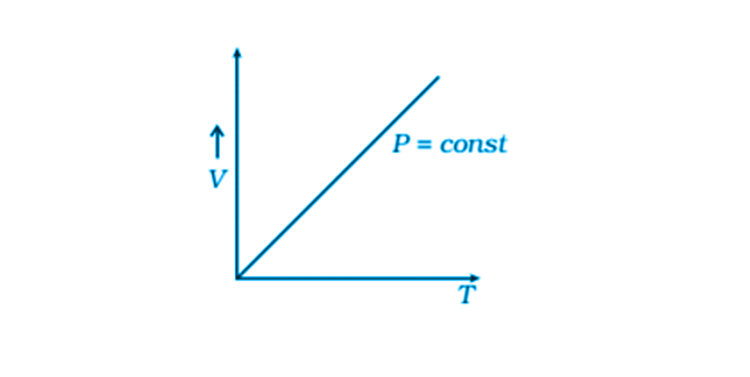
a)

Exemplar Solutions Physics Class 11 Chapter 13 - 7

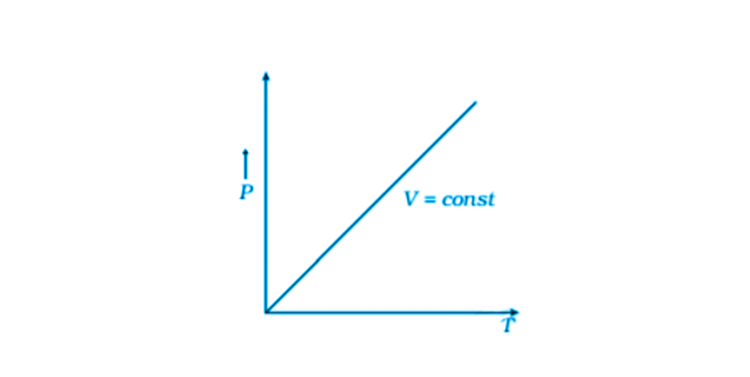
c)

Exemplar Solutions Physics Class 11 Chapter 13 - 8

Q13.13Written answer

When an ideal gas is compressed adiabatically, its temperature rises: the molecules on the average have more kinetic energy than before. The kinetic energy increases,

a) because of collisions with moving parts of the wall only

b) because of collisions with the entire wall

c) because the molecules gets accelerated in their motion inside the volume

d) because of the redistribution of energy amongst the molecules

Show solutionHide solution
Worked solution

The correct answer is a) because of collisions with moving parts of the wall only

Very Short Answers
Q13.14Written answer

Calculate the number of atoms in 39.4 g gold. The molar mass of gold is 197 g/mole.

Show solutionHide solution
Worked solution

Molar mass = 6.023 × 10²³ atoms

Mass of gold, m = 39.4 g

Molar mass of gold, M = 197 g/mol

196 g of gold contains 6.023 × 10²³ atoms

39.4 g of gold contains 1.20 × 10²³ atoms.

Q13.15Written answer

The volume of a given mass of a gas at 27oC, 1 atm is 100 cc. What will be its volume at 327oC?

Show solutionHide solution
Worked solution

T1 = 27oC

T1 = 300 K

V1 = 100 cm3

We know that V is proportional to T

V/T = constant

V1/T1 = V2/T2

V2 = V1(T2/T1)

V2 = 200 cc

Q13.16Written answer

The molecules of a given mass of gas have root mean square speeds of 100 m/s at 27oC and 1.00 atmospheric pressure. What will be the root mean square speeds of the molecules of the gas at 127oC and 2.0 atmospheric pressure?

Show solutionHide solution
Worked solution

Vrms = 100 m/s

T1 = 300 K

T2 = 400 K

Vrms = √3RT/M

V2rms =?

Vrms = 115.4 m/s

Q13.17Written answer

Two molecules of a gas have speeds of 9 × 10⁶ m/s and 1 × 10⁶ m/s, respectively. What is the root mean square speed of these molecules?

Show solutionHide solution
Worked solution

V1 = 9 × 10⁶ m/s

V2 = 1 × 10⁶ m/s

Vrms = 6.4 × 10⁶ m/s

Q13.18Written answer

A gas mixture consists of 2.0 moles of oxygen and 4.0 moles of neon a temperature T. Neglecting all vibrational modes, calculate the total internal energy of the system. (Oxygen has two rotational modes.)

Show solutionHide solution
Worked solution

Degree of freedom of oxygen = 5

Total internal energy of 2-mole oxygen = 5RT

Total internal energy of 4 mole of Ne = 6RT

The total internal energy of the system = 11 RT

Q13.19Written answer

Calculate the ratio of the mean free paths of the molecules of two gases having molecular diameters 1 A and 2 A. The gases may be considered under identical conditions of temperature, pressure, and volume.

Show solutionHide solution
Worked solution

The ratio of the mean free paths of the molecules is 4:1.

Short Answers
Q13.20Written answer

The container shown in the figure has two chambers, separated by a partition, of volumes V1 = 2.0 litre and V2 = 3.0 litre. The chambers contain μ1 = 4.0 and μ2 = 5.0 moles of a gas at pressure p1 = 1.00 atm and p2 = 2.00 atm. Calculate the pressure after the partition is removed and the mixture attains equilibrium.

V1 V2
μ1 μ2
p1 p2
Show solutionHide solution
Worked solution

For an ideal gas, PV = μRT

P1V1 = μ1R1T1

P2V2 = μ2R2T2

P1 = 1 atm

P2 = 2 atm

V1 = 2L

V2 = 3L

T1 = T = T2

μ1 = 4

μ2 = 5

Substituting all the values we get, P = 1.6 atm