My Cart
Your Cart 0

    Your cart is empty.

  • Total (Amount) ₹0.00
NCERT Exemplar · Class 11 · Physics

Chapter 13: Kinetic Theory

Practice each question, then open the answer or worked solution.

Questions

31 questions
Q13.1Multiple choice

A cubic vessel (with faces horizontal + vertical) contains an ideal gas at NTP. The vessel is being carried by a rocket which is moving at a speed of 500 m/s in the vertical direction. The pressure of the gas inside the vessel as observed by us on the ground

Show answerHide answer
Correct option: B
Show solutionHide solution
Worked solution

The correct answer is b) remains the same because the motion of the vessel as a whole does not affect the relative motion of the gas molecules and the walls

Q13.2Multiple choice

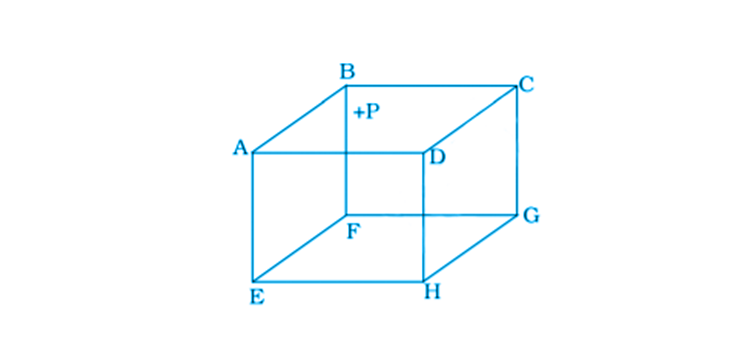
1 mole of an ideal gas is contained in a cubical volume V, ABCDEFGH at 300 K. One face of the cube (EFGH) is made up of a material which totally absorbs any gas molecule incident on it. At any given time,

Exemplar Solutions Physics Class 11 Chapter 13 - 2

Show answerHide answer
Correct option: D
Show solutionHide solution
Worked solution

The correct answer is d) the pressure on EFGH would be half that on ABCD

Q13.3Written answer

Boyle’s law is applicable for an

a) adiabatic process

b) isothermal process

c) isobaric process

d) isochoric process

Show solutionHide solution
Worked solution

The correct answer is b) isothermal process

Q13.4Written answer

A cylinder containing an ideal gas is in a vertical position and has a piston of mass M that is able to move up or down without friction. If the temperature is increased,

Exemplar Solutions Physics Class 11 Chapter 13 - 3

a) both p and V of the gas will change

b) only p will increase according to Charle’s law

c) V will change but not p

d) p will change but not V

Show solutionHide solution
Worked solution

The correct answer is c) V will change but not p

Q13.5Written answer

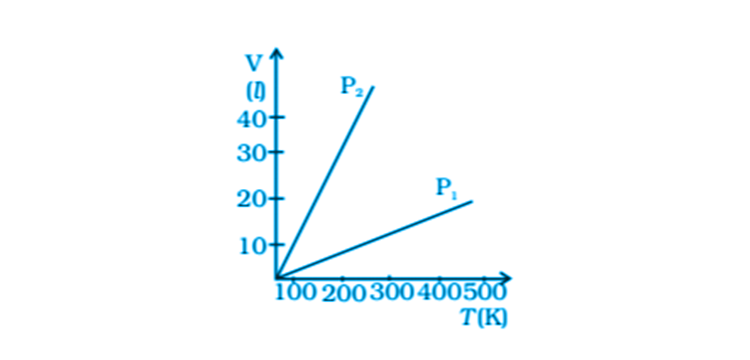
Volume versus temperature graphs for a given mass of an ideal gas are shown in the figure at two different values of constant pressure. What can be inferred about the relation between P1 and P2?

Exemplar Solutions Physics Class 11 Chapter 13 - 4

a) P1 > P2

b) P1 = P2

c) P1 < P2

d) data is insufficient

Show solutionHide solution
Worked solution

The correct answer is a) P1 > P2

Q13.6Written answer

1 mole of H2 gas is contained in a box of volume V = 1.00 m3 at T = 300 K. The gas is heated to a temperature of T = 3000 K and the gas gets converted to a gas of hydrogen atoms. The final pressure would be

a) same as the pressure initially

b) 2 times the pressure initially

c) 10 times the pressure initially

d) 20 times the pressure initially

Show solutionHide solution
Worked solution

The correct answer is d) 20 times the pressure initially

Q13.7Written answer

A vessel of volume V contains a mixture of 1 mole of hydrogen and 1 mole of oxygen. Let f1(v)dv, denote the fraction of molecules with speed between v and (v + dv) with f2(v)dv similarly for oxygen. Then

a) f1(v) + f2(v) = f(v) obeys the Maxwell’s distribution law

b) f1(v), f2(v) will obey the Maxwell’s distribution law separately

c) neither f1(v) nor f2(v) will obey the Maxwell’s distribution law

d) f2(v) and f1(v) will be the same

Show solutionHide solution
Worked solution

The correct answer is b) f1(v), f2(v) will obey the Maxwell’s distribution law separately

Q13.8Written answer

An inflated rubber balloon contains one mole of an ideal gas, has a pressure p, volume V, and temperature T. If the temperature rises to 1.1T and the volume is increased to 1.05V, the final pressure will be

a) 1.1 p

b) p

c) less than p

d) between p and 1.1

Show solutionHide solution
Worked solution

The correct answer is d) between p and 1.1

Multiple Choice Questions II
Q13.9Written answer

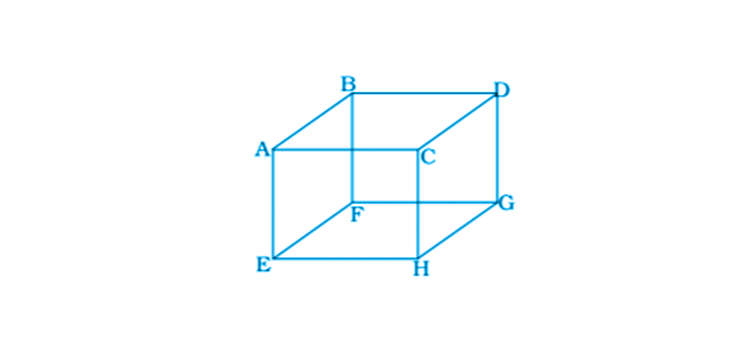
ABCDEFGH is a hollow cube made of an insulator. Face ABCD has a positive charge on it. Inside the cube, we have ionized hydrogen. The usual kinetic theory expression for pressure

Exemplar Solutions Physics Class 11 Chapter 13 - 5

a) will be valid

b) will not be valid since the ions would experience forces other than due to collision with the walls

c) will not be valid since collisions with walls would not be elastic

d) will not be valid because isotropy is lost

Show solutionHide solution
Worked solution

The correct answer is

b) will not be valid since the ions would experience forces other than due to collision with the walls

d) will not be valid because isotropy is lost

Q13.10Written answer

Diatomic molecules like hydrogen have energies due to both translational as well as rotational motion. From the equation in kinetic theory pV = 2/3 E, E is

a) the total energy per unit volume

d) only the translational part of energy because rotational energy is very small compared to the translational energy

c) only the translational part of the energy because during collisions with the wall pressure relates to change in linear momentum

d) the translational part of the energy, because rotational energies of molecules can be either sign and its average over all the molecules is zero

Show solutionHide solution
Worked solution

The correct answer is c) only the translational part of the energy because during collisions with the wall, pressure relates to a change in linear momentum