My Cart
Your Cart 0

    Your cart is empty.

  • Total (Amount) ₹0.00
NCERT Exemplar · Class 11 · Physics

Chapter 11: Thermal Properties of Matter

Practice each question, then open the answer or worked solution.

Questions

27 questions
Q11.21Written answer

One day in the morning, Ramesh filled up 1/3 bucket of hot water from geyser, to take bath. Remaining 2/3 was to be filled by cold water to bring mixture to a comfortable temperature. Suddenly Ramesh had to attend something which would take some times, say 5-10 minutes before he could take bath. Now he has two options:

a) fill the remaining bucket completely by cold water and then attend the work

b) first attend to the work and fill the remaining bucket just before taking bath.

Which option do you think would have kept water warmer? Explain.

Show solutionHide solution
Worked solution

Using the concept of Newton’s law of cooling, we can say that rate of cooling is directly proportional to the difference in the temperature of the body and surroundings.

According to first option, the water should be warmer, as the difference between the temperature of the surrounding and water is small, therefore, less heat is lost.

According to second option, the heat lost is more, as the difference between the surrounding and water is large.

Long Answer


Q11.22Written answer

We would like to prepare a scale whose length does not change with temperature. It is proposed to prepare a unit scale of this type whose length remains, say 10 cm. We can use a bimetallic strip made of brass and iron each of different length whose length would change in such a way that difference between their lengths remain constant. If αiron = 1.2 × 10⁻⁵/K and αbrass = 1.8 × 10⁻⁵/K, what should we take as length of each strip?

Show solutionHide solution
Worked solution

Change in length of iron rod

Exemplar Solution Physics Class 11 Chapter 11 Img 22

Change in length of brass rod

Exemplar Solution Physics Class 11 Chapter 11 Img 23

Change in both the rods are equal, so

Exemplar Solution Physics Class 11 Chapter 11 Img 24

Substituting the values we get, Lbrass = 20 cm.

Q11.23Written answer

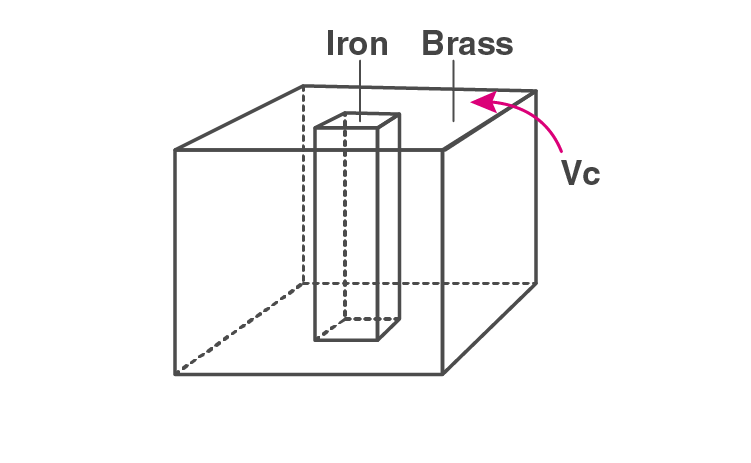
We would like to make a vessel whose volume does not change with temperature. We can use brass and iron (βbrass = 6 × 10⁻⁶/K and βiron = 3.55 × 10⁻⁵/K) to create a volume of 100 cc. How do you think you can achieve this?

Show solutionHide solution
Worked solution

Exemplar Solutions Physics Class 11 Chapter 11 - 7

Volume of vessel = 100 cm3 = 10-4 = constant

Volume of iron vessel – Volume of brass rod = 10-4 m3

We know that,

Exemplar Solution Physics Class 11 Chapter 11 Img 25

Exemplar Solution Physics Class 11 Chapter 11 Img 26

Using the above equation, Viron = 244.9cm3

Q11.24Written answer

Calculate the stress developed inside a tooth cavity filled with copper when hot tea at temperature of 57oC is drunk. You can take body temperature to be 37oC and α = 1.7 × 10⁻⁵oC, bulk modulus for copper = 140 × 109 N/m2.

Show solutionHide solution
Worked solution

Decrease in temperature, ∆t = 57 – 37 = 20oC

Coefficient of linear expansion, α = 1.7 × 10⁻⁵oC

Bulk modulus for copper, B = 140 × 109 N/m2

Coefficient of cubical expansion, γ = 3α = 5.1 × 10⁻⁵oC

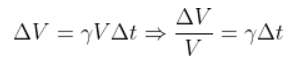
Increase in volume with increase in temperature is given as

Exemplar Solution Physics Class 11 Chapter 11 Img 27

Thermal stress = B(γ∆t) = 1.428 × 10⁸ N/m2

Q11.25Written answer

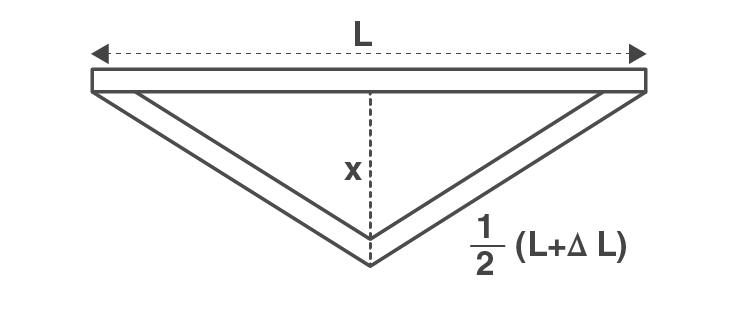
A rail track made of steel having length 10 m is clamped on a railway line at its two ends. On a summer day due to rise in temperature by 20oC, it is deformed as shown in the figure. Find x if αsteel = 1.2 × 10⁻⁵/oC.

Exemplar Solutions Physics Class 11 Chapter 11 - 8

Show solutionHide solution
Worked solution

Given:

αsteel = 1.2 × 10⁻⁵/oC

Lo = 10 m

∆T = 20oC

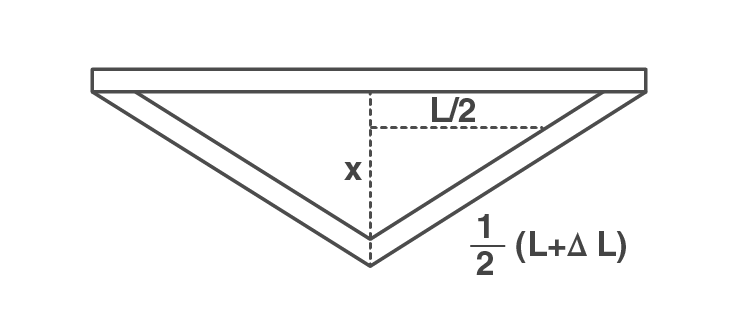
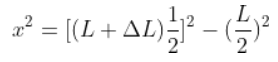
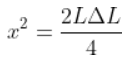
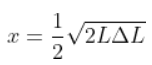
Using Pythagoras theorem,

Exemplar Solutions Physics Class 11 Chapter 11 - 9

Exemplar Solution Physics Class 11 Chapter 11 Img 28

Exemplar Solution Physics Class 11 Chapter 11 Img 29

Exemplar Solution Physics Class 11 Chapter 11 Img 30

Substituting the values and solving those values we get

x = 10.8 cm

Q11.26Written answer

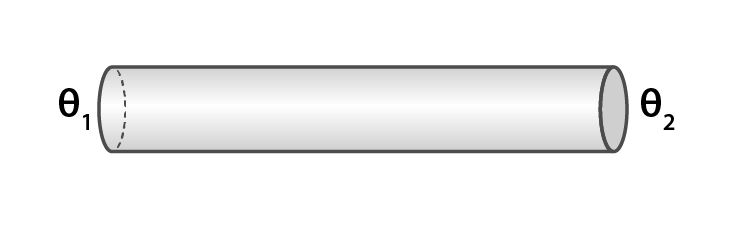
A thin rod having length Lo at 0oC and coefficient of linear expansion α has its two ends maintained at temperatures θ1 and θ2, respectively. Find its new length.

Show solutionHide solution
Worked solution

Consider the following diagram

Exemplar Solutions Physics Class 11 Chapter 11 - 10

From the diagram, we can say that

Exemplar Solution Physics Class 11 Chapter 11 Img 31

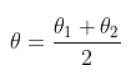
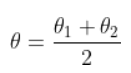
The temperature varies from θ1 to θ2 linearly. Let us consider θ to be the temperature at the centre of the rod. Therefore the average temperature at the mid-point of the rod is given as:

Exemplar Solution Physics Class 11 Chapter 11 Img 32

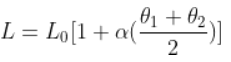
We also know that,

L = Lo(1+αθ)

Which is also same as

Exemplar Solution Physics Class 11 Chapter 11 Img 33

Q11.27Written answer

According to Stefan’s law of radiation, a black body radiates energy σT4 from its unit surface area every second where T is the surface temperature of the black body and σ = 5.67 × 10⁻⁸ W/m2K4 is known as Stefan’s constant. A nuclear weapon may be thought of as a ball of radius 0.5 m. When denoted, it reaches temperature of 106K and can be treated as a black body.

a) estimate the power it radiates

b) if surrounding has water at 30oC, how much water can 10% of the energy produced evaporate in 1 sec?

c) if all this energy U is in the form of radiation, corresponding momentum is p = U/c. How much momentum per unit time does it impart on unit area at a distance of 1 km?

Show solutionHide solution
Worked solution

a) E = σT4

Total energy = energy radiated from surface area A per second

P = σAT4

σ = 5.67 × 10⁻⁸ W/m2K4

R = 0.5 m

T = 106 K

Substituting the values we get,

P = 1.8 × 10¹⁷ J/s

b) P = 18 × 1016 Watt

10% of this energy is used in evaporation of water

E = (10/100)(18)(1016) Watt = 1.8 × 10¹⁶ J/s

Energy required to evaporate water in 1 sec using 10% of energy is

Exemplar Solution Physics Class 11 Chapter 11 Img 34

m = 7 109 kg

c) Momentum per unit time p’ = U/C = 0.6 × 10⁹

P’ = 6 × 10⁸ kg.m/s2

P per unit time at a distance 1 km is

Exemplar Solution Physics Class 11 Chapter 11 Img 35

Substituting the values, we get P per sec at 1 km on m2 = 47.8 N/m2