My Cart
Your Cart 0

    Your cart is empty.

  • Total (Amount) ₹0.00
NCERT · Class 8 · Maths

Chapter 5: Data Handling

Practice each question, then open the answer or worked solution.

Exercise 5.3

Textbook page 87 · 6 questions
Q1Written answer

List the outcomes you can see in these experiments.

(a) Spinning a wheel (b) Tossing two coins together

NCERT Solution For Class 8 Maths Chapter 5- 17

Show solutionHide solution
Worked solution

(a) There are four letters A, B, C and D in a spinning wheel. So, there are 4 outcomes.

(b) When two coins are tossed together. There are four possible outcomes HH, HT, TH, and TT.
Q2Written answer

When a die is thrown, list the outcomes of an event of getting

(i) (a) a prime number (b) not a prime number

(ii) (a) a number greater than 5 (b) a number not greater than 5

Show solutionHide solution
Worked solution

(i) (a) Outcomes of the event of getting a prime number are 2, 3 and 5.

(b) Outcomes of the event of not getting a prime number are 1, 4 and 6.

(ii) (a) Outcomes of the event of getting a number greater than 5 is 6.

(b) Outcomes of the event of not getting a number greater than 5 are 1, 2, 3, 4 and 5.

Q3Written answer

Find the.

(a) Probability of the pointer stopping on D in (Question 1-(a)).

(b) Probability of getting an ace from a well-shuffled deck of 52 playing cards.

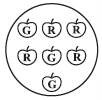
(c) Probability of getting a red apple. (See figure below)

NCERT Solution For Class 8 Maths Chapter 5- 18

Show solutionHide solution
Worked solution

(a) In a spinning wheel, there are five pointers A, A, B, C, D. So, there are five

outcomes. The pointer stops at D, which is one outcome.

So, the probability of the pointer stopping on D = 1/5

(b) There are 4 aces in a deck of 52 playing cards. So, there are four events for getting an ace.

So, the probability of getting an ace = 4/52 = 1/13

(c) Total number of apples = 7

Number of red apples = 4

Probability of getting a red apple = 4/7

Q4Written answer

Numbers 1 to 10 are written on ten separate slips (one number on one slip), kept in a box and mixed well. One slip is chosen from the box without looking into it. What is the probability of

(i) getting a number 6?

(ii) getting a number less than 6? (iii) getting a number greater than 6? (iv)getting a 1-digit number?

Show solutionHide solution
Worked solution

(i) Outcome of getting a number 6 from ten separate slips is one.

∴ probability of getting a number 6 = 1/10

(ii) Numbers less than 6 are 1, 2, 3, 4 and 5, which are five. So, there are 5 outcomes.

∴ probability of getting a number less 6 =5/10 = ½

(iii) Number greater than 6 out of ten that are 7, 8, 9, 10. So there are 4 possible outcomes.

∴ probability of getting a number greater than 6 = 4/10 = 2/5

(iv) One-digit numbers are 1, 2, 3, 4, 5, 6, 7, 8, 9 out of ten.

∴ probability of getting a 1-digit number = 9/10

Q5Written answer

If you have a spinning wheel with 3 green sectors, 1 blue sector and 1 red sector, what is the probability of getting a green sector? What is the probability of getting a non-blue sector?

Show solutionHide solution
Worked solution

A total of five sectors are present.

Out of the five sectors, three sectors are green.

∴ probability of getting a green sector = 3/5

Out of the five sectors, one sector is blue. Hence, non-blue sectors = 5 – 1 = 4 sectors

∴ probability of getting a non-blue sector= 4/5

Q6Written answer

Find the probabilities of the events given in Question 2.

Show solutionHide solution
Worked solution

When a die is thrown, there is a total of six outcomes, i.e., 1, 2, 3, 4, 5 and 6.

(i)

(a) 2, 3, 5 are the prime numbers. So, there are 3 outcomes out of 6.

∴ probability of getting a prime number =3/6 = ½

(b) 1, 4, 6 are not the prime numbers. So, there are 3 outcomes out of 6.

∴ probability of getting a prime number =3/6 = ½

(ii)

(c) Only 6 is greater than 5.

So there is one outcome out of 6.

∴ probability of getting a number greater than 5= 1/6

(d) Numbers not greater than 5 are 1, 2, 3, 4 and 5. So there are 5 outcomes out of 6.

∴ probability of not getting a number greater than 5= 5/6