My Cart
Your Cart 0

    Your cart is empty.

  • Total (Amount) ₹0.00
NCERT · Class 11 · Maths

Chapter 9: Straight lines

Practice each question, then open the answer or worked solution.

EXERCISE 10.1

Textbook page 211 · 14 questions
Q1Written answer

Draw a quadrilateral in the Cartesian plane whose vertices are (– 4, 5), (0, 7), (5, – 5) and (– 4, –2). Also, find its area.

Show solutionHide solution
Worked solution

Let ABCD be the given quadrilateral with vertices A (-4,5), B (0,7), C (5.-5) and D (-4,-2).

Now, let us plot the points on the Cartesian plane by joining the points AB, BC, CD, and AD, which give us the required quadrilateral.
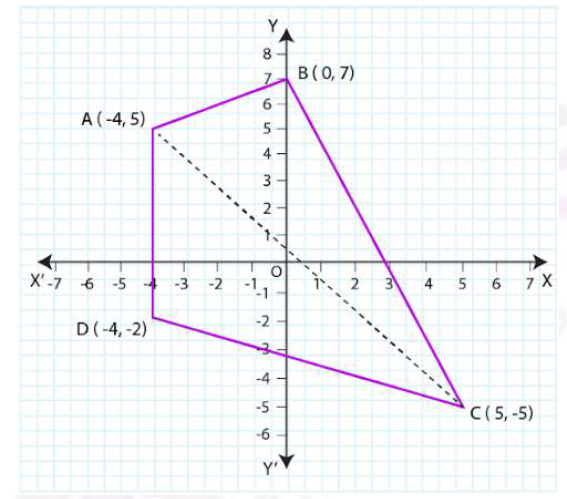
NCERT Solutions for Class 11 Maths Chapter 10 – Straight Lines image - 1

To find the area, draw diagonal AC.

So, area (ABCD) = area (∆ABC) + area (∆ADC)

Then, area of triangle with vertices (x1,y1) , (x2, y2) and (x3,y3) is

Are of ∆ ABC = ½ [x1 (y2 – y3) + x2 (y3 – y1) + x3 (y1 – y2)]

= ½ [-4 (7 + 5) + 0 (-5 – 5) + 5 (5 – 7)] unit2

= ½ [-4 (12) + 5 (-2)] unit2

= ½ (58) unit2

= 29 unit2

Are of ∆ ACD = ½ [x1 (y2 – y3) + x2 (y3 – y1) + x3 (y1 – y2)]

= ½ [-4 (-5 + 2) + 5 (-2 – 5) + (-4) (5 – (-5))] unit2

= ½ [-4 (-3) + 5 (-7) – 4 (10)] unit2

= ½ (-63) unit2

= -63/2 unit2

Since area cannot be negative, area ∆ ACD = 63/2 unit2

Area (ABCD) = 29 + 63/2

= 121/2 unit2
Q2Written answer

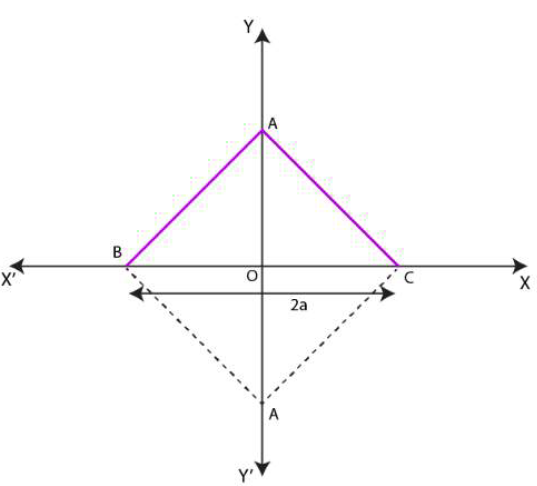
The base of an equilateral triangle with side 2a lies along the y-axis such that the mid-point of the base is at the origin. Find the vertices of the triangle.

Show solutionHide solution
Worked solution

NCERT Solutions for Class 11 Maths Chapter 10 – Straight Lines image - 2

Let us consider ABC, the given equilateral triangle with side 2a.

Where, AB = BC = AC = 2a

In the above figure, assuming that the base BC lies on the x-axis such that the mid-point of BC is at the origin, i.e., BO = OC = a, where O is the origin.

The coordinates of point C are (0, a) and that of B are (0,-a).

The line joining a vertex of an equilateral ∆ with the mid-point of its opposite side is perpendicular.

So, vertex A lies on the y –axis.

By applying Pythagoras’ theorem,

(AC)2 = OA2 + OC2

(2a)2= a2 + OC2

4a2 – a2 = OC2

3a2 = OC2

OC =√3a

Co-ordinates of point C = ± √3a, 0

∴ The vertices of the given equilateral triangle are (0, a), (0, -a), (√3a, 0)

Or (0, a), (0, -a) and (-√3a, 0)

Q3Written answer

Find the distance between P (x1, y1) and Q (x2, y2) when: (i) PQ is parallel to the y-axis, (ii) PQ is parallel to the x-axis.

Show solutionHide solution
Worked solution

Given:

Points P (x1, y1) and Q(x2, y2)

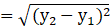
(i) When PQ is parallel to the y-axis, then x1 = x2

So, the distance between P and Q is given by
NCERT Solutions for Class 11 Maths Chapter 10 – Straight Lines image - 3

NCERT Solutions for Class 11 Maths Chapter 10 – Straight Lines image - 4

= |y2 – y1|

(ii) When PQ is parallel to the x-axis, then y1 = y2

So, the distance between P and Q is given by =
NCERT Solutions for Class 11 Maths Chapter 10 – Straight Lines image - 5

= NCERT Solutions for Class 11 Maths Chapter 10 – Straight Lines image - 6

= |x2 – x1|

Q4Written answer

Find a point on the x-axis which is equidistant from points (7, 6) and (3, 4).

Show solutionHide solution
Worked solution

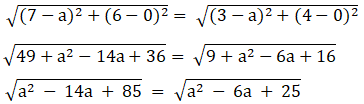
Let us consider (a, 0) to be the point on the x-axis that is equidistant from the point (7, 6) and (3, 4).

So,

NCERT Solutions for Class 11 Maths Chapter 10 – Straight Lines image - 7

Now, let us square on both sides; we get,

a2 – 14a + 85 = a2 – 6a + 25

-8a = -60

a = 60/8

= 15/2

∴ The required point is (15/2, 0)

Q5Written answer

Find the slope of a line, which passes through the origin, and the mid-point of the line segment joining the points P (0, – 4) and B (8, 0).

Show solutionHide solution
Worked solution

The co-ordinates of the mid-point of the line segment joining the points P (0, – 4) and B (8, 0) are (0+8)/2, (-4+0)/2 = (4, -2)

The slope ‘m’ of the line non-vertical line passing through the point (x1, y1) and

(x2, y2) is given by m = (y2 – y1)/(x2 – x1) where, x ≠ x1

The slope of the line passing through (0, 0) and (4, -2) is (-2-0)/(4-0) = -1/2

∴ The required slope is -1/2.

Q6Written answer

Without using Pythagoras’ theorem, show that the points (4, 4), (3, 5) and (–1, –1) are the vertices of a right-angled triangle.

Show solutionHide solution
Worked solution

The vertices of the given triangle are (4, 4), (3, 5) and (–1, –1).

The slope (m) of the line non-vertical line passing through the point (x1, y1) and

(x2, y2) is given by m = (y2 – y1)/(x2 – x1) where, x ≠ x1

So, the slope of the line AB (m1) = (5-4)/(3-4) = 1/-1 = -1

The slope of the line BC (m2) = (-1-5)/(-1-3) = -6/-4 = 3/2

The slope of the line CA (m3) = (4+1)/(4+1) = 5/5 = 1

It is observed that m1.m3 = -1.1 = -1

Hence, the lines AB and CA are perpendicular to each other.

∴ given triangle is right-angled at A (4, 4)

And the vertices of the right-angled ∆ are (4, 4), (3, 5) and (-1, -1)

Q7Written answer

Find the slope of the line, which makes an angle of 30° with the positive direction of the y-axis measured anticlockwise.

Show solutionHide solution
Worked solution

We know that if a line makes an angle of 30° with the positive direction of the y-axis measured anti-clock-wise, then the angle made by the line with the positive direction of the x-axis measured anti-clock-wise is 90° + 30° = 120°

∴ The slope of the given line is tan 120° = tan (180° – 60°)

= – tan 60°

= –√3

Q8Written answer

Find the value of x for which the points (x, – 1), (2, 1) and (4, 5) are collinear.

Show solutionHide solution
Worked solution

If the points (x, – 1), (2, 1) and (4, 5) are collinear, then the Slope of AB = Slope of BC

Then, (1+1)/(2-x) = (5-1)/(4-2)

2/(2-x) = 4/2

2/(2-x) = 2

2 = 2(2-x)

2 = 4 – 2x

2x = 4 – 2

2x = 2

x = 2/2

= 1

∴ The required value of x is 1.

Q9Written answer

Without using the distance formula, show that points (– 2, – 1), (4, 0), (3, 3) and (–3, 2) are the vertices of a parallelogram.

Show solutionHide solution
Worked solution

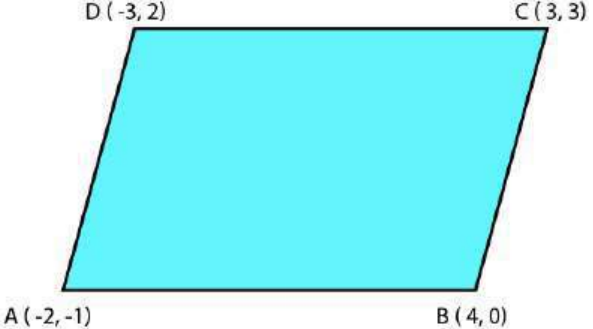
image name
Let the given point be A (-2, -1) , B (4, 0) , C ( 3, 3) and D ( -3, 2)

So now, the slope of AB = (0+1)/(4+2) = 1/6

The slope of CD = (3-2)/(3+3) = 1/6

Hence, the Slope of AB = Slope of CD

∴ AB ∥ CD

Now,

The slope of BC = (3-0)/(3-4) = 3/-1 = -3

The slope of AD = (2+1)/(-3+2) = 3/-1 = -3

Hence, the Slope of BC = Slope of AD

∴ BC ∥ AD

Thus, the pair of opposite sides are quadrilateral are parallel, so we can say that ABCD is a parallelogram.

Hence, the given vertices, A (-2, -1), B (4, 0), C(3, 3) and D(-3, 2) are vertices of a parallelogram.

Q10Written answer

Find the angle between the x-axis and the line joining the points (3, –1) and (4, –2).

Show solutionHide solution
Worked solution

The Slope of the line joining the points (3, -1) and (4, -2) is given by

m = (y2 – y1)/(x2 – x1) where, x ≠ x1

m = (-2 –(-1))/(4-3)

= (-2+1)/(4-3)

= -1/1

= -1

The angle of inclination of the line joining the points (3, -1) and (4, -2) is given by

tan θ = -1

θ = (90° + 45°) = 135°

∴ The angle between the x-axis and the line joining the points (3, –1) and (4, –2) is 135°.