My Cart
Your Cart 0

    Your cart is empty.

  • Total (Amount) ₹0.00
NCERT · Class 11 · Maths

Chapter 9: Straight lines

Practice each question, then open the answer or worked solution.

EXERCISE 10.3

Textbook page 227 · 18 questions
Q1Written answer

Reduce the following equations into slope-intercept form and find their slopes and the y-intercepts.
(i) x + 7y = 0

(ii) 6x + 3y – 5 = 0
(iii) y = 0

Show solutionHide solution
Worked solution

(i) x + 7y = 0

Given:

The equation is x + 7y = 0

The slope-intercept form is represented in the form ‘y = mx + c’, where m is the slope and c is the y-intercept.

So, the above equation can be expressed as

y = -1/7x + 0

∴ The above equation is of the form y = mx + c, where m = -1/7 and c = 0

(ii) 6x + 3y – 5 = 0

Given:

The equation is 6x + 3y – 5 = 0

The slope-intercept form is represented in the form ‘y = mx + c’, where m is the slope and c is the y-intercept.

So, the above equation can be expressed as

3y = -6x + 5

y = -6/3x + 5/3

= -2x + 5/3

∴ The above equation is of the form y = mx + c, where m = -2 and c = 5/3

(iii) y = 0

Given:

The equation is y = 0

The slope-intercept form is given by ‘y = mx + c’, where m is the slope and c is the y-intercept.

y = 0 × x + 0

∴ The above equation is of the form y = mx + c, where m = 0 and c = 0
Q2Written answer

Reduce the following equations into intercept form and find their intercepts on the axes.

(i) 3x + 2y – 12 = 0

(ii) 4x – 3y = 6

(iii) 3y + 2 = 0

Show solutionHide solution
Worked solution

(i) 3x + 2y – 12 = 0

Given:

The equation is 3x + 2y – 12 = 0

The equation of the line in intercept form is given by x/a + y/b = 1, where ‘a’ and ‘b’ are intercepted on the x-axis and the y-axis, respectively.

So, 3x + 2y = 12

Now, let us divide both sides by 12; we get

3x/12 + 2y/12 = 12/12

x/4 + y/6 = 1

∴ The above equation is of the form x/a + y/b = 1, where a = 4, b = 6

The intercept on the x-axis is 4.

The intercept on the y-axis is 6.

(ii) 4x – 3y = 6

Given:

The equation is 4x – 3y = 6

The equation of the line in intercept form is given by x/a + y/b = 1, where ‘a’ and ‘b’ are intercepted on the x-axis and the y-axis, respectively.

So, 4x – 3y = 6

Now, let us divide both sides by 6; we get

4x/6 – 3y/6 = 6/6

2x/3 – y/2 = 1

x/(3/2) + y/(-2) = 1

∴ The above equation is of the form x/a + y/b = 1, where a = 3/2, b = -2

The intercept on the x-axis is 3/2.

The intercept on the y-axis is -2.

(iii) 3y + 2 = 0

Given:

The equation is 3y + 2 = 0

The equation of the line in intercept form is given by x/a + y/b = 1, where ‘a’ and ‘b’ are intercepted on the x-axis and the y-axis, respectively.

So, 3y = -2

Now, let us divide both sides by -2; we get

3y/-2 = -2/-2

3y/-2 = 1

y/(-2/3) = 1

∴ The above equation is of the form x/a + y/b = 1, where a = 0, b = -2/3

The intercept on the x-axis is 0.

The intercept on the y-axis is -2/3.

Q3Written answer

Reduce the following equations into normal form. Find their perpendicular distances from the origin and the angle between the perpendicular and the positive x-axis.

(i) x – √3y + 8 = 0

(ii) y – 2 = 0

(iii) x – y = 4

Show solutionHide solution
Worked solution

(i) x – √3y + 8 = 0

Given:

The equation is x – √3y + 8 = 0

The equation of the line in normal form is given by x cos θ + y sin θ = p where ‘θ’ is the angle between the perpendicular and the positive x-axis and ‘p’ is the perpendicular distance from the origin.

So now, x – √3y + 8 = 0

x – √3y = -8

Divide both the sides by √(12 + (√3)2) = √(1 + 3) = √4 = 2

x/2 – √3y/2 = -8/2

(-1/2)x + √3/2y = 4

This is in the form of: x cos 120o + y sin 120o = 4

∴ The above equation is of the form x cos θ + y sin θ = p, where θ = 120° and p = 4.

Perpendicular distance of the line from origin = 4

The angle between the perpendicular and positive x-axis = 120°

(ii) y – 2 = 0

Given:

The equation is y – 2 = 0

The equation of the line in normal form is given by x cos θ + y sin θ = p where ‘θ’ is the angle between the perpendicular and the positive x-axis and ‘p’ is the perpendicular distance from the origin.

So now, 0 × x + 1 × y = 2

Divide both sides by √(02 + 12) = √1 = 1

0 (x) + 1 (y) = 2

This is in the form of: x cos 90o + y sin 90o = 2

∴ The above equation is of the form x cos θ + y sin θ = p, where θ = 90° and p = 2.

Perpendicular distance of the line from origin = 2

The angle between the perpendicular and positive x-axis = 90°

(iii) x – y = 4

Given:

The equation is x – y + 4 = 0

The equation of the line in normal form is given by x cos θ + y sin θ = p where ‘θ’ is the angle between the perpendicular and the positive x-axis and ‘p’ is the perpendicular distance from the origin.

So now, x – y = 4

Divide both the sides by √(12 + 12) = √(1+1) = √2

x/√2 – y/√2 = 4/√2

(1/√2)x + (-1/√2)y = 2√2

This is in the form: x cos 315o + y sin 315o = 2√2

∴ The above equation is of the form x cos θ + y sin θ = p, where θ = 315° and p = 2√2.

Perpendicular distance of the line from origin = 2√2

The angle between the perpendicular and the positive x-axis = 315°

Q4Written answer

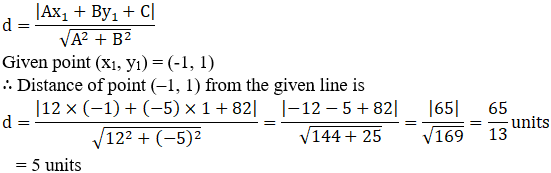
Find the distance of the point (–1, 1) from the line 12(x + 6) = 5(y – 2).

Show solutionHide solution
Worked solution

Given:

The equation of the line is 12(x + 6) = 5(y – 2).

12x + 72 = 5y – 10

12x – 5y + 82 = 0 … (1)

Now, compare equation (1) with the general equation of line Ax + By + C = 0, where A = 12, B = –5, and C = 82

Perpendicular distance (d) of a line Ax + By + C = 0 from a point (x1, y1) is given by

NCERT Solutions for Class 11 Maths Chapter 10 – Straight Lines image - 33

∴ The distance is 5 units.

Q5Written answer

Find the points on the x-axis whose distances from the line x/3 + y/4 = 1 are 4 units.

Show solutionHide solution
Worked solution

Given:

The equation of the line is x/3 + y/4 = 1

4x + 3y = 12

4x + 3y – 12 = 0 …. (1)

Now, compare equation (1) with the general equation of line Ax + By + C = 0, where A = 4, B = 3, and C = -12

Let (a, 0) be the point on the x-axis whose distance from the given line is 4 units.

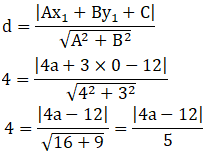
So, the perpendicular distance (d) of a line Ax + By + C = 0 from a point (x1, y1) is given by

NCERT Solutions for Class 11 Maths Chapter 10 – Straight Lines image - 34

|4a – 12| = 4 × 5

± (4a – 12) = 20

4a – 12 = 20 or – (4a – 12) = 20

4a = 20 + 12 or 4a = -20 + 12

a = 32/4 or a = -8/4

a = 8 or a = -2

∴ The required points on the x-axis are (-2, 0) and (8, 0)

Q6Written answer

Find the distance between parallel lines.
(i) 15x + 8y – 34 = 0 and 15x + 8y + 31 = 0

(ii) l(x + y) + p = 0 and l (x + y) – r = 0

Show solutionHide solution
Worked solution

(i) 15x + 8y – 34 = 0 and 15x + 8y + 31 = 0

Given:

The parallel lines are 15x + 8y – 34 = 0 and 15x + 8y + 31 = 0.

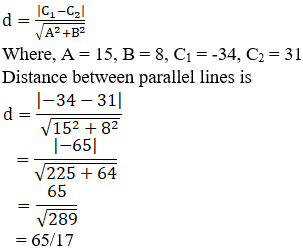
By using the formula,

The distance (d) between parallel lines Ax + By + C1 = 0 and Ax + By + C2 = 0 is given by

NCERT Solutions for Class 11 Maths Chapter 10 – Straight Lines image - 35

∴ The distance between parallel lines is 65/17

(ii) l(x + y) + p = 0 and l (x + y) – r = 0

Given:

The parallel lines are l (x + y) + p = 0 and l (x + y) – r = 0

lx + ly + p = 0 and lx + ly – r = 0

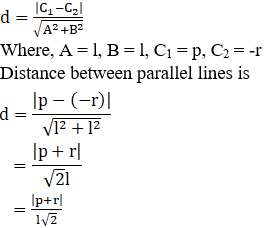
By using the formula,

The distance (d) between parallel lines Ax + By + C1 = 0 and Ax + By + C2 = 0 is given by

NCERT Solutions for Class 11 Maths Chapter 10 – Straight Lines image - 36

∴ The distance between parallel lines is |p+r|/l√2

Q7Written answer

Find the equation of the line parallel to the line 3x − 4y + 2 = 0 and passing through the point (–2, 3).

Show solutionHide solution
Worked solution

Given:

The line is 3x – 4y + 2 = 0

So, y = 3x/4 + 2/4

= 3x/4 + ½

Which is of the form y = mx + c, where m is the slope of the given line.

The slope of the given line is 3/4

We know that parallel lines have the same slope.

∴ Slope of other line = m = 3/4

The equation of line having slope m and passing through (x1, y1) is given by

y – y1 = m (x – x1)

∴ The equation of the line having slope 3/4 and passing through (-2, 3) is

y – 3 = ¾ (x – (-2))

4y – 3 × 4 = 3x + 3 × 2

3x – 4y = 18

∴ The equation is 3x – 4y = 18

Q8Written answer

Find equation of the line perpendicular to the line x – 7y + 5 = 0 and having x intercept 3.

Show solutionHide solution
Worked solution

Given:

The equation of line is x – 7y + 5 = 0

So, y = 1/7x + 5/7 [which is of the form y = mx + c, where m is the slope of the given line.]

The slope of the given line is 1/7

The slope of the line perpendicular to the line having slope m is -1/m

The slope of the line perpendicular to the line having a slope of 1/7 is -1/(1/7) = -7

So, the equation of the line with slope -7 and the x-intercept 3 is given by y = m(x – d)

y = -7 (x – 3)

y = -7x + 21

7x + y = 21

∴ The equation is 7x + y = 21

Q9Written answer

Find angles between the lines √3x + y = 1 and x + √3y = 1.

Show solutionHide solution
Worked solution

Given:

The lines are √3x + y = 1 and x + √3y = 1

So, y = -√3x + 1 … (1) and

y = -1/√3x + 1/√3 …. (2)

The slope of the line (1) is m1 = -√3, while the slope of the line (2) is m2 = -1/√3

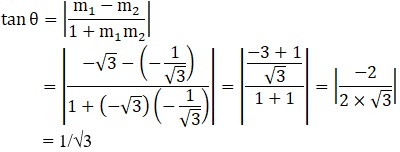
Let θ be the angle between two lines.

So,

NCERT Solutions for Class 11 Maths Chapter 10 – Straight Lines image - 37

θ = 30°

∴ The angle between the given lines is either 30° or 180°- 30° = 150°

Q10Written answer

The line through the points (h, 3) and (4, 1) intersects the line 7x − 9y −19 = 0. At the right angle. Find the value of h.

Show solutionHide solution
Worked solution

Let the slope of the line passing through (h, 3) and (4, 1) be m1

Then, m1 = (1-3)/(4-h) = -2/(4-h)

Let the slope of line 7x – 9y – 19 = 0 be m2

7x – 9y – 19 = 0

So, y = 7/9x – 19/9

m2 = 7/9

Since the given lines are perpendicular,

m1 × m2 = -1

-2/(4-h) × 7/9 = -1

-14/(36-9h) = -1

-14 = -1 × (36 – 9h)

36 – 9h = 14

9h = 36 – 14

h = 22/9

∴ The value of h is 22/9