My Cart
Your Cart 0

    Your cart is empty.

  • Total (Amount) ₹0.00
NCERT · Class 11 · Maths

Chapter 9: Sequences and Series Exercise 9.2

Practice each question, then open the answer or worked solution.

Questions

18 questions
Q1Written answer

Find the sum of odd integers from 1 to 2001.

Show solutionHide solution
Worked solution

The odd integers from 1 to 2001 are 1, 3, 5, …1999, 2001.

It clearly forms a sequence in A.P.

Where, the first term, a = 1

The common difference, d = 2

Now,

a + (n -1)d = 2001

1 + (n-1)(2) = 2001

2n – 2 = 2000

2n = 2000 + 2 = 2002

n = 1001

We know,

Sn = n/2 [2a + (n-1)d]
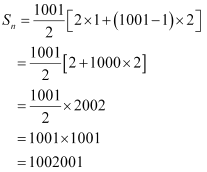
NCERT Solutions Class 11 Mathematics Chapter 9 ex.9.2 - 1

Therefore, the sum of odd numbers from 1 to 2001 is 1002001.
Q2Written answer

Find the sum of all natural numbers lying between 100 and 1000, which are multiples of 5.

Show solutionHide solution
Worked solution

The natural numbers lying between 100 and 1000, which are multiples of 5, are 105, 110, … 995.

It clearly forms a sequence in A.P.

Where, the first term, a = 105

The common difference, d = 5

Now,

a + (n -1)d = 995

105 + (n – 1)(5) = 995

105 + 5n – 5 = 995

5n = 995 – 105 + 5 = 895

n = 895/5

n = 179

We know,

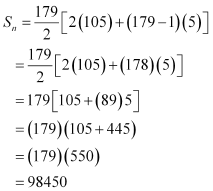
Sn = n/2 [2a + (n-1)d]

NCERT Solutions Class 11 Mathematics Chapter 9 ex.9.2 - 2

Therefore, the sum of all natural numbers lying between 100 and 1000, which are multiples of 5, is 98450.

Q3Written answer

In an A.P, the first term is 2, and the sum of the first five terms is one-fourth of the next five terms. Show that the 20th term is –112.

Show solutionHide solution
Worked solution

Given,

The first term (a) of an A.P. = 2

Let’s assume d be the common difference of the A.P.

So, the A.P. will be 2, 2 + d, 2 + 2d, 2 + 3d, …

Then,

Sum of first five terms = 10 + 10d

Sum of next five terms = 10 + 35d

From the question, we have

10 + 10d = ¼ (10 + 35d)

40 + 40d = 10 + 35d

30 = -5d

d = -6

a20 = a + (20 – 1)d = 2 + (19) (-6) = 2 – 114 = -112

Therefore, the 20th term of the A.P. is –112.

Q4Written answer

How many terms of the A.P. -6, -11/2, -5, …. are needed to give the sum –25?

Show solutionHide solution
Worked solution

Let’s consider the sum of n terms of the given A.P. as –25.

We know that,

Sn = n/2 [2a + (n-1)d]

where n = number of terms, a = first term, and d = common difference

So here, a = –6

d = -11/2 + 6 = (-11 + 12)/ 2 = 1/2

Thus, we have

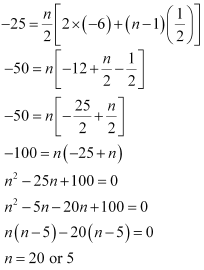
NCERT Solutions Class 11 Mathematics Chapter 9 ex.9.2 - 3

Q5Written answer

In an A.P., if pth term is 1/q and qth term is 1/p, prove that the sum of first pq terms is ½ (pq + 1) where p ≠ q.  

Show solutionHide solution
Worked solution

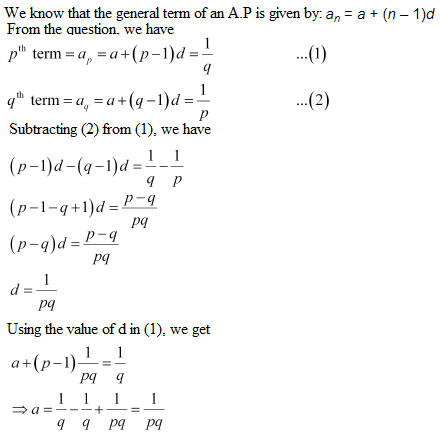
NCERT Solutions Class 11 Mathematics Chapter 9 ex.9.2 - 4

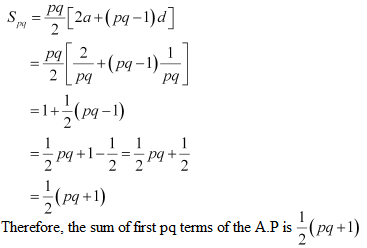
NCERT Solutions Class 11 Mathematics Chapter 9 ex.9.2 - 5

Q6Written answer

If the sum of a certain number of terms of the A.P. 25, 22, 19, … is 116. Find the last term

Show solutionHide solution
Worked solution

Given A.P.,

25, 22, 19, …

Here,

First term, a = 25 and

Common difference, d = 22 – 25 = -3

Also given, the sum of a certain number of terms of the A.P. is 116

The number of terms be n

So, we have

Sn = n/2 [2a + (n-1)d] = 116

116 = n/2 [2(25) + (n-1)(-3)]

116 x 2 = n [50 – 3n + 3]

232 = n [53 – 3n]

232 = 53n – 3n2

3n2 – 53n + 232 = 0

3n2 – 24n – 29n+ 232 = 0

3n(n – 8) – 29(n – 8) = 0

(3n – 29) (n – 8) = 0

Hence,

n = 29/3 or n = 8

As n can only be an integral value, n = 8

Thus, the 8th term is the last term of the A.P.

a8 = 25 + (8 – 1)(-3)

= 25 – 21

= 4

Q7Written answer

Find the sum to n terms of the A.P., whose kth term is 5k + 1.

Show solutionHide solution
Worked solution

Given, the kth term of the A.P. is 5k + 1.

kth term = ak = a + (k – 1)d

And,

a + (k – 1)d = 5k + 1

a + kd – d = 5k + 1

On comparing the coefficient of k, we get d = 5

a – d = 1

a – 5 = 1

⇒ a = 6

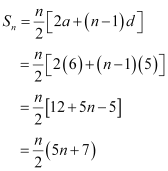
NCERT Solutions Class 11 Mathematics Chapter 9 ex.9.2 - 6

Q8Written answer

If the sum of n terms of an A.P. is (pn + qn2), where p and q are constants, find the common difference.

Show solutionHide solution
Worked solution

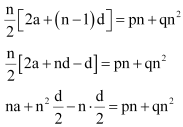
We know that,

Sn = n/2 [2a + (n-1)d]

From the question we have,

NCERT Solutions Class 11 Mathematics Chapter 9 ex.9.2 - 7

On comparing the coefficients of n2 on both sides, we get

d/2 = q

Hence, d = 2q

Therefore, the common difference of the A.P. is 2q.

Q9Written answer

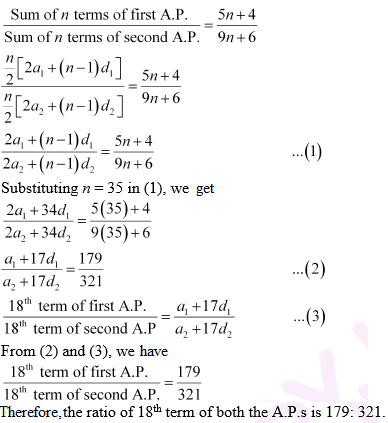
The sums of n terms of two arithmetic progressions are in the ratio 5n + 4: 9n + 6. Find the ratio of their 18th terms.

Show solutionHide solution
Worked solution

Let a1, a2, and d1, d2 be the first terms and the common difference of the first and second arithmetic progression, respectively.

Then, from the question we have

NCERT Solutions Class 11 Mathematics Chapter 9 ex.9.2 - 8

Q10Written answer

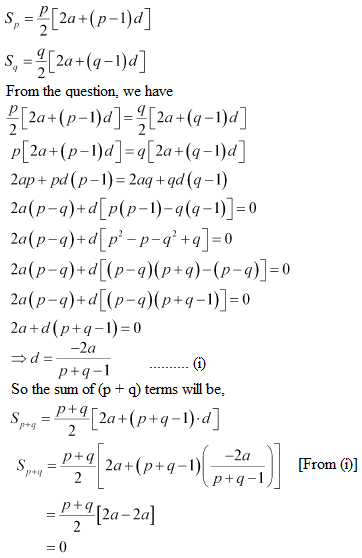
If the sum of the first p terms of an A.P. is equal to the sum of the first q terms, then find the sum of the first (p + q) terms.

Show solutionHide solution
Worked solution

Let’s take a and d to be the first term and the common difference of the A.P., respectively.

Then, it is given that

NCERT Solutions Class 11 Mathematics Chapter 9 ex.9.2 - 9

Therefore, the sum of (p + q) terms of the A.P. is 0.