My Cart
Your Cart 0

    Your cart is empty.

  • Total (Amount) ₹0.00
NCERT · Class 11 · Maths

Chapter 9: Sequences And Series Miscellaneous Exercise

Practice each question, then open the answer or worked solution.

Questions

32 questions
Q1Written answer

Show that the sum of (m + n)th and (m – n)th terms of an A.P. is equal to twice the mth term.

Show solutionHide solution
Worked solution

Let’s take a and d to be the first term and the common difference of the A.P., respectively.

We know that the kth term of an A. P. is given by

ak = a + (k –1) d

So, am + n = a + (m + n –1) d

And, am – n = a + (m – n –1) d

am = a + (m –1) d

Thus,

am + n + am – n  = a + (m + n –1) d + a + (m – n –1) d

= 2a + (m + n –1 + m – n –1) d

= 2a + (2m – 2) d

= 2a + 2 (m – 1) d

=2 [a + (m – 1) d]

= 2am

Therefore, the sum of (m + n)th and (m – n)th terms of an A.P. is equal to twice the mth term
Q2Written answer

If the sum of three numbers in A.P., is 24 and their product is 440, find the numbers.

Show solutionHide solution
Worked solution

Let’s consider the three numbers in A.P. as a – d, a, and a + d.

Then, from the question we have

(a – d) + (a) + (a + d) = 24 … (i)

3a = 24

∴ a = 8

And,

(a – d) a (a + d) = 440 … (ii)

(8 – d) (8) (8 + d) = 440

(8 – d) (8 + d) = 55

64 – d2 = 55

d2 = 64 – 55 = 9

∴ d = ± 3

Thus,

When d = 3, the numbers are 5, 8, and 11 and

When d = –3, the numbers are 11, 8, and 5.

Therefore, the three numbers are 5, 8, and 11.

Q3Written answer

Let the sum of n, 2n, 3n terms of an A.P. be S1, S2 and S3, respectively, show that S3 = 3 (S2– S1)

Show solutionHide solution
Worked solution

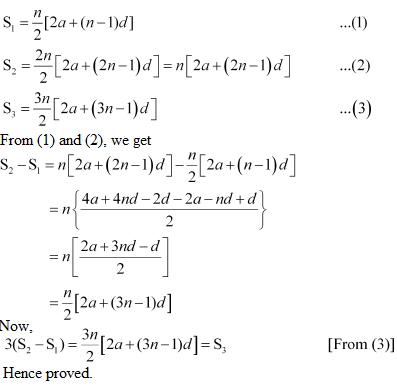
Let’s take a and d to be the first term and the common difference of the A.P., respectively.

So, we have

NCERT Solutions Class 11 Mathematics Chapter 9 misc ex. - 1

Q4Written answer

Find the sum of all numbers between 200 and 400 which are divisible by 7.

Show solutionHide solution
Worked solution

First, let’s find the numbers between 200 and 400, which are divisible by 7.

The numbers are:

203, 210, 217, … 399

Here, the first term, a = 203

Last term, l = 399 and

Common difference, d = 7

Let’s consider the number of terms of the A.P. to be n.

Hence, an = 399 = a + (n –1) d

399 = 203 + (n –1) 7

7 (n –1) = 196

n –1 = 28

n = 29

Then, the sum of 29 terms of the A.P is given by:

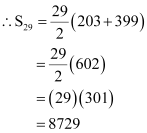
NCERT Solutions Class 11 Mathematics Chapter 9 misc ex. - 2

Therefore, the required sum is 8729.

Q5Written answer

Find the sum of integers from 1 to 100 that are divisible by 2 or 5.

Show solutionHide solution
Worked solution

First, let’s find the integers from 1 to 100, which are divisible by 2.

And they are 2, 4, 6… 100.

Clearly, this forms an A.P. with the first term and common difference both equal to 2.

So, we have

100 = 2 + (n –1) 2

n = 50

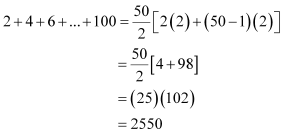
Hence, the sum is

NCERT Solutions Class 11 Mathematics Chapter 9 misc ex. - 3

Now, the integers from 1 to 100, which are divisible by 5, are 5, 10… 100.

This also forms an A.P. with the first term and common difference both equal to 5.

So, we have

100 = 5 + (n –1) 5

5n = 100

n = 20

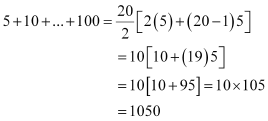
Hence, the sum is

NCERT Solutions Class 11 Mathematics Chapter 9 misc ex. - 4

Lastly, the integers which are divisible by both 2 and 5, are 10, 20, … 100.

And this also forms an A.P. with the first term and common difference both equal to 10.

So, we have

100 = 10 + (n –1) (10)

100 = 10n

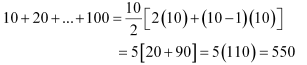
n = 10

NCERT Solutions Class 11 Mathematics Chapter 9 misc ex. - 5

Thus, the required sum = 2550 + 1050 – 550 = 3050

Therefore, the sum of the integers from 1 to 100, which are divisible by 2 or 5, is 3050.

Q6Written answer

Find the sum of all two digit numbers which when divided by 4, yields 1 as remainder.

Show solutionHide solution
Worked solution

First, we have to find the two-digit numbers, which when divided by 4, yield 1 as the remainder.

They are: 13, 17, … 97.

As it’s seen that this series forms an A.P. with the first term (a) 13 and common difference (d) 4.

Let n be the number of terms of the A.P.

We know that the nth term of an A.P. is given by,

an = a + (n –1) d

So, 97 = 13 + (n –1) (4)

4 (n –1) = 84

n – 1 = 21

n = 22

Now, the sum of n terms of an A.P. is given by,

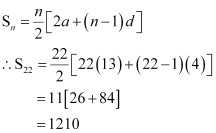
NCERT Solutions Class 11 Mathematics Chapter 9 misc ex. - 6

Therefore, the required sum is 1210.

Q7Written answer

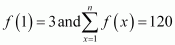
If f is a function satisfying f(x + y) = f(x) f(y) for all x, y ∈ N such thatNCERT Solutions Class 11 Mathematics Chapter 9 misc ex. - 7, find the value of n.

Show solutionHide solution
Worked solution

Given that,

f (x + y) = f (x) × f (y) for all x, y ∈ N … (1)

f (1) = 3

Taking x = y = 1 in (1), we have

f (1 + 1) = f (2) = f (1) f (1) = 3 × 3 = 9

Similarly,

f (1 + 1 + 1) = f (3) = f (1 + 2) = f (1) f (2) = 3 × 9 = 27

And, f (4) = f (1 + 3) = f (1) f (3) = 3 × 27 = 81

Thus, f (1), f (2), f (3), …, that is 3, 9, 27, …, forms a G.P. with the first term and common ratio both equal to 3.

We know that sum of terms in G.P is given by,

NCERT Solutions Class 11 Mathematics Chapter 9 misc ex. - 8

And it’s given that,

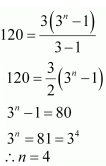
NCERT Solutions Class 11 Mathematics Chapter 9 misc ex. - 9

Hence, the sum of the terms of the function is 120.

NCERT Solutions Class 11 Mathematics Chapter 9 misc ex. - 10

Therefore, the value of n is 4.

Q8Written answer

The sum of some terms of G.P. is 315, whose first term and the common ratio are 5 and 2, respectively. Find the last term and the number of terms.

Show solutionHide solution
Worked solution

Given that the sum of some terms in a G.P is 315.

Let the number of terms be n.

We know that the sum of terms is

NCERT Solutions Class 11 Mathematics Chapter 9 misc ex. - 11

Given that the first term a is 5 and the common ratio r is 2.

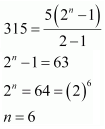
NCERT Solutions Class 11 Mathematics Chapter 9 misc ex. - 12

Hence, the last term of the G.P = 6th term = ar6 – 1 = (5)(2)5 = (5)(32) = 160

Therefore, the last term of the G.P. is 160.

Q9Written answer

The first term of a G.P. is 1. The sum of the third term and fifth term is 90. Find the common ratio of G.P.

Show solutionHide solution
Worked solution

Let’s consider a and r to be the first term and the common ratio of the G.P., respectively.

Given, a = 1

a3 = ar2 = r2

a5 = ar4 = r4

Then, from the question we have

r2 + r4 = 90

r4 + r2 – 90 = 0

NCERT Solutions Class 11 Mathematics Chapter 9 misc ex. - 13

Therefore, the common ratio of the G.P. is ±3.

Q10Written answer

The sum of three numbers in G.P. is 56. If we subtract 1, 7, 21 from these numbers in that order, we obtain an arithmetic progression. Find the numbers.

Show solutionHide solution
Worked solution

Let’s consider the three numbers in G.P. to be as a, ar, and ar2.

Then from the question, we have

a + ar + ar2 = 56

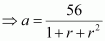
a (1 + r + r2) = 56

NCERT Solutions Class 11 Mathematics Chapter 9 misc ex. - 14 … (1)

Also, given

a – 1, ar – 7, ar2 – 21 form an A.P.

So, (ar – 7) – (a – 1) = (ar2 – 21) – (ar – 7)

ar – a – 6 = ar2 – ar – 14

ar2 – 2ar + a = 8

ar2 – ar – ar + a = 8

a(r2 + 1 – 2r) = 8

a (r – 1)2 = 8 … (2)

NCERT Solutions Class 11 Mathematics Chapter 9 misc ex. - 15

7(r2 – 2r + 1) = 1 + r + r2

7r2 – 14 r + 7 – 1 – r – r2 = 0

6r2 – 15r + 6 = 0

6r2 – 12r – 3r + 6 = 0

6r (r – 2) – 3 (r – 2) = 0

(6r – 3) (r – 2) = 0

r = 2, 1/2

When r = 2, a = 8

When r = ½, a = 32

Thus,

When r = 2, the three numbers in G.P. are 8, 16, and 32.

When r = 1/2, the three numbers in G.P. are 32, 16, and 8.

Therefore, in either case, the required three numbers are 8, 16, and 32.