My Cart
Your Cart 0

    Your cart is empty.

  • Total (Amount) ₹0.00
NCERT · Class 11 · Maths

Chapter 9: Sequences And Series Miscellaneous Exercise

Practice each question, then open the answer or worked solution.

Questions

32 questions
Q21Written answer

Find the sum of the following series up to n terms:

(i) 5 + 55 + 555 + … (ii) .6 + .66 + . 666 + …

Show solutionHide solution
Worked solution

(i) Given, 5 + 55 + 555 + …

Let Sn = 5 + 55 + 555 + ….. up to n terms

NCERT Solutions Class 11 Mathematics Chapter 9 misc ex. - 36

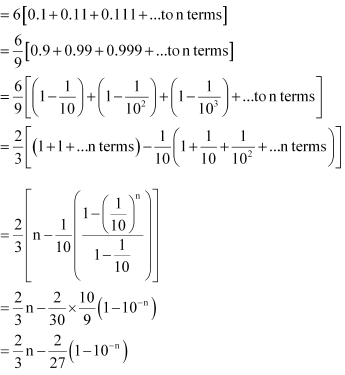
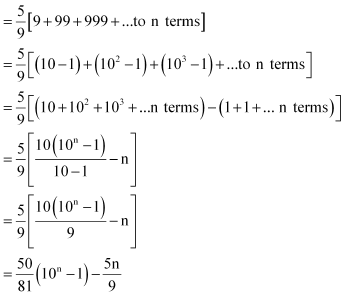
(ii) Given, .6 + .66 + . 666 + …

Let Sn = 06. + 0.66 + 0.666 + … up to n terms

NCERT Solutions Class 11 Mathematics Chapter 9 misc ex. - 37

Q22Written answer

Find the 20th term of the series 2 × 4 + 4 × 6 + 6 × 8 + … + n terms.

Show solutionHide solution
Worked solution

Given series is 2 × 4 + 4 × 6 + 6 × 8 + … n terms

∴ nth term = an = 2n × (2n + 2) = 4n2 + 4n

The 20th term,

a20 = 4 (20)2 + 4(20) = 4 (400) + 80 = 1600 + 80 = 1680

Therefore, the 20th term of the series is 1680.

Q23Written answer

Find the sum of the first n terms of the series: 3 + 7 + 13 + 21 + 31 + …

Show solutionHide solution
Worked solution

The given series is 3 + 7 + 13 + 21 + 31 + …

S = 3 + 7 + 13 + 21 + 31 + …+ an–1 + an

S = 3 + 7 + 13 + 21 + …. + an – 2 + an – 1 + an

On subtracting both equations, we get

S – S = [3 + (7 + 13 + 21 + 31 + …+ an–1 + an)] – [(3 + 7 + 13 + 21 + 31 + …+ an–1) + an]

S – S = 3 + [(7 – 3) + (13 – 7) + (21 – 13) + … + (an – an–1)] – an

0 = 3 + [4 + 6 + 8 + … (n –1) terms] – an

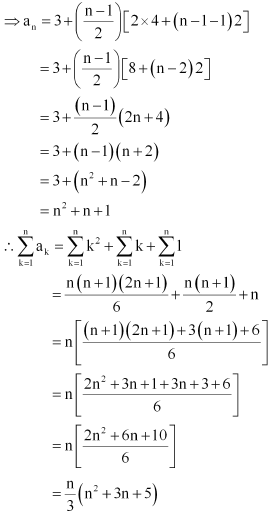
an = 3 + [4 + 6 + 8 + … (n –1) terms]

NCERT Solutions Class 11 Mathematics Chapter 9 misc ex. - 38

Q24Written answer

If S1, S2, S3 are the sum of first n natural numbers, their squares and their cubes, respectively, show that 9S22 = S3 (1 + 8S1).

Show solutionHide solution
Worked solution

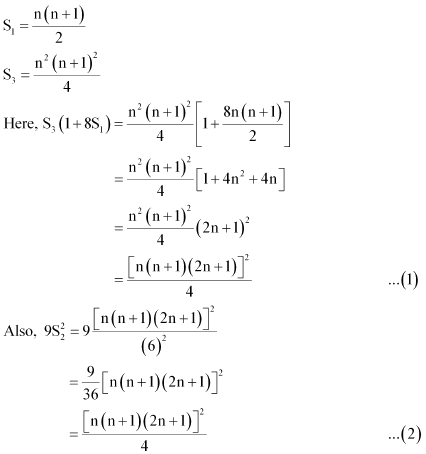
From the question, we have

NCERT Solutions Class 11 Mathematics Chapter 9 misc ex. - 39

Therefore, from (1) and (2), we have 9S22 = S3 (1 + 8S1).

Q25Written answer

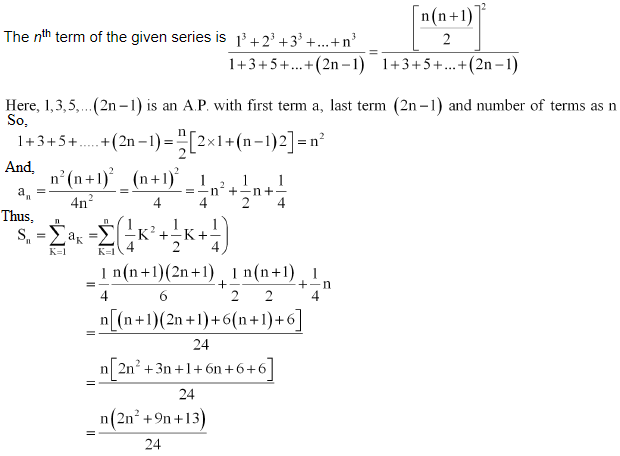
Find the sum of the following series up to n terms:NCERT Solutions Class 11 Mathematics Chapter 9 misc ex. - 40

Show solutionHide solution
Worked solution

NCERT Solutions Class 11 Mathematics Chapter 9 misc ex. - 41

Q26Written answer

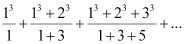
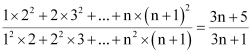
Show that 

NCERT Solutions Class 11 Mathematics Chapter 9 misc ex. - 43

Show solutionHide solution
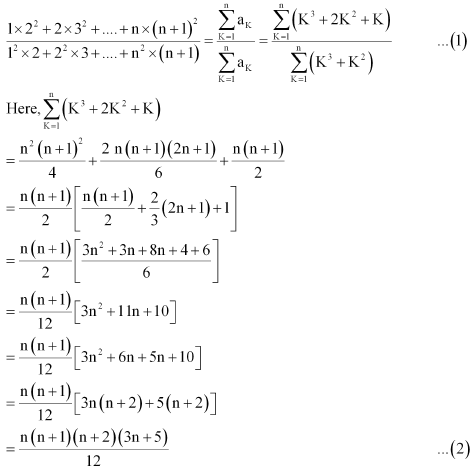
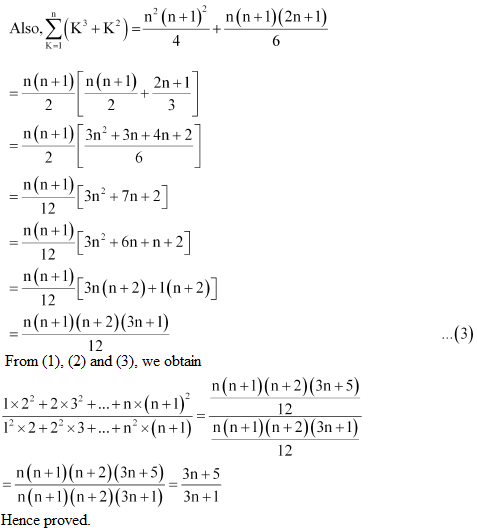
Worked solution

nth term of the numerator = n(n + 1)2 = n3 + 2n2 + n

nth term of the denominator = n2(n + 1) = n3 + n2

NCERT Solutions Class 11 Mathematics Chapter 9 misc ex. - 44

NCERT Solutions Class 11 Mathematics Chapter 9 misc ex. - 45

Q27Written answer

A farmer buys a used tractor for Rs 12000. He pays Rs 6000 cash and agrees to pay the balance in annual installments of Rs 500 plus 12% interest on the unpaid amount. How much will be the tractor cost him?

Show solutionHide solution
Worked solution

Given, the farmer pays Rs 6000 in cash.

So, the unpaid amount = Rs 12000 – Rs 6000 = Rs 6000

From the question, the interest paid annually will be,

12% of 6000, 12% of 5500, 12% of 5000, …, 12% of 500

Hence, the total interest to be paid = 12% of 6000 + 12% of 5500 + 12% of 5000 + … + 12% of 500

= 12% of (6000 + 5500 + 5000 + … + 500)

= 12% of (500 + 1000 + 1500 + … + 6000)

It’s seen that the series 500, 1000, 1500 … 6000 is an A.P. with the first term and common difference both equal to 500.

Let’s take the number of terms of the A.P. to be n.

So, 6000 = 500 + (n – 1) 500

1 + (n – 1) = 12

n = 12

Now,

The sum of the A.P = 12/2 [2(500) + (12 – 1)(500)] = 6 [1000 + 5500] = 6(6500) = 39000

Hence, the total interest to be paid = 12% of (500 + 1000 + 1500 + … + 6000)

= 12% of 39000 = Rs 4680

Therefore, the tractor will cost the farmer = (Rs 12000 + Rs 4680) = Rs 16680
Q28Written answer

Shamshad Ali buys a scooter for Rs 22000. He pays Rs 4000 cash and agrees to pay the balance in annual installment of Rs 1000 plus 10% interest on the unpaid amount. How much will the scooter cost him?

Show solutionHide solution
Worked solution

Given, Shamshad Ali buys a scooter for Rs 22000 and pays Rs 4000 in cash.

So, the unpaid amount = Rs 22000 – Rs 4000 = Rs 18000

From the question, it’s understood that the interest paid annually is

10% of 18000, 10% of 17000, 10% of 16000 … 10% of 1000

Hence, the total interest to be paid = 10% of 18000 + 10% of 17000 + 10% of 16000 + … + 10% of 1000

= 10% of (18000 + 17000 + 16000 + … + 1000)

= 10% of (1000 + 2000 + 3000 + … + 18000)

It’s seen that 1000, 2000, 3000 … 18000 forms an A.P. with the first term and common difference both equal to 1000.

Let’s take the number of terms to be n.

So, 18000 = 1000 + (n – 1) (1000)

n = 18

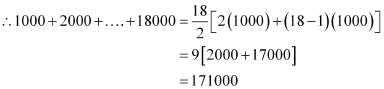
Now, the sum of the A.P is given by:

NCERT Solutions Class 11 Mathematics Chapter 9 misc ex. - 51

Thus,

Total interest paid = 10% of (18000 + 17000 + 16000 + … + 1000)

= 10% of Rs 171000 = Rs 17100

Therefore, the cost of scooter = Rs 22000 + Rs 17100 = Rs 39100

Q29Written answer

A person writes a letter to four of his friends. He asks each one of them to copy the letter and mail to four different persons with instruction that they move the chain similarly. Assuming that the chain is not broken and that it costs 50 paise to mail one letter. Find the amount spent on the postage when 8th set of letter is mailed.

Show solutionHide solution
Worked solution

It’s seen that,

The numbers of letters mailed forms a G.P.: 4, 42, … 48

Here, first term = 4 and common ratio = 4

And the number of terms = 8

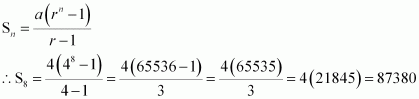
The sum of n terms of a G.P. is given by:

NCERT Solutions Class 11 Mathematics Chapter 9 misc ex. - 46

Also, given that the cost to mail one letter is 50 paisa.

Hence, Cost of mailing 87380 letters = Rs 87380 x (50/100) = Rs 43690 = Rs 43690

Therefore, the amount spent when 8th set of letter is mailed will be Rs 43690.

Q30Written answer

A man deposited Rs 10000 in a bank at the rate of 5% simple interest annually. Find the amount in 15th year since he deposited the amount and also calculate the total amount after 20 years.

Show solutionHide solution
Worked solution

Given, the man deposited Rs 10000 in a bank at the rate of 5% simple interest annually.

Hence, the interest in first year = (5/100) x Rs 10000 = Rs 500

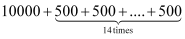
NCERT Solutions Class 11 Mathematics Chapter 9 misc ex. - 47So, the amount in 15th year = Rs

= Rs 10000 + 14 × Rs 500

= Rs 10000 + Rs 7000

= Rs 17000

NCERT Solutions Class 11 Mathematics Chapter 9 misc ex. - 48And, the amount after 20 years =

= Rs 10000 + 20 × Rs 500

= Rs 10000 + Rs 10000

= Rs 20000

Therefore, the amount in the 15th year is Rs 17000, and the total amount after 20 years will be Rs 20000.