My Cart
Your Cart 0

    Your cart is empty.

  • Total (Amount) ₹0.00
NCERT · Class 11 · Maths

Chapter 9: Sequences And Series Miscellaneous Exercise

Practice each question, then open the answer or worked solution.

Questions

32 questions
Q11Written answer

A G.P. consists of an even number of terms. If the sum of all the terms is 5 times the sum of terms occupying odd places, then find its common ratio.

Show solutionHide solution
Worked solution

Let’s consider the terms in the G.P. to be T1, T2, T3, T4, … T2n.

The number of terms = 2n

Then, from the question we have

T1 + T2 + T3 + …+ T2n = 5 [T1 + T3 + … +T2n–1]

T1 + T2 + T3 + … + T2n – 5 [T1 + T3 + … + T2n–1] = 0

T2 + T4 + … + T2n = 4 [T1 + T3 + … + T2n–1] …… (1)

Now, let the terms in G.P. be a, ar, ar2, ar3, …

Then (1) becomes,
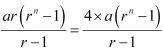
NCERT Solutions Class 11 Mathematics Chapter 9 misc ex. - 16[Using sum of terms in G.P.]

ar = 4a

r = 4

Thus, the common ratio of the G.P. is 4.
Q12Written answer

The sum of the first four terms of an A.P. is 56. The sum of the last four terms is 112. If its first term is 11, then find the number of terms.

Show solutionHide solution
Worked solution

Let’s consider the terms in A.P. to be a, a + d, a + 2d, a + 3d, … a + (n – 2) d, a + (n – 1)d.

From the question, we have

Sum of first four terms = a + (a + d) + (a + 2d) + (a + 3d) = 4a + 6d

Sum of last four terms = [a + (n – 4) d] + [a + (n – 3) d] + [a + (n – 2) d] + [a + n – 1) d]

= 4a + (4n – 10) d

Then according to the given condition,

4a + 6d = 56

4(11) + 6d = 56 [Since a = 11 (given)]

6d = 12

d = 2

Hence, 4a + (4n –10) d = 112

4(11) + (4n – 10)2 = 112

(4n – 10)2 = 68

4n – 10 = 34

4n = 44

n = 11

Therefore, the number of terms of the A.P. is 11.

Q13Written answer

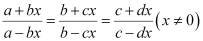
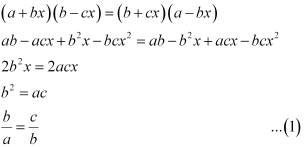
IfNCERT Solutions Class 11 Mathematics Chapter 9 misc ex. - 17, then show that a, b, c and d are in G.P.
Show solutionHide solution
Worked solution

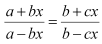
Given,

NCERT Solutions Class 11 Mathematics Chapter 9 misc ex. - 18

On cross-multiplying, we have

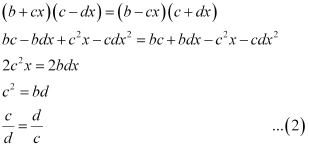
NCERT Solutions Class 11 Mathematics Chapter 9 misc ex. - 19

NCERT Solutions Class 11 Mathematics Chapter 9 misc ex. - 20Also, given

On cross-multiplying, we have

NCERT Solutions Class 11 Mathematics Chapter 9 misc ex. - 21

From (1) and (2), we get

b/a = c/b = d/c

Therefore, a, b, c and d are in G.P.

Q14Written answer

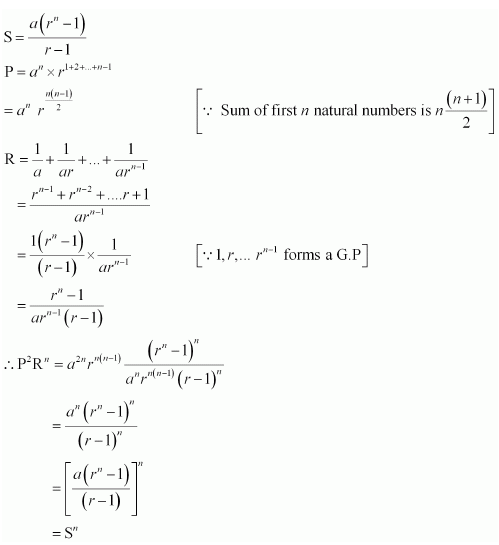
Let S be the sum, P the product and R the sum of reciprocals of n terms in a G.P. Prove that P2Rn = Sn

Show solutionHide solution
Worked solution

Let the terms in G.P. be a, ar, ar2, ar3, … arn – 1…

From the question, we have

NCERT Solutions Class 11 Mathematics Chapter 9 misc ex. - 22

Hence, P2 Rn = Sn

Q15Written answer

The pth, qth and rth terms of an A.P. are a, b, c respectively.

Show that (q – r) a + (r – p) b + (p -q) c = 0

Show solutionHide solution
Worked solution

Let’s assume t and d to be the first term and the common difference of the A.P., respectively.

Then the nth term of the A.P. is given by, an = t + (n – 1) d

Thus,

ap = t + (p – 1) d = a  … (1)

aq = t + (q – 1) d = b  … (2)

ar = t + (r – 1) d = c  … (3)

On subtracting equation (2) from (1), we get

(p – 1 – q + 1) d = a – b

(p – q) d = a – b

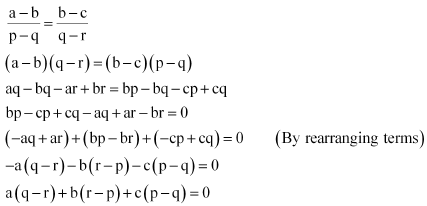
NCERT Solutions Class 11 Mathematics Chapter 9 misc ex. - 24

On subtracting equation (3) from (2), we get

(q – 1 – r + 1) d = b – c

(q – r) d = b – c

NCERT Solutions Class 11 Mathematics Chapter 9 misc ex. - 25

Equating both the values of d obtained in (4) and (5), we get

NCERT Solutions Class 11 Mathematics Chapter 9 misc ex. - 26

Therefore, the given result is proved.

Q16Written answer

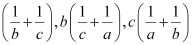
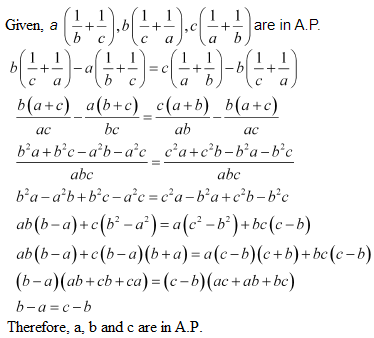
If aNCERT Solutions Class 11 Mathematics Chapter 9 misc ex. - 27are in A.P., prove that a, b, c are in A.P.
Show solutionHide solution
Worked solution

NCERT Solutions Class 11 Mathematics Chapter 9 misc ex. - 28

Q17Written answer

If a, b, c, d are in G.P, prove that (an + bn), (bn + cn), (cn + dn) are in G.P.

Show solutionHide solution
Worked solution

Given, a, b, c, and d are in G.P.

So, we have

∴b2 = ac … (i)

c2 = bd … (ii)

ad = bc … (iii)

Required to prove (an + bn), (bn + cn), (cn + dn) are in G.P. i.e.,

(bn + cn)2 = (an + bn) (cn + dn)

Taking L.H.S.

(bn + cn)2 = b2n + 2bncn + c2n

= (b2)n+ 2bncn + (c2) n

= (ac)n + 2bncn + (bd)n  [Using (i) and (ii)]

= an cn + bncn+ bn cn + bn dn

= an cn + bncn+ an dn + bn dn  [Using (iii)]

= cn (an + bn) + dn (an + bn)

= (an + bn) (cn + dn)

= R.H.S.

Therefore, (an + bn), (bn + cn), and (cn + dn) are in G.P

– Hence proved.

Q18Written answer

If a and b are the roots of x2 – 3x + p = 0 and c, dare roots of x2 – 12x + q = 0, where a, b, c, d, form a G.P. Prove that (q + p): (q – p) = 17:15.

Show solutionHide solution
Worked solution

Given, a and b are the roots of x2 – 3x + p = 0

So, we have a + b = 3 and ab = p  … (i)

Also, c and d are the roots of x2 – 12x + q = 0

So, c + d = 12 and cd = q  … (ii)

And given a, b, c, d are in G.P.

Let’s take a = x, b = xr, c = xr2, d = xr3

From (i) and (ii), we get

x + xr = 3

x (1 + r) = 3

And,

xr2 + xr3 =12

xr2 (1 + r) = 12

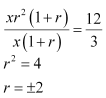
On dividing, we get

NCERT Solutions Class 11 Mathematics Chapter 9 misc ex. - 29

When r = 2, x = 3/(1 + 2) = 3/3 = 1

When r = -2, x = 3/(1 – 2) = 3/-1 = -3

Case I:

When r = 2 and x =1,

ab = x2r = 2

cd = x2r5 = 32

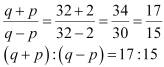
NCERT Solutions Class 11 Mathematics Chapter 9 misc ex. - 30

Case II:

When r = –2, x = –3,

ab = x2r = –18

cd = x2r5 = – 288

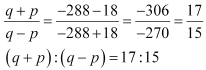
NCERT Solutions Class 11 Mathematics Chapter 9 misc ex. - 31

Therefore, in both the cases, we get (q + p): (q – p) = 17:15\

Q19Written answer

The ratio of the A.M and G.M. of two positive numbers a and b, is m: n. Show that NCERT Solutions Class 11 Mathematics Chapter 9 misc ex. - 32.

Show solutionHide solution
Worked solution

Let the two numbers be a and b.

A.M = (a + b)/ 2 and G.M. = √ab

From the question, we have

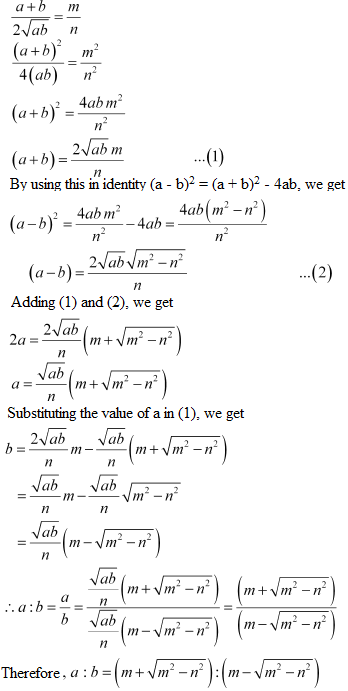
NCERT Solutions Class 11 Mathematics Chapter 9 misc ex. - 33

Q20Written answer

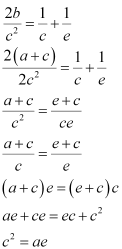
If a, b, c are in A.P,; b, c, d are in G.P and 1/c, 1/d, 1/e are in A.P. prove that a, c, e are in G.P.

Show solutionHide solution
Worked solution

Given a, b, c are in A.P.

Hence, b – a = c – b  … (1)

And, given that b, c, d are in G.P.

So, c2 = bd  … (2)

Also, 1/c, 1/d, 1/e are in A.P.

So,

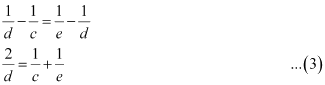
NCERT Solutions Class 11 Mathematics Chapter 9 misc ex. - 34

Now, required to prove that a, c, e are in G.P. i.e., c2 = ae

From (1), we have

2b = a + c

b = (a + c)/ 2

And from (2), we have

d = c2/ b

On substituting these values in (3), we get

NCERT Solutions Class 11 Mathematics Chapter 9 misc ex. - 35

Therefore, a, c, and e are in G.P.