Find the values of k for which the line (k – 3) x – (4 – k2) y + k2 – 7k + 6 = 0 is
(a) Parallel to the x-axis
(b) Parallel to the y-axis
(c) Passing through the origin
Show solutionHide solution
It is given that
(k – 3) x – (4 – k2) y + k2 – 7k + 6 = 0 … (1)
(a) Here, if the line is parallel to the x-axis
Slope of the line = Slope of the x-axis
It can be written as
(4 – k2) y = (k – 3) x + k2 – 7k + 6 = 0
We get

By further calculation,
k – 3 = 0
k = 3
Hence, if the given line is parallel to the x-axis, then the value of k is 3.
(b) Here, if the line is parallel to the y-axis, it is vertical, and the slope will be undefined.
So, the slope of the given line
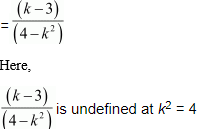
k2 = 4
k = ± 2
Hence, if the given line is parallel to the y-axis, then the value of k is ± 2.
(c) Here, if the line is passing through (0, 0), which is the origin satisfies the given equation of the line.
(k – 3) (0) – (4 – k2) (0) + k2 – 7k + 6 = 0
By further calculation,
k2 – 7k + 6 = 0
Separating the terms,
k2 – 6k – k + 6 = 0
We get
(k – 6) (k – 1) = 0
k = 1 or 6
Hence, if the given line is passing through the origin, then the value of k is either 1 or 6.