My Cart
Your Cart 0

    Your cart is empty.

  • Total (Amount) ₹0.00
NCERT · Class 11 · Maths

Chapter 9: Straight lines

Practice each question, then open the answer or worked solution.

Miscellaneous EXERCISE

Textbook page 233 · 24 questions
Q1Written answer

Find the values of k for which the line (k – 3) x – (4 – k2) y + k2 – 7k + 6 = 0 is

(a) Parallel to the x-axis

(b) Parallel to the y-axis

(c) Passing through the origin

Show solutionHide solution
Worked solution

It is given that

(k – 3) x – (4 – k2) y + k2 – 7k + 6 = 0 … (1)

(a) Here, if the line is parallel to the x-axis

Slope of the line = Slope of the x-axis

It can be written as

(4 – k2) y = (k – 3) x + k2 – 7k + 6 = 0

We get

NCERT Solutions for Class 11 Maths Chapter 10 – Straight Lines image - 47

By further calculation,

k – 3 = 0

k = 3

Hence, if the given line is parallel to the x-axis, then the value of k is 3.

(b) Here, if the line is parallel to the y-axis, it is vertical, and the slope will be undefined.

So, the slope of the given line
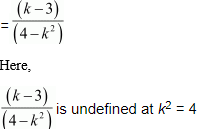
NCERT Solutions for Class 11 Maths Chapter 10 – Straight Lines image - 48

k2 = 4

k = ± 2

Hence, if the given line is parallel to the y-axis, then the value of k is ± 2.

(c) Here, if the line is passing through (0, 0), which is the origin satisfies the given equation of the line.

(k – 3) (0) – (4 – k2) (0) + k2 – 7k + 6 = 0

By further calculation,

k2 – 7k + 6 = 0

Separating the terms,

k2 – 6k – k + 6 = 0

We get

(k – 6) (k – 1) = 0

k = 1 or 6

Hence, if the given line is passing through the origin, then the value of k is either 1 or 6.
Q2Written answer

Find the values of θ and p, if the equation x cos θ + y sin θ = p is the normal form of the line √3x + y + 2 = 0.

Show solutionHide solution
Worked solution

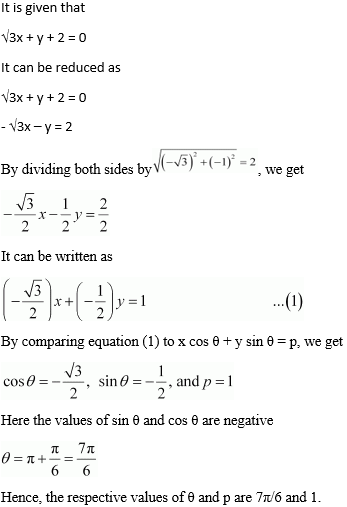
NCERT Solutions for Class 11 Maths Chapter 10 – Straight Lines image - 49

Q3Written answer

Find the equations of the lines, which cut-off intercepts on the axes whose sum and product are 1 and –6, respectively.

Show solutionHide solution
Worked solution

Consider the intercepts cut by the given lines on the a and b axes.

a + b = 1 …… (1)

ab = – 6 …….. (2)

By solving both equations, we get

a = 3 and b = -2 or a = – 2 and b = 3

We know that the equation of the line whose intercepts on the a and b axes is

NCERT Solutions for Class 11 Maths Chapter 10 – Straight Lines image - 50

Case I – a = 3 and b = – 2

So, the equation of the line is – 2x + 3y + 6 = 0, i.e. 2x – 3y = 6

Case II – a = -2 and b = 3

So, the equation of the line is 3x – 2y + 6 = 0, i.e. -3x + 2y = 6

Hence, the required equation of the lines are 2x – 3y = 6 and -3x + 2y = 6

Q4Written answer

What are the points on the y-axis whose distance from the line x/3 + y/4 = 1 is 4 units?

Show solutionHide solution
Worked solution

Consider (0, b) as the point on the y-axis whose distance from line x/3 + y/4 = 1 is 4 units.

It can be written as 4x + 3y – 12 = 0 ……. (1)

By comparing equation (1) to the general equation of line Ax + By + C = 0, we get

A = 4, B = 3 and C = – 12

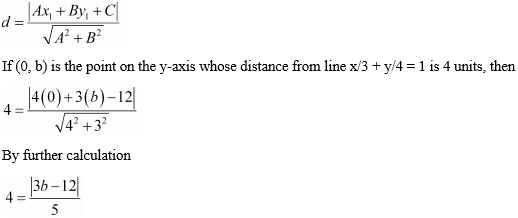
We know that the perpendicular distance (d) of a line Ax + By + C = 0 from (x1, y1) is written as

NCERT Solutions for Class 11 Maths Chapter 10 – Straight Lines image - 51

By cross multiplication,

20 = |3b – 12|

We get

20 = ± (3b – 12)

Here, 20 = (3b – 12) or 20 = – (3b – 12)

It can be written as

3b = 20 + 12 or 3b = -20 + 12

So, we get

b = 32/3 or b = -8/3

Hence, the required points are (0, 32/3) and (0, -8/3).

Q5Written answer

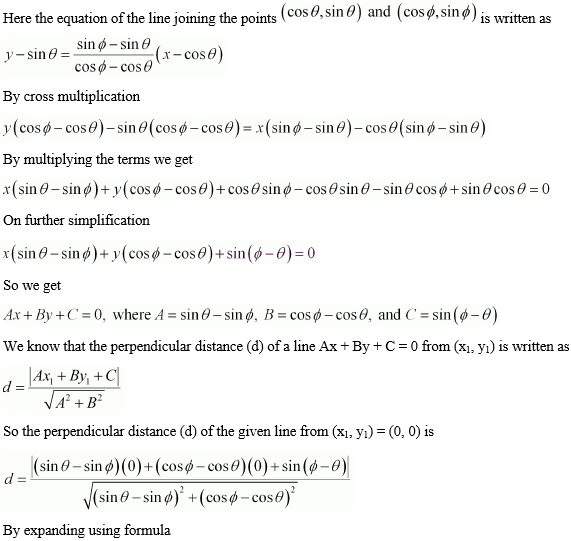
Find the perpendicular distance from the origin to the line joining the points NCERT Solutions for Class 11 Maths Chapter 10 – Straight Lines image - 52

Show solutionHide solution
Worked solution

NCERT Solutions for Class 11 Maths Chapter 10 – Straight Lines image - 53

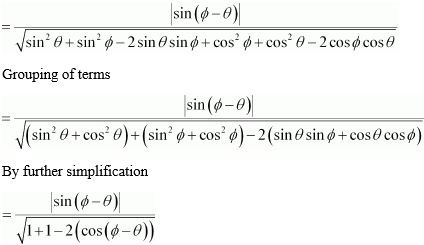
NCERT Solutions for Class 11 Maths Chapter 10 – Straight Lines image - 54

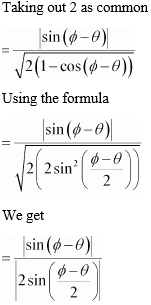
NCERT Solutions for Class 11 Maths Chapter 10 – Straight Lines image - 55

Q6Written answer

Find the equation of the line parallel to the y-axis and draw through the point of intersection of the lines x – 7y + 5 = 0 and 3x + y = 0.

Show solutionHide solution
Worked solution

Here, the equation of any line parallel to the y-axis is of the form

x = a ……. (1)

Two given lines are

x – 7y + 5 = 0 …… (2)

3x + y = 0 …… (3)

By solving equations (2) and (3), we get

x = -5/22 and y = 15/22

(-5/ 22, 15/22) is the point of intersection of lines (2) and (3)

If the line x = a passes through point (-5/22, 15/22), we get a = -5/22

Hence, the required equation of the line is x = -5/22

Q7Written answer

Find the equation of a line drawn perpendicular to the line x/4 + y/6 = 1 through the point where it meets the y-axis.

Show solutionHide solution
Worked solution

It is given that

x/4 + y/6 = 1

We can write it as

3x + 2y – 12 = 0

So, we get

y = -3/2 x + 6, which is of the form y = mx + c

Here, the slope of the given line = -3/2

So, the slope of line perpendicular to the given line = -1/ (-3/2) = 2/3

Consider the given line intersects, the y-axis at (0, y)

By substituting x as zero in the equation of the given line,

y/6 = 1

y = 6

Hence, the given line intersects the y-axis at (0, 6).

We know that the equation of the line that has a slope of 2/3 and passes through the point (0, 6) is

(y – 6) = 2/3 (x – 0)

By further calculation,

3y – 18 = 2x

So, we get

2x – 3y + 18 = 0

Hence, the required equation of the line is 2x – 3y + 18 = 0

Q8Written answer

Find the area of the triangle formed by the lines y – x = 0, x + y = 0 and x – k = 0.

Show solutionHide solution
Worked solution

It is given that

y – x = 0 …… (1)

x + y = 0 …… (2)

x – k = 0 ……. (3)

Here, the point of intersection of

Lines (1) and (2) is

x = 0 and y = 0

Lines (2) and (3) is

x = k and y = – k

Lines (3) and (1) is

x = k and y = k

So, the vertices of the triangle formed by the three given lines are (0, 0), (k, -k) and (k, k).

Here, the area of triangle whose vertices are (x1, y1), (x2, y2) and (x3, y3) is

½ |x1 (y2 – y3) + x2 (y3 – y1) + x3 (y1 – y2)|

So, the area of the triangle formed by the three given lines is

= ½ |0 (-k – k) + k (k – 0) + k (0 + k)| square units

By further calculation,

= ½ |k2 + k2| square units

So, we get

= ½ |2k2|

= k2 square units

Q9Written answer

Find the value of p so that the three lines 3x + y – 2 = 0, px + 2y – 3 = 0 and 2x – y – 3 = 0 may intersect at one point.

Show solutionHide solution
Worked solution

It is given that

3x + y – 2 = 0 …… (1)

px + 2y – 3 = 0 ….. (2)

2x – y – 3 = 0 …… (3)

By solving equations (1) and (3), we get

x = 1 and y = -1

Here, the three lines intersect at one point, and the point of intersection of lines (1) and (3) will also satisfy line (2)

p (1) + 2 (-1) – 3 = 0

By further calculation,

p – 2 – 3 = 0

So we get

p = 5

Hence, the required value of p is 5.

Q10Written answer

If three lines whose equations are y = m1x + c1, y = m2x + c2 and y = m3x + c3 are concurrent, then show that m1 (c2 – c3) + m2 (c3 – c1) + m3 (c1 – c2) = 0.

Show solutionHide solution
Worked solution

It is given that

y = m1x + c1 ….. (1)

y = m2x + c2 ….. (2)

y = m3x + c3 ….. (3)

By subtracting equation (1) from (2), we get

0 = (m2 – m1) x + (c2 – c1)

(m1 – m2) x = c2 – c1

So we get

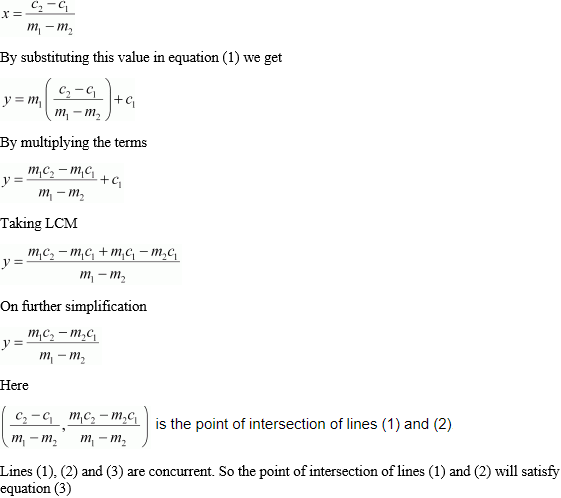
NCERT Solutions for Class 11 Maths Chapter 10 – Straight Lines image - 56

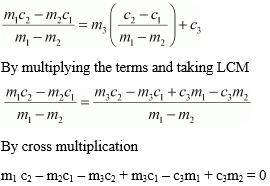
NCERT Solutions for Class 11 Maths Chapter 10 – Straight Lines image - 57

Taking out the common terms,

m1 (c2 – c3) + m2 (c3 – c1) + m3 (c1 – c2) = 0

Therefore, m1 (c2 – c3) + m2 (c3 – c1) + m3 (c1 – c2) = 0