My Cart
Your Cart 0

    Your cart is empty.

  • Total (Amount) ₹0.00
NCERT · Class 10 · Maths

Chapter 12: Surface Areas and Volumes

Practice each question, then open the answer or worked solution.

Exercise: 13.5 (Optional) (

7 questions
Q1Written answer

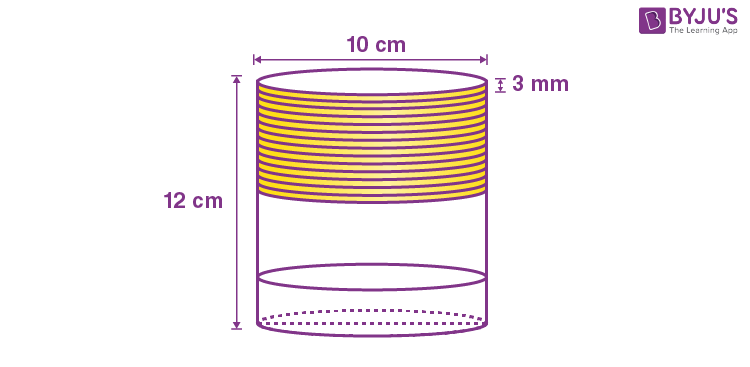
A copper wire, 3 mm in diameter, is wound about a cylinder whose length is 12 cm, and diameter 10 cm, so as to cover the curved surface of the cylinder. Find the length and mass of the wire, assuming the density of copper to be 8.88 g per cm3.

Show solutionHide solution
Worked solution

NCERT Solutions for Class 10 Maths Chapter 13 Exercise 13.5 Solution 1

Given that,

Diameter of cylinder = 10 cm

So, the radius of the cylinder (r) = 10/2 cm = 5 cm

∴ Length of wire in completely one round = 2πr = 3.14×5 cm = 31.4 cm

It is given that diameter of wire = 3 mm = 3/10 cm

∴ The thickness of the cylinder covered in one round = 3/10 m

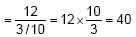
Hence, the number of turns (rounds) of the wire to cover 12 cm will be
Ncert solutions class 10 chapter 13-31

Now, the length of wire required to cover the whole surface = length of wire required to complete 40 rounds

40 x 31.4 cm = 1256 cm

Radius of the wire = 0.3/2 = 0.15 cm

The volume of wire = Area of the cross-section of wire × Length of wire

= π(0.15)2×1257.14

= 88.898 cm3

We know,

Mass = Volume × Density

= 88.898×8.88

= 789.41 gm
Q2Written answer

A right triangle whose sides are 3 cm and 4 cm (other than the hypotenuse) is made to revolve about its hypotenuse. Find the volume and surface area of the double cone so formed. (Choose the value of π as found appropriate)

Show solutionHide solution
Worked solution

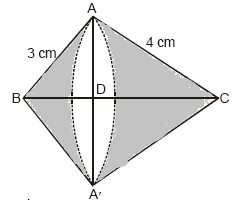
Draw the diagram as follows:

Ncert solutions class 10 chapter 13-32

Let us consider the ABA

Here,

AS = 3 cm, AC = 4 cm

So, Hypotenuse BC = 5 cm

We have got 2 cones on the same base AA’ where the radius = DA or DA’

Now, AD/CA = AB/CB

By putting the value of CA, AB and CB, we get,

AD = 2/5 cm

We also know,

DB/AB = AB/CB

So, DB = 9/5 cm

As, CD = BC-DB,

CD = 16/5 cm

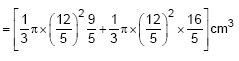
Now, the volume of the double cone will be

Ncert solutions class 10 chapter 13-33

Solving this, we get

V = 30.14 cm3

The surface area of the double cone will be

Ncert solutions class 10 chapter 13-34

= 52.75 cm2

Q3Written answer

A cistern, internally measuring 150 cm × 120 cm × 100 cm, has 129600 cm3 of water in it. Porous bricks are placed in the water until the cistern is full to the brim. Each brick absorbs one-seventeenth of its own volume of water. How many bricks can be put in without overflowing the water, each being 22.5 cm × 7.5 cm × 6.5 cm?

Show solutionHide solution
Worked solution

Given that the dimension of the cistern = 150 × 120 × 110

So, volume = 1980000 cm3

Volume to be filled in cistern = 1980000 – 129600

= 1850400 cm3

Now, let the number of bricks placed to be “n”

So, the volume of n bricks will be = n×22.5×7.5×6.5

Now, as each brick absorbs one-seventeenth of its volume, the volume will be

= n/(17)×(22.5×7.5×6.5)

For the condition given in the question,

The volume of n bricks has to be equal to the volume absorbed by n bricks + the volume to be filled in the cistern

Or, n×22.5×7.5×6.5 = 1850400+n/(17)×(22.5×7.5×6.5)

Solving this, we get

n = 1792.41

Q4Written answer

In one fortnight of a given month, there was a rainfall of 10 cm in a river valley. If the area of the valley is 7280 km2, show that the total rainfall was approximately equivalent to the addition to the normal water of three rivers, each 1072 km long, 75 m wide and 3 m deep.

Show solutionHide solution
Worked solution

From the question, it is clear that

Total volume of 3 rivers = 3×[(Surface area of a river)×Depth]

Given,

Surface area of a river = [1072×(75/1000)] km

And,

Depth = (3/1000) km

Now, volume of 3 rivers = 3×[1072×(75/1000)]×(3/1000)

= 0.7236 km3

Now, the volume of rainfall = total surface area × total height of rain

Ncert solutions class 10 chapter 13-35

= 0.7280 km3

For the total rainfall to be approximately equivalent to the addition to the normal water of three rivers, the volume of rainfall has to be equal to the volume of 3 rivers.

But, 0.7280 km3 = 0.7236 km3

So, the question statement is true.

Q5Written answer

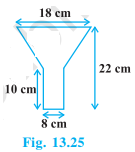
An oil funnel made of a tin sheet consists of a 10 cm long cylindrical portion attached to a frustum of a cone. If the total height is 22 cm, the diameter of the cylindrical portion is 8 cm, and the diameter of the top of the funnel is 18 cm, find the area of the tin sheet required to make the funnel (see Fig.).

Ncert solutions class 10 chapter 13-36

Show solutionHide solution
Worked solution

Given,

Diameter of the upper circular end of the frustum part = 18 cm

So, radius (r1) = 9 cm

Now, the radius of the lower circular end of the frustum (r2) will be equal to the radius of the circular end of the cylinder

So, r2 = 8/2 = 4 cm

Now, height (h1) of the frustum section = 22 – 10 = 12 cm

And,

Height (h2) of cylindrical section = 10 cm (given)

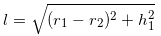
Now, the slant height will be-

Ncert solutions class 10 chapter 13-37

Or, l = 13 cm

Area of tin sheet required = CSA of frustum part + CSA of the cylindrical part

= π(r1+r2)l+2πr2h2

Solving this, we get

Area of tin sheet required = 782 4/7 cm2

Q6Written answer

Derive the formula for the curved surface area and total surface area of the frustum of a cone, given to you in Section 13.5, using the symbols as explained.

Show solutionHide solution
Worked solution

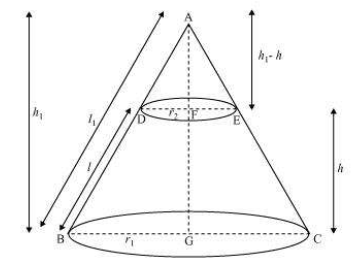
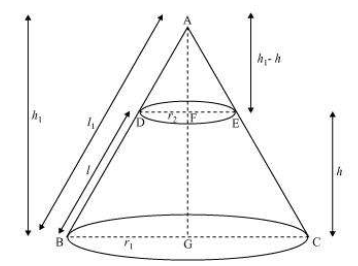
Consider the diagram

Ncert solutions class 10 chapter 13-38

Let ABC be a cone. From the cone, the frustum DECB is cut by a plane parallel to its base. Here, r1 and r2 are the radii of the frustum ends of the cone, and h is the frustum height.

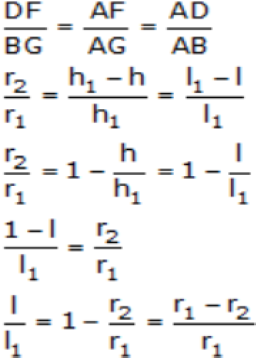
Now, consider the ΔABG and ΔADF,

Here, DF||BG

So, ΔABG ~ ΔADF

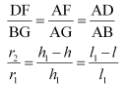
Ncert solutions class 10 chapter 13-39

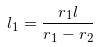
Now, by rearranging, we get

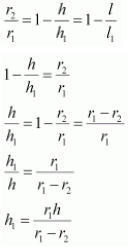
Ncert solutions class 10 chapter 13-40

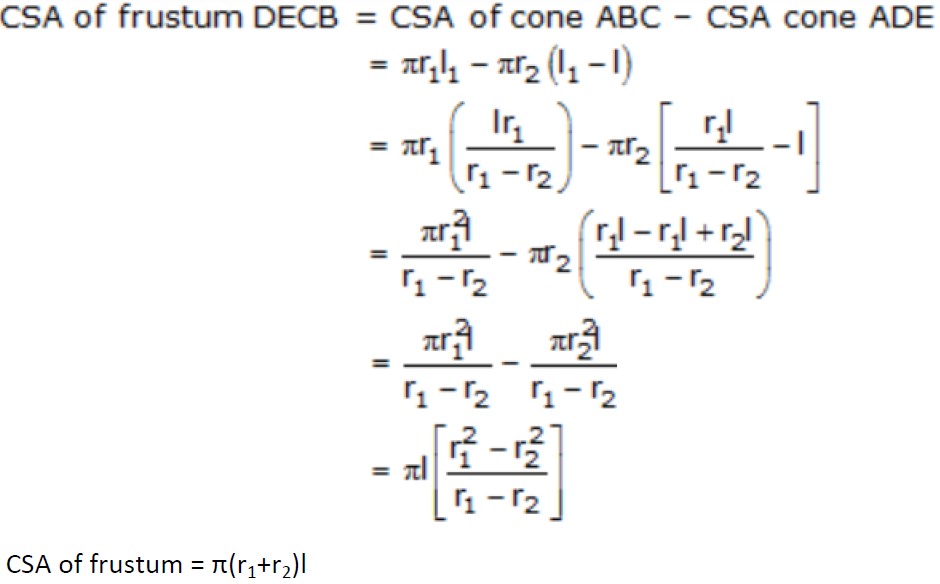
NCERT Solutions for Class 10 Maths Chapter 13 Exercise 13.5 Question Number 6

The total surface area of the frustum will be equal to the total CSA of the frustum + the area of the upper circular end + the area of the lower circular end

= π(r1+r2)l+πr22+πr12

∴ Surface area of frustum = π[(r1+r2)l+r12+r22]

Q7Written answer

Derive the formula for the volume of the frustum of a cone.

Show solutionHide solution
Worked solution

Consider the same diagram as the previous question.

Ncert solutions class 10 chapter 13-41

Now, approach the question in the same way as the previous one and prove that

ΔABG ~ ΔADF

Again,

Ncert solutions class 10 chapter 13-42

Now, rearrange them in terms of h and h1

Ncert solutions class 10 chapter 13-43

The total volume of the frustum of the cone will be = Volume of cone ABC – Volume of cone ADE

= (⅓)πr12h1 -(⅓)πr22(h1 – h)

= (π/3)[r12h1-r22(h1 – h)]

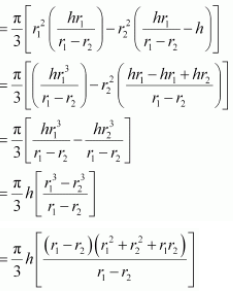
Ncert solutions class 10 chapter 13-44

Now, solving this, we get

∴ The volume of frustum of the cone = (⅓)πh(r12+r22+r1r2)