My Cart
Your Cart 0

    Your cart is empty.

  • Total (Amount) ₹0.00
NCERT · Class 10 · Maths

Chapter 8: Introduction to Trigonometry

Practice each question, then open the answer or worked solution.

Exercise 8.1

11 questions
Q1Written answer

In $\Delta ABC$ right angled at $B$, $AB=24\text{ cm}$, $BC=7\text{ cm}$. Determine 

i) $\sin A,\cos A$ 

ii) $\sin C,\cos C$ 

Show solutionHide solution
Worked solution

Ans: Given that in the right angle triangle $\Delta ABC$, $AB=24\text{ cm}$, $BC=7\text{ cm}$.

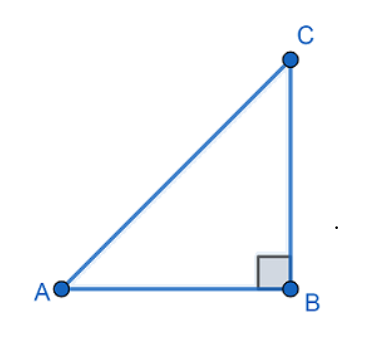
Let us draw a right triangle $\Delta ABC$, also $AB=24\text{ cm}$, $BC=7\text{ cm}$. We get
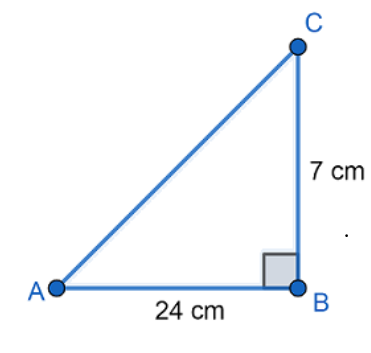
seo images


We have to find $\sin A,\cos A$.

We know that for right triangle

$\sin \theta =\dfrac{\text{opposite side}}{\text{hypotenuse}}$ and 

$\cos \theta =\dfrac{\text{adjacent side}}{\text{hypotenuse}}$

Now, we need to apply the Pythagoras theorem to find the measure of hypotenuse.

In $\Delta ABC$, by Pythagoras theorem ,

${{\left( \text{hypotenuse} \right)}^{2}}={{\left( base \right)}^{2}}+{{\left( perpendicular \right)}^{2}}$ 

Here, $AB=24\text{ cm}$, $BC=7\text{ cm}$

We get

$\Rightarrow {{\left( \text{AC} \right)}^{2}}={{\left( AB \right)}^{2}}+{{\left( BC \right)}^{2}}$ 

$\Rightarrow {{\left( \text{AC} \right)}^{2}}={{\left( 24 \right)}^{2}}+{{\left( 7 \right)}^{2}}$

$\Rightarrow {{\left( \text{AC} \right)}^{2}}=576+49$

$\Rightarrow {{\left( \text{AC} \right)}^{2}}=625\text{ }c{{m}^{2}}$

$\Rightarrow AC=25\text{ cm}$ 

Now, 

$\sin \theta =\dfrac{\text{opposite side}}{\text{hypotenuse}}$ 

$\Rightarrow \sin A=\dfrac{BC}{AC}$ 

$\therefore \sin A=\dfrac{7}{25}$

$\cos \theta =\dfrac{\text{adjacent side}}{\text{hypotenuse}}$

$\Rightarrow \cos A=\dfrac{AB}{AC}$

$\therefore \cos A=\dfrac{24}{25}$

Ans: Given that in the right angle triangle $\Delta ABC$, $AB=24\text{ cm}$, $BC=7\text{ cm}$.

Let us draw a right triangle $\Delta ABC$, also $AB=24\text{ cm}$, $BC=7\text{ cm}$. We get

seo images

We have to find $\sin C,\cos C$.

We know that for right triangle

$\sin \theta =\dfrac{\text{opposite side}}{\text{hypotenuse}}$ and 

$\cos \theta =\dfrac{\text{adjacent side}}{\text{hypotenuse}}$

Now, we need to apply the Pythagoras theorem to find the measure of hypotenuse.

In $\Delta ABC$, by Pythagoras theorem ,

${{\left( \text{hypotenuse} \right)}^{2}}={{\left( base \right)}^{2}}+{{\left( perpendicular \right)}^{2}}$ 

Here, $AB=24\text{ cm}$, $BC=7\text{ cm}$

We get

$\Rightarrow {{\left( \text{AC} \right)}^{2}}={{\left( AB \right)}^{2}}+{{\left( BC \right)}^{2}}$ 

$\Rightarrow {{\left( \text{AC} \right)}^{2}}={{\left( 24 \right)}^{2}}+{{\left( 7 \right)}^{2}}$

$\Rightarrow {{\left( \text{AC} \right)}^{2}}=576+49$

$\Rightarrow {{\left( \text{AC} \right)}^{2}}=625\text{ }c{{m}^{2}}$

$\Rightarrow AC=25\text{ cm}$

Now, 

$\sin \theta =\dfrac{\text{opposite side}}{\text{hypotenuse}}$ 

$\Rightarrow \sin C=\dfrac{AB}{AC}$ 

$\therefore \sin C=\dfrac{24}{25}$

$\cos \theta =\dfrac{\text{adjacent side}}{\text{hypotenuse}}$

$\Rightarrow \cos C=\dfrac{BC}{AC}$

$\therefore \cos A=\dfrac{7}{25}$
Q2Written answer

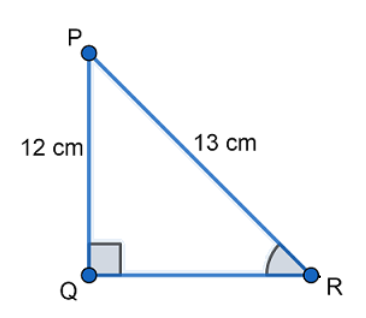
In the given figure find $\tan P-\cot R$.

seo images


Show solutionHide solution
Worked solution

Ans: Given in the figure, 

$PQ=12\text{ cm}$ 

$PQ=13\text{ cm}$

We know that for right triangle

$\tan \theta =\dfrac{\text{opposite side}}{\text{adjacent side}}$ and 

$\cot \theta =\dfrac{\text{adjacent side}}{\text{opposite side}}$

Now, we need to apply the Pythagoras theorem to find the measure of adjacent side/base.

In $\Delta PQR$, by Pythagoras theorem ,

${{\left( \text{hypotenuse} \right)}^{2}}={{\left( base \right)}^{2}}+{{\left( perpendicular \right)}^{2}}$ 

We get

$\Rightarrow {{\left( PR \right)}^{2}}={{\left( PQ \right)}^{2}}+{{\left( QR \right)}^{2}}$ 

$\Rightarrow {{\left( 13 \right)}^{2}}={{\left( 12 \right)}^{2}}+{{\left( QR \right)}^{2}}$

$\Rightarrow 169=144+{{\left( QR \right)}^{2}}$

$\Rightarrow {{\left( QR \right)}^{2}}=169-144$

$\Rightarrow {{\left( QR \right)}^{2}}=25\text{ }c{{m}^{2}}$

$\Rightarrow QR=5\text{ cm}$ 

Now, 

$\tan P=\dfrac{\text{opposite side}}{\text{adjacent side}}$ 

$\Rightarrow \tan P=\dfrac{QR}{PQ}$ 

$\therefore \tan P=\dfrac{5}{12}$

$\cot R=\dfrac{\text{adjacent side}}{\text{opposite side}}$

$\Rightarrow \cot R=\dfrac{QR}{PQ}$

$\therefore \cot R=\dfrac{5}{12}$

$\Rightarrow \tan P-\cot R=\dfrac{5}{12}-\dfrac{5}{12}$

$\therefore \tan P-\cot R=0$

Q3Written answer

If $\sin A=\dfrac{3}{4}$, calculate $\cos A$ and $\tan A$.

Show solutionHide solution
Worked solution

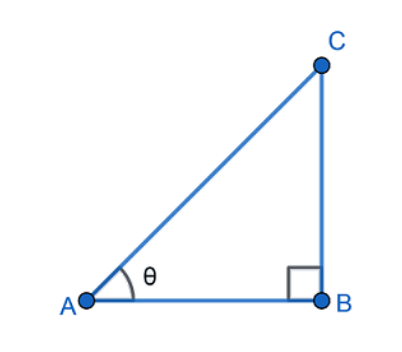
Ans: Let us consider a right angled triangle $\Delta ABC$. We get

seo images


Given that $\sin A=\dfrac{3}{4}$.

We know that  $\sin \theta =\dfrac{\text{opposite side}}{\text{hypotenuse}}$.

From the above figure, we get

$\sin A=\dfrac{BC}{AC}$

Therefore, we get

$\Rightarrow BC=3$ and

$\Rightarrow AC=4$ 

Now, we have to find the values of $\cos A$ and $\tan A$.

We know that $\cos \theta =\dfrac{\text{adjacent side}}{\text{hypotenuse}}$ and $\tan \theta =\dfrac{\text{opposite side}}{\text{adjacent side}}$.

Now, we need to apply the Pythagoras theorem to find the measure of adjacent side/base.

In $\Delta ABC$, by Pythagoras theorem ,

${{\left( \text{hypotenuse} \right)}^{2}}={{\left( base \right)}^{2}}+{{\left( perpendicular \right)}^{2}}$ 

Here, $AC=4\text{ cm}$, $BC=3\text{ cm}$

We get

$\Rightarrow {{\left( \text{AC} \right)}^{2}}={{\left( AB \right)}^{2}}+{{\left( BC \right)}^{2}}$ 

$\Rightarrow {{4}^{2}}=A{{B}^{2}}+{{3}^{2}}$

$\Rightarrow 16=A{{B}^{2}}+9$

$\Rightarrow A{{B}^{2}}=16-9$

$\Rightarrow A{{B}^{2}}=7$

$\Rightarrow AB=\sqrt{7}\text{ cm}$

Now, we get

$\cos A=\dfrac{AB}{AC}$ 

$\therefore \cos A=\dfrac{\sqrt{7}}{4}$ 

And $\tan A=\dfrac{BC}{AB}$

$\therefore \tan A=\dfrac{3}{\sqrt{7}}$

Q4Written answer

Given $15\cot A=8$. Find $\sin A$ and $\sec A$.

Show solutionHide solution
Worked solution

Ans: Let us consider a right angled triangle $\Delta ABC$. We get

seo images


Given that $15\cot A=8$.

We get $\cot A=\dfrac{8}{15}$.

We know that $\cot \theta =\dfrac{\text{adjacent side}}{\text{opposite side}}$.

From the above figure, we get

$\cot A=\dfrac{AB}{BC}$

Therefore, we get

$\Rightarrow BC=15$ and

$\Rightarrow AB=8$ 

Now, we have to find the values of $\sin A$ and $\sec A$.

We know that $\sin \theta =\dfrac{\text{opposite side}}{\text{hypotenuse}}$ and $\sec \theta =\dfrac{\text{hypotenuse}}{\text{adjacent side}}$.

Now, we need to apply the Pythagoras theorem to find the measure of hypotenuse.

In $\Delta ABC$, by Pythagoras theorem ,

${{\left( \text{hypotenuse} \right)}^{2}}={{\left( base \right)}^{2}}+{{\left( perpendicular \right)}^{2}}$ 

We get

$\Rightarrow {{\left( \text{AC} \right)}^{2}}={{\left( AB \right)}^{2}}+{{\left( BC \right)}^{2}}$ 

$\Rightarrow A{{C}^{2}}={{8}^{2}}+{{15}^{2}}$

$\Rightarrow A{{C}^{2}}=64+225$

$\Rightarrow A{{C}^{2}}=289$

$\Rightarrow AC=17\text{ cm}$

Now, we get

$\sin A=\dfrac{BC}{AC}$ 

$\therefore \sin A=\dfrac{15}{17}$ 

And $\sec A=\dfrac{AC}{AB}$

$\therefore \sec A=\dfrac{17}{8}$

Q5Written answer

Given $\sec \theta =\dfrac{13}{12}$, calculate all other trigonometric ratios.

Show solutionHide solution
Worked solution

Ans: Let us consider a right angled triangle $\Delta ABC$. We get

seo images


Given that $\sec \theta =\dfrac{13}{12}$.

We know that $\sec \theta =\dfrac{\text{hypotenuse}}{\text{adjacent side}}$.

From the above figure, we get

$\sec \theta =\dfrac{AC}{AB}$

Therefore, we get

$\Rightarrow AC=13$ and

$\Rightarrow AB=12$ 

Now, we need to apply the Pythagoras theorem to find the measure of the perpendicular/opposite side.

In $\Delta ABC$, by Pythagoras theorem ,

${{\left( \text{hypotenuse} \right)}^{2}}={{\left( base \right)}^{2}}+{{\left( perpendicular \right)}^{2}}$ 

We get

$\Rightarrow {{\left( \text{AC} \right)}^{2}}={{\left( AB \right)}^{2}}+{{\left( BC \right)}^{2}}$ 

$\Rightarrow {{13}^{2}}={{12}^{2}}+B{{C}^{2}}$

$\Rightarrow 169=144+B{{C}^{2}}$

$\Rightarrow B{{C}^{2}}=25$

$\Rightarrow BC=5\text{ cm}$

Now, we know that

$\sin \theta =\dfrac{\text{opposite side}}{\text{hypotenuse}}$

Here, $\sin \theta =\dfrac{BC}{AC}$ 

$\therefore \sin \theta =\dfrac{5}{13}$ 

We know that $\cos \theta =\dfrac{\text{adjacent side}}{\text{hypotenuse}}$

Here, $\cos \theta =\dfrac{AB}{AC}$ 

$\therefore \cos \theta =\dfrac{12}{13}$

We know that $\tan \theta =\dfrac{\text{opposite side}}{\text{adjacent side}}$

Here, $\tan \theta =\dfrac{BC}{AB}$ 

$\therefore \tan \theta =\dfrac{5}{12}$

We know that $\operatorname{cosec}\theta =\dfrac{\text{hypotenuse}}{\text{opposite side}}$

Here, $\operatorname{cosec}\theta =\dfrac{AC}{BC}$

$\therefore \operatorname{cosec}\theta =\dfrac{13}{5}$

We know that $\cot \theta =\dfrac{\text{adjacent side}}{\text{opposite side}}$

Here, $\cot \theta =\dfrac{\text{AB}}{BC}$

\[\therefore \cot \theta =\dfrac{12}{5}\].

Q6Written answer

If $\angle A$ and $\angle B$ are acute angles such that $\cos A=\cos B$, then show that $\angle A=\angle B$.

Show solutionHide solution
Worked solution

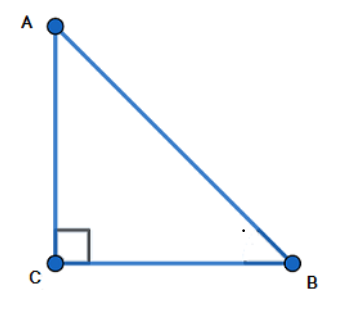
Ans: Let us consider a right angled triangle $\Delta ABC$. We get

seo images


Given that $\cos A=\cos B$.

In a right triangle $\Delta ABC$, we know that 

$\cos \theta =\dfrac{\text{adjacent side}}{\text{hypotenuse}}$

Here, 

$\cos A=\dfrac{AC}{AB}$ 

And $\cos B=\dfrac{BC}{AB}$ 

As given $\cos A=\cos B$, we get

$\Rightarrow \dfrac{AC}{AB}=\dfrac{BC}{AB}$ 

$\Rightarrow AC=AB$ 

Now, we know that angles opposite to the equal sides are also equal in measure.

Then, we get

$\angle A=\angle B$ 

Hence proved.


Q7Written answer

Evaluate the following if $\cot \theta =\dfrac{7}{8}$

i) $\dfrac{\left( 1+\sin \theta  \right)\left( 1-\sin \theta  \right)}{\left( 1+\cos \theta  \right)\left( 1-\cos \theta  \right)}$ 

ii) ${{\cot }^{2}}\theta $ 

Show solutionHide solution
Worked solution

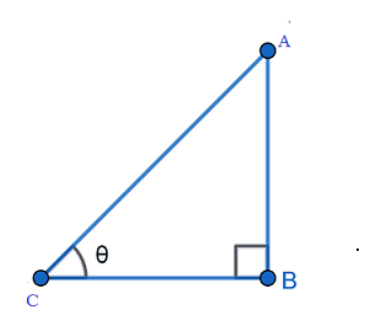
Ans: Let us consider a right angled triangle $\Delta ABC$. We get

seo images

Now, in a right triangle we know that $\cot \theta =\dfrac{\text{adjacent side}}{\text{opposite side}}$.

Here, from the figure $\cot \theta =\dfrac{BC}{AB}$ .

We get

$AB=8$ and 

$BC=7$ 

Now, we need to apply the Pythagoras theorem to find the measure of hypotenuse.

In $\Delta ABC$, by Pythagoras theorem ,

${{\left( \text{hypotenuse} \right)}^{2}}={{\left( base \right)}^{2}}+{{\left( perpendicular \right)}^{2}}$ 

We get

$\Rightarrow {{\left( \text{AC} \right)}^{2}}={{\left( AB \right)}^{2}}+{{\left( BC \right)}^{2}}$ 

$\Rightarrow {{\left( \text{AC} \right)}^{2}}={{8}^{2}}+{{7}^{2}}$

$\Rightarrow {{\left( \text{AC} \right)}^{2}}=64+49$

$\Rightarrow {{\left( \text{AC} \right)}^{2}}=113$

$\Rightarrow AC=\sqrt{113}$ 

Now, we know that 

$\sin \theta =\dfrac{\text{opposite side}}{\text{hypotenuse}}$

Here, we get

$\sin \theta =\dfrac{AB}{AC}=\dfrac{8}{\sqrt{113}}$ and 

$\cos \theta =\dfrac{\text{adjacent side}}{\text{hypotenuse}}$

Here, we get

$\cos \theta =\dfrac{BC}{AC}=\dfrac{7}{\sqrt{113}}$ 

Now, we have to evaluate 

$\dfrac{\left( 1+\sin \theta  \right)\left( 1-\sin \theta  \right)}{\left( 1+\cos \theta  \right)\left( 1-\cos \theta  \right)}$

Applying the identity $\left( a+b \right)\left( a-b \right)={{a}^{2}}-{{b}^{2}}$, we get

\[\Rightarrow \dfrac{\left( 1+\sin \theta  \right)\left( 1-\sin \theta  \right)}{\left( 1+\cos \theta  \right)\left( 1-\cos \theta  \right)}=\dfrac{1-{{\sin }^{2}}\theta }{1-{{\cos }^{2}}\theta }\] 

Substituting the values, we get

\[\Rightarrow \dfrac{\left( 1+\sin \theta  \right)\left( 1-\sin \theta  \right)}{\left( 1+\cos \theta  \right)\left( 1-\cos \theta  \right)}=\dfrac{1-{{\left( \dfrac{8}{\sqrt{113}} \right)}^{2}}}{1-{{\left( \dfrac{7}{\sqrt{113}} \right)}^{2}}}\]

\[\Rightarrow \dfrac{\left( 1+\sin \theta  \right)\left( 1-\sin \theta  \right)}{\left( 1+\cos \theta  \right)\left( 1-\cos \theta  \right)}=\dfrac{1-\dfrac{64}{113}}{1-\dfrac{49}{113}}\]

\[\Rightarrow \dfrac{\left( 1+\sin \theta  \right)\left( 1-\sin \theta  \right)}{\left( 1+\cos \theta  \right)\left( 1-\cos \theta  \right)}=\dfrac{\dfrac{113-64}{113}}{\dfrac{113-49}{113}}\]

\[\Rightarrow \dfrac{\left( 1+\sin \theta  \right)\left( 1-\sin \theta  \right)}{\left( 1+\cos \theta  \right)\left( 1-\cos \theta  \right)}=\dfrac{\dfrac{49}{113}}{\dfrac{64}{113}}\]

\[\therefore \dfrac{\left( 1+\sin \theta  \right)\left( 1-\sin \theta  \right)}{\left( 1+\cos \theta  \right)\left( 1-\cos \theta  \right)}=\dfrac{49}{64}\]

Ans: Given that $\cot \theta =\dfrac{7}{8}$.

Now, ${{\cot }^{2}}\theta ={{\left( \dfrac{7}{8} \right)}^{2}}$

$\therefore {{\cot }^{2}}\theta =\dfrac{49}{64}$

Q8Written answer

If $3\cot A=4$, check whether $\dfrac{1-{{\tan }^{2}}A}{1+{{\tan }^{2}}A}={{\cos }^{2}}A-{{\sin }^{2}}A$ or not.

Show solutionHide solution
Worked solution

Ans: Let us consider a right angled triangle $\Delta ABC$. We get

seo images


Given that $3\cot A=4$.

We get $\cot A=\dfrac{4}{3}$.

We know that $\cot \theta =\dfrac{\text{adjacent side}}{\text{opposite side}}$.

From the above figure, we get

$\cot A=\dfrac{AB}{BC}$

Therefore, we get

$\Rightarrow BC=3$ and

$\Rightarrow AB=4$ 

Now, we need to apply the Pythagoras theorem to find the measure of hypotenuse.

In $\Delta ABC$, by Pythagoras theorem ,

${{\left( \text{hypotenuse} \right)}^{2}}={{\left( base \right)}^{2}}+{{\left( perpendicular \right)}^{2}}$ 

We get

$\Rightarrow {{\left( \text{AC} \right)}^{2}}={{\left( AB \right)}^{2}}+{{\left( BC \right)}^{2}}$ 

$\Rightarrow A{{C}^{2}}={{4}^{2}}+{{3}^{2}}$

$\Rightarrow A{{C}^{2}}=16+9$

$\Rightarrow A{{C}^{2}}=25$

$\Rightarrow AC=5$

Now, let us consider LHS of the expression $\dfrac{1-{{\tan }^{2}}A}{1+{{\tan }^{2}}A}={{\cos }^{2}}A-{{\sin }^{2}}A$, we get

$LHS=\dfrac{1-{{\tan }^{2}}A}{1+{{\tan }^{2}}A}$

Now, we know that $\tan \theta =\dfrac{\text{opposite side}}{\text{adjacent side}}$

Here, we get

$\tan A=\dfrac{BC}{AB}=\dfrac{3}{4}$ 

Substitute the value, we get

$\Rightarrow \dfrac{1-{{\tan }^{2}}A}{1+{{\tan }^{2}}A}=\dfrac{1-{{\left( \dfrac{3}{4} \right)}^{2}}}{1+{{\left( \dfrac{3}{4} \right)}^{2}}}$

$\Rightarrow \dfrac{1-{{\tan }^{2}}A}{1+{{\tan }^{2}}A}=\dfrac{1-\dfrac{9}{16}}{1+\dfrac{9}{16}}$

$\Rightarrow \dfrac{1-{{\tan }^{2}}A}{1+{{\tan }^{2}}A}=\dfrac{\dfrac{16-9}{16}}{\dfrac{16+9}{16}}$

$\Rightarrow \dfrac{1-{{\tan }^{2}}A}{1+{{\tan }^{2}}A}=\dfrac{\dfrac{7}{16}}{\dfrac{25}{16}}$

$\Rightarrow \dfrac{1-{{\tan }^{2}}A}{1+{{\tan }^{2}}A}=\dfrac{7}{25}$

Now, let us consider RHS of the expression $\dfrac{1-{{\tan }^{2}}A}{1+{{\tan }^{2}}A}={{\cos }^{2}}A-{{\sin }^{2}}A$, we get

$RHS={{\cos }^{2}}A-{{\sin }^{2}}A$

We know that $\sin \theta =\dfrac{\text{opposite side}}{\text{hypotenuse}}$ and $\cos \theta =\dfrac{\text{adjacent side}}{\text{hypotenuse}}$.

Here, we get

$\sin A=\dfrac{BC}{AC}=\dfrac{3}{5}$  

And $\cos A=\dfrac{AB}{AC}=\dfrac{4}{5}$

Substitute the values, we get

$\Rightarrow {{\cos }^{2}}A-{{\sin }^{2}}A={{\left( \dfrac{4}{5} \right)}^{2}}-{{\left( \dfrac{3}{5} \right)}^{2}}$

$\Rightarrow {{\cos }^{2}}A-{{\sin }^{2}}A=\dfrac{16}{25}-\dfrac{9}{25}$

$\Rightarrow {{\cos }^{2}}A-{{\sin }^{2}}A=\dfrac{7}{25}$

Hence, we get LHS=RHS

$\therefore \dfrac{1-{{\tan }^{2}}A}{1+{{\tan }^{2}}A}={{\cos }^{2}}A-{{\sin }^{2}}A$.


Q9Written answer

In $ABC$, right angled at $B$. If $\tan A=\dfrac{1}{\sqrt{3}}$, find the value of 

i) $\sin A\cos C+\cos A\sin C$ 

ii) $\cos A\cos C-\sin A\sin C$

Show solutionHide solution
Worked solution

Ans: Let us consider a right angled triangle $\Delta ABC$. We get

seo images


Given that $\tan A=\dfrac{1}{\sqrt{3}}$.

In a right triangle, we know that $\tan \theta =\dfrac{\text{opposite side}}{\text{adjacent side}}$

Here, from the figure we get

$\tan A=\dfrac{BC}{AB}=\dfrac{1}{\sqrt{3}}$

We get $BC=1$ and $AB=\sqrt{3}$ .

Now, we need to apply the Pythagoras theorem to find the measure of hypotenuse.

In $\Delta ABC$, by Pythagoras theorem ,

${{\left( \text{hypotenuse} \right)}^{2}}={{\left( base \right)}^{2}}+{{\left( perpendicular \right)}^{2}}$ 

We get

$\Rightarrow {{\left( \text{AC} \right)}^{2}}={{\left( AB \right)}^{2}}+{{\left( BC \right)}^{2}}$ 

$\Rightarrow A{{C}^{2}}={{\left( \sqrt{3} \right)}^{2}}+{{1}^{2}}$

$\Rightarrow A{{C}^{2}}=3+1$

$\Rightarrow A{{C}^{2}}=4$

$\Rightarrow AC=2$

We know that $\sin \theta =\dfrac{\text{opposite side}}{\text{hypotenuse}}$ and $\cos \theta =\dfrac{\text{adjacent side}}{\text{hypotenuse}}$.

Here, we get

$\sin A=\dfrac{BC}{AC}=\dfrac{1}{2}$  and $\sin C=\dfrac{AB}{AC}=\dfrac{\sqrt{3}}{2}$

And $\cos A=\dfrac{AB}{AC}=\dfrac{\sqrt{3}}{2}$and $\cos C=\dfrac{BC}{AC}=\dfrac{1}{2}$

Now, we have to find the value of the expression $\sin A\cos C+\cos A\sin C$.

Substituting the values we get

$\Rightarrow \sin A\cos C+\cos A\sin C=\dfrac{1}{2}\times \dfrac{1}{2}+\dfrac{\sqrt{3}}{2}\times \dfrac{\sqrt{3}}{2}$ 

$\Rightarrow \sin A\cos C+\cos A\sin C=\dfrac{1}{4}+\dfrac{3}{4}$

$\Rightarrow \sin A\cos C+\cos A\sin C=\dfrac{4}{4}$

$\therefore \sin A\cos C+\cos A\sin C=1$

Ans: Let us consider a right angled triangle $\Delta ABC$. We get

seo images

Given that $\tan A=\dfrac{1}{\sqrt{3}}$.

In a right triangle, we know that $\tan \theta =\dfrac{\text{opposite side}}{\text{adjacent side}}$

Here, from the figure we get

$\tan A=\dfrac{BC}{AB}=\dfrac{1}{\sqrt{3}}$

We get $BC=1$ and $AB=\sqrt{3}$ .

Now, we need to apply the Pythagoras theorem to find the measure of hypotenuse.

In $\Delta ABC$, by Pythagoras theorem ,

${{\left( \text{hypotenuse} \right)}^{2}}={{\left( base \right)}^{2}}+{{\left( perpendicular \right)}^{2}}$ 

We get

$\Rightarrow {{\left( \text{AC} \right)}^{2}}={{\left( AB \right)}^{2}}+{{\left( BC \right)}^{2}}$ 

$\Rightarrow A{{C}^{2}}={{\left( \sqrt{3} \right)}^{2}}+{{1}^{2}}$

$\Rightarrow A{{C}^{2}}=3+1$

$\Rightarrow A{{C}^{2}}=4$

$\Rightarrow AC=2$

We know that $\sin \theta =\dfrac{\text{opposite side}}{\text{hypotenuse}}$ and $\cos \theta =\dfrac{\text{adjacent side}}{\text{hypotenuse}}$.

Here, we get

$\sin A=\dfrac{BC}{AC}=\dfrac{1}{2}$  and $\sin C=\dfrac{AB}{AC}=\dfrac{\sqrt{3}}{2}$

And $\cos A=\dfrac{AB}{AC}=\dfrac{\sqrt{3}}{2}$and $\cos C=\dfrac{BC}{AC}=\dfrac{1}{2}$

Now, we have to find the value of the expression $\cos A\cos C-\sin A\sin C$.

Substituting the values we get

$\Rightarrow \cos A\cos C-\sin A\sin C=\dfrac{\sqrt{3}}{2}\times \dfrac{1}{2}-\dfrac{1}{2}\times \dfrac{\sqrt{3}}{2}$ 

$\Rightarrow \cos A\cos C-\sin A\sin C=\dfrac{\sqrt{3}}{4}-\dfrac{\sqrt{3}}{4}$

$\therefore \Rightarrow \cos A\cos C-\sin A\sin C=0$


Q10Written answer

In $\Delta PQR$, right angled at $Q$, $PR+QR=25\text{ cm}$ and $PQ=5\text{ cm}$. Determine the values of $\sin P,\cos P$ and $\tan P$.

Show solutionHide solution
Worked solution

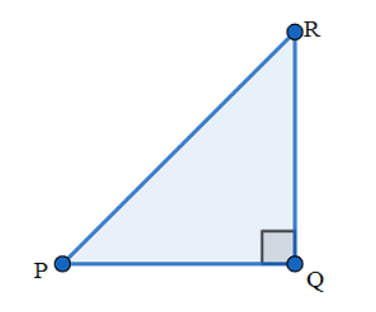
Ans: Let us consider a right angled triangle $\Delta PQR$, we get

seo images

Given that $PR+QR=25\text{ cm}$ and $PQ=5\text{ cm}$.

Let $QR=25-PR$

Now, applying the Pythagoras theorem in $\Delta PQR$, we get

${{\left( \text{hypotenuse} \right)}^{2}}={{\left( base \right)}^{2}}+{{\left( perpendicular \right)}^{2}}$ 

We get

$\Rightarrow {{\left( PR \right)}^{2}}={{\left( PQ \right)}^{2}}+{{\left( QR \right)}^{2}}$ 

$\Rightarrow P{{R}^{2}}={{5}^{2}}+{{\left( 25-PR \right)}^{2}}$

$\Rightarrow P{{R}^{2}}=25+{{25}^{2}}+P{{R}^{2}}-50PR$

$\Rightarrow P{{R}^{2}}=P{{R}^{2}}+25+625-50PR$

$\Rightarrow 50PR=650$

$\Rightarrow PR=13\text{ cm}$ 

Therefore, 

$QR=25-13$

$\Rightarrow QR=12\text{ cm}$ 

Now, we know that in right triangle,

$\sin \theta =\dfrac{\text{opposite side}}{\text{hypotenuse}}$, $\cos \theta =\dfrac{\text{adjacent side}}{\text{hypotenuse}}$ and $\tan \theta =\dfrac{\text{opposite side}}{\text{adjacent side}}$.

Here, we get

$\sin P=\dfrac{QR}{PR}$ 

$\therefore \sin P=\dfrac{12}{13}$ 

$\cos P=\dfrac{PQ}{PR}$ 

$\therefore \cos P=\dfrac{5}{13}$ 

$\tan P=\dfrac{QR}{PQ}$ 

$\therefore \tan P=\dfrac{12}{5}$