My Cart
Your Cart 0

    Your cart is empty.

  • Total (Amount) ₹0.00
NCERT · Class 10 · Maths

Chapter 12: Surface Areas and Volumes

Practice each question, then open the answer or worked solution.

Exercise: 13.1 (

8 questions
Q1Written answer

2 cubes each of volume 64 cm3 are joined end to end. Find the surface area of the resulting cuboid.

Show solutionHide solution
Worked solution

The diagram is given as:
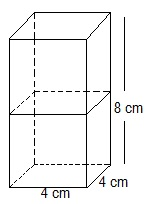
Ncert solutions class 10 chapter 13-1

Given,

The Volume (V) of each cube is = 64 cm3

This implies that a3 = 64 cm3

∴ a = 4 cm

Now, the side of the cube = a = 4 cm

Also, the length and breadth of the resulting cuboid will be 4 cm each, while its height will be 8 cm.

So, the surface area of the cuboid = 2(lb+bh+lh)

= 2(8×4+4×4+4×8) cm2

= 2(32+16+32) cm2

= (2×80) cm2 = 160 cm2
Q2Written answer

A vessel is in the form of a hollow hemisphere mounted by a hollow cylinder. The diameter of the hemisphere is 14 cm, and the total height of the vessel is 13 cm. Find the inner surface area of the vessel.

Show solutionHide solution
Worked solution

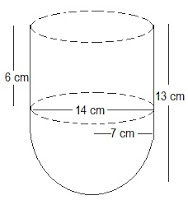
The diagram is as follows:

Ncert solutions class 10 chapter 13-2

Now, the given parameters are:

The diameter of the hemisphere = D = 14 cm

The radius of the hemisphere = r = 7 cm

Also, the height of the cylinder = h = (13-7) = 6 cm

And the radius of the hollow hemisphere = 7 cm

Now, the inner surface area of the vessel = CSA of the cylindrical part + CSA of the hemispherical part

(2πrh+2πr2) cm2 = 2πr(h+r) cm2

2×(22/7)×7(6+7) cm2 = 572 cm2

Q3Written answer

A toy is in the form of a cone of radius 3.5 cm mounted on a hemisphere of the same radius. The total height of the toy is 15.5 cm. Find the total surface area of the toy.

Show solutionHide solution
Worked solution

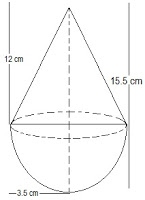
The diagram is as follows:

Ncert solutions class 10 chapter 13-3

Given that the radius of the cone and the hemisphere (r) = 3.5 cm or 7/2 cm

The total height of the toy is given as 15.5 cm.

So, the height of the cone (h) = 15.5-3.5 = 12 cm

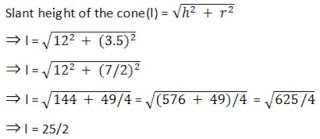
Ncert solutions class 10 chapter 13-4

∴ The curved surface area of the cone = πrl

(22/7)×(7/2)×(25/2) = 275/2 cm2

Also, the curved surface area of the hemisphere = 2πr2

2×(22/7)×(7/2)2

= 77 cm2

Now, the Total surface area of the toy = CSA of the cone + CSA of the hemisphere

= (275/2)+77 cm2

= (275+154)/2 cm2

= 429/2 cm2 = 214.5cm2

So, the total surface area (TSA) of the toy is 214.5cm2

Q4Written answer

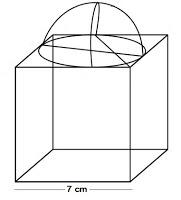
A cubical block of side 7 cm is surmounted by a hemisphere. What is the greatest diameter the hemisphere can have? Find the surface area of the solid.

Show solutionHide solution
Worked solution

It is given that each side of the cube is 7 cm. So, the radius will be 7/2 cm.

Ncert solutions class 10 chapter 13-5

We know,

The total surface area of solid (TSA) = surface area of the cubical block + CSA of the hemisphere – Area of the base of the hemisphere

∴ TSA of solid = 6×(side)2+2πr2-πr2

= 6×(side)2+πr2

= 6×(7)2+(22/7)×(7/2)×(7/2)

= (6×49)+(77/2)

= 294+38.5 = 332.5 cm2

So, the surface area of the solid is 332.5 cm2

Q5Written answer

A hemispherical depression is cut out from one face of a cubical wooden block such that the diameter l of the hemisphere is equal to the edge of the cube. Determine the surface area of the remaining solid.

Show solutionHide solution
Worked solution

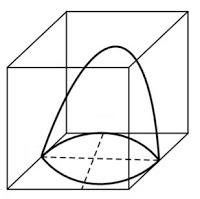
The diagram is as follows:

Ncert solutions class 10 chapter 13-6

Now, the diameter of the hemisphere = Edge of the cube = l

So, the radius of the hemisphere = l/2

∴ The total surface area of solid = surface area of cube + CSA of the hemisphere – Area of the base of the hemisphere

The surface area of the remaining solid = 6 (edge)2+2πr2-πr2

= 6l2 + πr2

= 6l2+π(l/2)2

= 6l2+πl2/4

= l2/4(24+π) sq. units

Q6Written answer

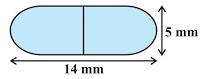
A medicine capsule is in the shape of a cylinder with two hemispheres stuck to each of its ends. The length of the entire capsule is 14 mm, and the diameter of the capsule is 5 mm. Find its surface area.

Ncert solutions class 10 chapter 13-7

Show solutionHide solution
Worked solution

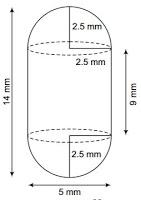
Two hemispheres and one cylinder are shown in the figure given below.

Ncert solutions class 10 chapter 13-8

Here, the diameter of the capsule = 5 mm

∴ Radius = 5/2 = 2.5 mm

Now, the length of the capsule = 14 mm

So, the length of the cylinder = 14-(2.5+2.5) = 9 mm

∴ The surface area of a hemisphere = 2πr2 = 2×(22/7)×2.5×2.5

= 275/7 mm2

Now, the surface area of the cylinder = 2πrh

= 2×(22/7)×2.5×9

(22/7)×45 = 990/7 mm2

Thus, the required surface area of the medicine capsule will be

= 2×surface area of hemisphere + surface area of the cylinder

= (2×275/7) × 990/7

= (550/7) + (990/7) = 1540/7 = 220 mm2

Q7Written answer

A tent is in the shape of a cylinder surmounted by a conical top. If the height and diameter of the cylindrical part are 2.1 m and 4 m, respectively, and the slant height of the top is 2.8 m, find the area of the canvas used for making the tent. Also, find the cost of the canvas of the tent at the rate of Rs 500 per m2. (Note that the base of the tent will not be covered with canvas.)

Show solutionHide solution
Worked solution

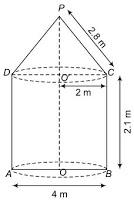
It is known that a tent is a combination of a cylinder and a cone.

Ncert solutions class 10 chapter 13-9

From the question, we know that

Diameter = 4 m

The slant height of the cone (l) = 2.8 m

Radius of the cone (r) = Radius of cylinder = 4/2 = 2 m

Height of the cylinder (h) = 2.1 m

So, the required surface area of the tent = surface area of the cone + surface area of the cylinder

= πrl+2πrh

= πr(l+2h)

= (22/7)×2(2.8+2×2.1)

= (44/7)(2.8+4.2)

= (44/7)×7 = 44 m2

∴ The cost of the canvas of the tent at the rate of ₹500 per m2 will be

= Surface area × cost per m2

44×500 = ₹22000

So, Rs. 22000 will be the total cost of the canvas.

Q8Written answer

From a solid cylinder whose height is 2.4 cm and diameter is 1.4 cm, a conical cavity of the

same height and same diameter is hollowed out. Find the total surface area of the

remaining solid to the nearest cm2.

Show solutionHide solution
Worked solution

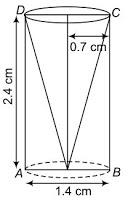
The diagram for the question is as follows:

Ncert solutions class 10 chapter 13-10

From the question, we know the following:

The diameter of the cylinder = diameter of conical cavity = 1.4 cm

So, the radius of the cylinder = radius of the conical cavity = 1.4/2 = 0.7

Also, the height of the cylinder = height of the conical cavity = 2.4 cm

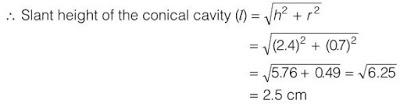
Ncert solutions class 10 chapter 13-11

Now, the TSA of the remaining solid = surface area of conical cavity + TSA of the cylinder

= πrl+(2πrh+πr2)

= πr(l+2h+r)

= (22/7)× 0.7(2.5+4.8+0.7)

= 2.2×8 = 17.6 cm2

So, the total surface area of the remaining solid is 17.6 cm2