My Cart
Your Cart 0

    Your cart is empty.

  • Total (Amount) ₹0.00
NCERT · Class 10 · Maths

Chapter 12: Surface Areas and Volumes

Practice each question, then open the answer or worked solution.

Exercise: 13.3 (

9 questions
Q1Written answer

A metallic sphere of radius 4.2 cm is melted and recast into the shape of a cylinder of radius 6 cm. Find the height of the cylinder.

Show solutionHide solution
Worked solution

It is given that radius of the sphere (R) = 4.2 cm

Also, the radius of the cylinder (r) = 6 cm

Now, let the height of the cylinder = h

It is given that the sphere is melted into a cylinder.

So, the volume of the sphere = Volume of the cylinder

∴ (4/3)×π×R3 = π×r2×h.

h = 2.74 cm
Q2Written answer

Metallic spheres of radii 6 cm, 8 cm and 10 cm, respectively, are melted to form a single solid sphere. Find the radius of the resulting sphere.

Show solutionHide solution
Worked solution

For Sphere 1:

Radius (r1) = 6 cm

∴ Volume (V1) = (4/3)×π×r13

For Sphere 2:

Radius (r2) = 8 cm

∴ Volume (V2) = (4/3)×π×r23

For Sphere 3:

Radius (r3) = 10 cm

∴ Volume (V3) = (4/3)× π× r33

Also, let the radius of the resulting sphere be “r”

Now,

The volume of the resulting sphere = V1+V2+V3

(4/3)×π×r3 = (4/3)×π×r13+(4/3)×π×r23 +(4/3)×π×r33

r3 = 63+83+103

r3 = 1728

r = 12 cm

Q3Written answer

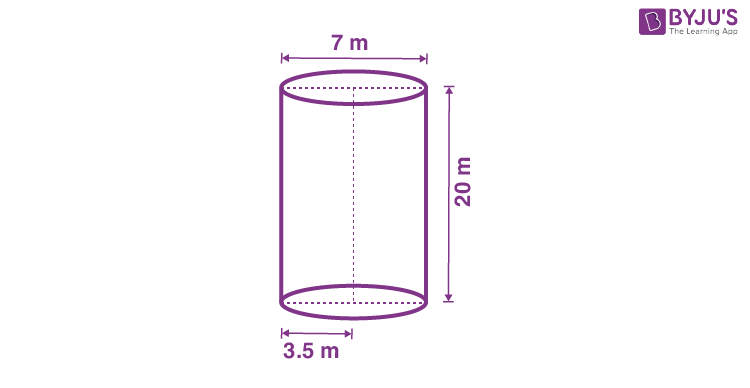
A 20 m deep well with a diameter of 7 m is dug, and the earth from digging is evenly spread out to form a platform 22 m by 14 m. Find the height of the platform.

Show solutionHide solution
Worked solution

NCERT Solutions for Class 10 Maths Chapter 13 Exercise 13.3 Solution 3

It is given that the shape of the well is the shape of a cylinder with a diameter of 7 m

So, radius = 7/2 m

Also, Depth (h) = 20 m

The volume of the earth dug out will be equal to the volume of the cylinder

Let the height of the platform = H

The volume of soil from the well (cylinder) = Volume of soil used to make such a platform

π×r2×h = Area of platform × Height of the platform

We know that the dimension of the platform is = 22×14

So, the Area of the platform = 22×14 m2

∴ π×r2×h = 22×14×H

⇒ H = 2.5 m

Q4Written answer

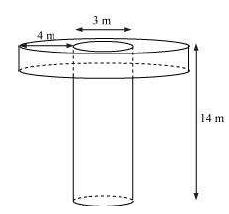
A well of diameter 3 m is dug 14 m deep. The earth taken out of it has been spread evenly all around it in the shape of a circular ring of width 4 m to form an embankment. Find the height of the embankment.

Show solutionHide solution
Worked solution

The shape of the well will be cylindrical, as given below.

Ncert solutions class 10 chapter 13-19

Given, depth (h1) of well = 14 m

Diameter of the circular end of the well =3 m

So, Radius (r1) = 3/2 m

Width of the embankment = 4 m

From the figure, it can be said that the embankment will be a cylinder having an outer radius (r2) as 4+(3/2) = 11/2 m and an inner radius (r1) as 3/2m

Now, let the height of the embankment be h2

∴ The volume of soil dug from the well = Volume of earth used to form the embankment

π×r12×h1 = π×(r22-r12) × h2

Solving this, we get,

The height of the embankment (h2) is 1.125 m.

Q5Written answer

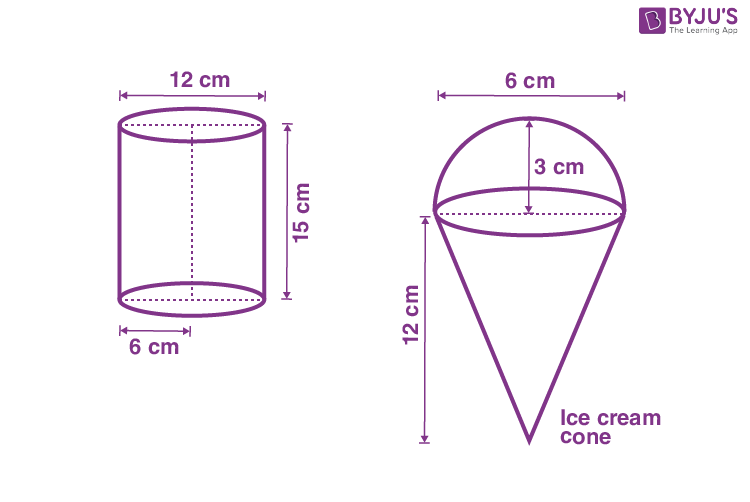
A container shaped like a right circular cylinder having a diameter of 12 cm and a height of 15 cm is full of ice cream. The ice cream is to be filled into cones of height 12 cm and diameter 6 cm, having a hemispherical shape on the top. Find the number of such cones which can be filled with ice cream.

Show solutionHide solution
Worked solution

NCERT Solutions for Class 10 Maths Chapter 13 Exercise 13.3 Solution 5

The number of cones will be = Volume of cylinder/Volume of ice cream cone

For the cylinder part,

Radius = 12/2 = 6 cm

Height = 15 cm

∴ Volume of cylinder = π×r2×h = 540π

For the ice cone part,

Radius of conical part = 6/2 = 3 cm

Height = 12 cm

Radius of hemispherical part = 6/2 = 3 cm

Now,

The volume of the ice cream cone = Volume of the conical part + Volume of the hemispherical part

= (⅓)×π×r2×h+(⅔)×π×r3

= 36π +18π

= 54π

∴ Number of cones = (540π/54π)

= 10

Q6Written answer

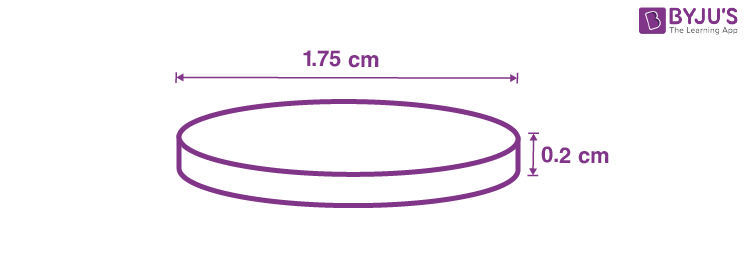
How many silver coins, 1.75 cm in diameter and of thickness 2 mm, must be melted to form a cuboid of dimensions 5.5 cm × 10 cm × 3.5 cm?

Show solutionHide solution
Worked solution

NCERT Solutions for Class 10 Maths Chapter 13 Exercise 13.3 Solution 6

It is known that the coins are cylindrical in shape.

So, height (h1) of the cylinder = 2 mm = 0.2 cm

Radius (r) of circular end of coins = 1.75/2 = 0.875 cm

Now, the number of coins to be melted to form the required cuboids be “n”

So, Volume of n coins = Volume of cuboids

n × π × r2 × h1 = l × b × h

n×π×(0.875)2×0.2 = 5.5×10×3.5

Or, n = 400

Q7Written answer

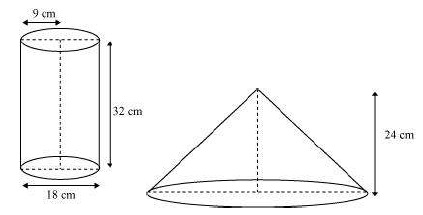
A cylindrical bucket, 32 cm high and with a radius of a base of 18 cm, is filled with sand. This bucket is emptied on the ground, and a conical heap of sand is formed. If the height of the conical heap is 24 cm, find the radius and slant height of the heap.

Show solutionHide solution
Worked solution

The diagram will be as-

Ncert solutions class 10 chapter 13-20

Given,

Height (h1) of cylindrical part of the bucket = 32 cm

Radius (r1) of circular end of the bucket = 18 cm

Height of the conical heap ((h2) = 24 cm

Now, let “r2” be the radius of the circular end of the conical heap.

We know that volume of the sand in the cylindrical bucket will be equal to the volume of sand in the conical heap.

∴ The volume of sand in the cylindrical bucket = Volume of sand in the conical heap

π×r12×h1 = (⅓)×π×r22×h2

π×182×32 = (⅓)×π ×r22×24

Or, r2= 36 cm

And,

Slant height (l) = √(362+242) = 12√13 cm.

Q8Written answer

Water in a canal, 6 m wide and 1.5 m deep, flows at a speed of 10 km/h. How much area will it irrigate in 30 minutes if 8 cm of standing water is needed?

Show solutionHide solution
Worked solution

It is given that the canal is the shape of a cuboid with dimensions as:

Breadth (b) = 6 m and Height (h) = 1.5 m

It is also given that

The speed of canal = 10 km/hr

Length of canal covered in 1 hour = 10 km

Length of canal covered in 60 minutes = 10 km

Length of canal covered in 1 min = (1/60)x10 km

Length of canal covered in 30 min (l) = (30/60)x10 = 5km = 5000 m

We know that the canal is cuboidal in shape. So,

The volume of the canal = lxbxh

= 5000x6x1.5 m3

= 45000 m3

Now,

The volume of water in the canal = Volume of area irrigated

= Area irrigated x Height

So, Area irrigated = 56.25 hectares

∴ The volume of the canal = lxbxh

45000 = Area irrigatedx8 cm

45000 = Area irrigated x (8/100)m

Or, Area irrigated = 562500 m2 = 56.25 hectares.

Q9Written answer

A farmer connects a pipe of internal diameter 20 cm from a canal into a cylindrical tank in her field, which is 10 m in diameter and 2 m deep. If water flows through the pipe at the rate of 3 km/h, in how much time will the tank be filled?

Show solutionHide solution
Worked solution

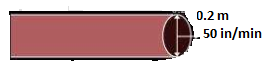
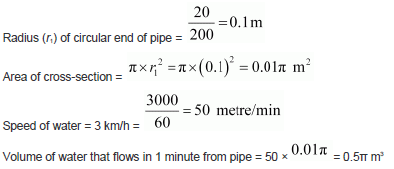
Consider the following diagram-

Ncert solutions class 10 chapter 13-21

Ncert solutions class 10 chapter 13-22

The volume of water that flows in t minutes from pipe = t×0.5π m3

Radius (r2) of circular end of cylindrical tank =10/2 = 5 m

Depth (h2) of cylindrical tank = 2 m

Let the tank be filled completely in t minutes.

The volume of water filled in the tank in t minutes is equal to the volume of water flowed in t minutes from the pipe.

The volume of water that flows in t minutes from pipe = Volume of water in tank

t×0.5π = π×r22×h2

Or, t = 100 minutes