My Cart
Your Cart 0

    Your cart is empty.

  • Total (Amount) ₹0.00
Previous year question hub

Stability and Compensation - Control Systems - Electrical Engineering Previous Year Questions

Practice Stability and Compensation - Control Systems - Electrical Engineering previous year questions organised from real papers, with year-wise coverage and clear topic navigation.

19Papers
15Years
33Questions
1Topics

Stability and Compensation question pattern

Every graph below is calculated only from this selection.

Questions by year

Year-wise coverage for Stability and Compensation. Each bar uses a separate theme-derived color.

Difficulty distribution

How the classified questions are distributed by difficulty.

Medium 27 81.8%
Easy 4 12.1%
Hard 2 6.1%

Question type distribution

MCQ, numerical, multiple-select and other formats found in these papers.

MCQ 27 81.8%
Numerical Answer Type (NAT) 5 15.2%
MSQ 1 3%

Subject weightage

Top subjects by unique question coverage.

Electrical Engineering
33 Qs

Most asked topics

Top topics across the included previous year papers.

Control Systems
33 Qs

Subtopic coverage

Top subtopics inside this exact selection.

Stability and Compensation
33 Qs

Paper coverage

Question coverage for the most populated papers. Every active PYP paper remains listed below.

Electrical Engineering (EE) 2025
2 Qs
Electrical Engineering (EE) 2024
1 Qs
Electrical Engineering (EE) 2022
2 Qs
Electrical Engineering (EE) 2020
3 Qs
Electrical Engineering (EE) 2019
1 Qs
Electrical Engineering (EE) 2018
1 Qs
Electrical Engineering (EE) 2017 [Session 2]
3 Qs
Electrical Engineering (EE) 2017 [Session 1]
1 Qs
Electrical Engineering (EE) 2016 [Session 1]
2 Qs
Electrical Engineering (EE) 2016 [Session 2]
2 Qs
Electrical Engineering (EE) 2014 [Session 1]
2 Qs
Electrical Engineering (EE) 2014 [Session 2]
1 Qs
Electrical Engineering (EE) 2014 [Session 3]
1 Qs
Electrical Engineering (EE) 2012
2 Qs
Electrical Engineering (EE) 2011
1 Qs
Electrical Engineering (EE) 2010
1 Qs
Electrical Engineering (EE) 2009
2 Qs
Electrical Engineering (EE) 2008
1 Qs
Electrical Engineering (EE) 2007
4 Qs

Included previous year papers

Newest papers appear first. Sort by year, question coverage or name.

PaperYear / sessionQuestions in this viewOpen
Electrical Engineering (EE) 202520252View paper
Electrical Engineering (EE) 202420241View paper
Electrical Engineering (EE) 202220222View paper
Electrical Engineering (EE) 202020203View paper
Electrical Engineering (EE) 201920191View paper
Electrical Engineering (EE) 201820181View paper
Electrical Engineering (EE) 2017 [Session 1]20171View paper
Electrical Engineering (EE) 2017 [Session 2]20173View paper
Electrical Engineering (EE) 2016 [Session 1]20162View paper
Electrical Engineering (EE) 2016 [Session 2]20162View paper
Electrical Engineering (EE) 2014 [Session 1]20142View paper
Electrical Engineering (EE) 2014 [Session 2]20141View paper
Electrical Engineering (EE) 2014 [Session 3]20141View paper
Electrical Engineering (EE) 201220122View paper
Electrical Engineering (EE) 201120111View paper
Electrical Engineering (EE) 201020101View paper
Electrical Engineering (EE) 200920092View paper
Electrical Engineering (EE) 200820081View paper
Electrical Engineering (EE) 200720074View paper

All Stability and Compensation previous year questions

Practice every matching question in batches of 20, with every available option.

1
2007 · Electrical Engineering · Control Systems · Stability and Compensation
Electrical Engineering (EE) 2007

The system shown in the figure is

Question diagram

Open complete paper
2
2007 · Electrical Engineering · Control Systems · Stability and Compensation
Electrical Engineering (EE) 2007
The system 900/[s(s+1)(s+9)] is to be compensated such that its gain-crossover frequency becomes same as its uncompensated phase-crossover frequency and provides a 45° phase margin. To achieve this, one may use
Open complete paper
3
2007 · Electrical Engineering · Control Systems · Stability and Compensation
Electrical Engineering (EE) 2007
Consider the discrete-time system shown in the figure where the impulse response of G(z) is g(0) = 0, g(1) = g(2) = 1, g(3) = g(4) = ... = 0.

This system is stable for range of values of K
Open complete paper
4
2007 · Electrical Engineering · Control Systems · Stability and Compensation
Electrical Engineering (EE) 2007
If the loop gain K of a negative feedback system having a loop transfer function K(s+3)/(s+8)² is to be adjusted to induce a sustained oscillation then
Open complete paper
5
2008 · Electrical Engineering · Control Systems · Stability and Compensation
Electrical Engineering (EE) 2008
Figure shows a feedback system where K > 0.

The range of K for which the system is stable will be given by
Open complete paper
6
2009 · Electrical Engineering · Control Systems · Stability and Compensation
Electrical Engineering (EE) 2009

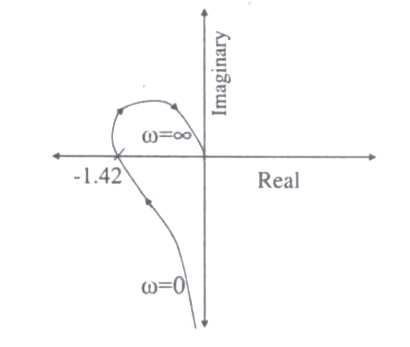
The polar plot of an open loop stable system is shown below. The closed loop system is

Question diagram

Open complete paper
7
2009 · Electrical Engineering · Control Systems · Stability and Compensation
Electrical Engineering (EE) 2009
The first two rows of Routh's tabulation of a third order equation are as follows.
\(s^3\)22
\(s^2\)44

This means there are
Open complete paper
8
2010 · Electrical Engineering · Control Systems · Stability and Compensation
Electrical Engineering (EE) 2010
The characteristic equation of a closed-loop system is \(s(s+1)(s+3) + k(s+2) = 0, \; k > 0\). Which of the following statements is true?
Open complete paper
9
2011 · Electrical Engineering · Control Systems · Stability and Compensation
Electrical Engineering (EE) 2011
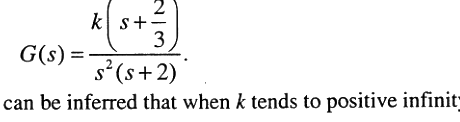
The open loop transfer function \(G(s)\) of a unity feedback control system is given as, \(G(s) = \frac{k\left(s+\frac{2}{3}\right)}{s^2(s+2)}\) From the root locus, it can be inferred that when \(k\) tends to positive infinity,

Question diagram

Open complete paper
10
2012 · Electrical Engineering · Control Systems · Stability and Compensation
Electrical Engineering (EE) 2012

The feedback system shown below oscillates at 2 rad/s when

Question diagram

Open complete paper
11
2012 · Electrical Engineering · Control Systems · Stability and Compensation
Electrical Engineering (EE) 2012
Gc(s) is a lead compensator if
Open complete paper
12
2014 · Electrical Engineering · Control Systems · Stability and Compensation
Electrical Engineering (EE) 2014 [Session 1]
In the formation of Routh-Hurwitz array for a polynomial, all the elements of a row have zero values. This premature termination of the array indicates the presence of
Open complete paper
13
2014 · Electrical Engineering · Control Systems · Stability and Compensation
Electrical Engineering (EE) 2014 [Session 1]
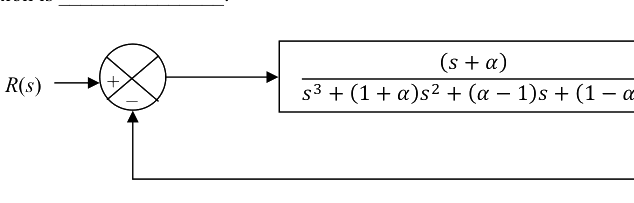
For the given system, it is desired that the system be stable. The minimum value of \(\alpha\) for this condition is ______.

Question diagram

Open complete paper
14
2014 · Electrical Engineering · Control Systems · Stability and Compensation
Electrical Engineering (EE) 2014 [Session 2]
A system with the open loop transfer function \( G(s) = \frac{K}{s(s+2)(s^2+2s+2)} \) is connected in a negative feedback configuration with a feedback gain of unity. For the closed loop system to be marginally stable, the value of K is __________.
Open complete paper
15
2014 · Electrical Engineering · Control Systems · Stability and Compensation
Electrical Engineering (EE) 2014 [Session 3]
A single-input single-output feedback system has forward transfer function \( G(s) \) and feedback transfer function \( H(s) \). It is given that \( |G(s)H(s)| \ll 1 \). Which of the following is true about the stability of the system?
Open complete paper
16
2016 · Electrical Engineering · Control Systems · Stability and Compensation
Electrical Engineering (EE) 2016 [Session 1]
Loop transfer function of a feedback system is \(G(s)H(s) = \frac{s+3}{s^2(s-3)}\). Take the Nyquist contour in the clockwise direction. Then, the Nyquist plot of \(G(s)H(s)\) encircles \(-1+j0\)
Open complete paper
17
2016 · Electrical Engineering · Control Systems · Stability and Compensation
Electrical Engineering (EE) 2016 [Session 1]
Given the following polynomial equation
\(s^3 + 5.5 s^2 + 8.5 s + 3 = 0\),
the number of roots of the polynomial, which have real parts strictly less than \(-1\), is ________.
Open complete paper
18
2016 · Electrical Engineering · Control Systems · Stability and Compensation
Electrical Engineering (EE) 2016 [Session 2]
The open loop transfer function of a unity feedback control system is given by \( G(s) = \frac{K(s+1)}{s(1+Ts)(1+2s)} \), \( K > 0, T > 0 \). The closed loop system will be stable if,
Open complete paper
19
2016 · Electrical Engineering · Control Systems · Stability and Compensation
Electrical Engineering (EE) 2016 [Session 2]
The gain at the breakaway point of the root locus of a unity feedback system with open loop transfer function \( G(s) = \frac{Ks}{(s-1)(s-4)} \) is
Open complete paper
20
2017 · Electrical Engineering · Control Systems · Stability and Compensation
Electrical Engineering (EE) 2017 [Session 1]
A closed loop system has the characteristic equation given by \( s^3 + Ks^2 + (K+2)s + 3 = 0 \). For this system to be stable, which one of the following conditions should be satisfied?
Open complete paper

Showing 20 of 33 questions