Using second law of motion, derive the relation between force and acceleration. A bullet of 10 g strikes a sand-bag at a speed of 103 m/s and gets embedded after travelling 5 cm. Calculate
(i) the resistive force exerted by the sand on the bullet
(ii) the time taken by the bullet to come to rest.
Soln:
(i) m =10 g
=
= 103 m/s
v = 0
s=
v2-u2= 2as
0-(103)2= 2a
a =
=107ms-2
F = ma
=105N
(ii) v=u+at
0=103-107t
107t= 103
t=103/107
= 10-4s
19. Derive the unit of force using the second law of motion. A force of 5 N produces an acceleration of 8 ms-2 on a mass m1 and an acceleration of 24 ms-2 on a mass m2. What acceleration would the same force provide if both the masses are tied together?
Soln:
F = m a = kg m s–2
This unit is also called newton. Its symbol is N.
m1=
m2 =
m=
=
Acceleration produced in M
a=
20. What is momentum? Write its SI unit. Interpret force in terms of momentum. Represent the following graphically
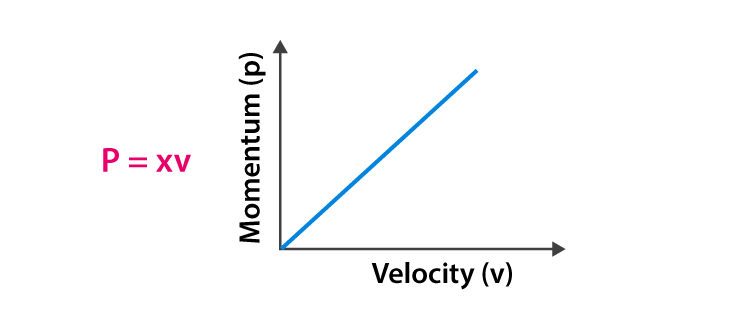
(a) momentum versus velocity when mass is fixed.
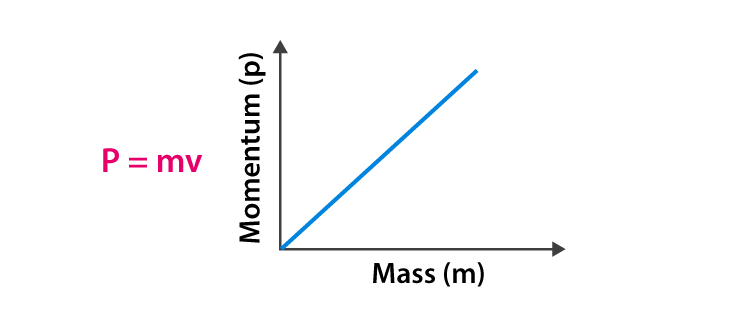
(b) momentum versus mass when velocity is constant.
Soln:
The quantity of motion of a moving body is called momentum. It is measured as product of mass and velocity.
Momentum = mass × velocity
SI unit of momentum is kg m s–1
Force = Rate of change in momentum
1)
2)
Show solutionHide solution
Solution coming soon.