The displacement of a moving object in a given interval of time is zero. Would the distance travelled by the object also be zero? Justify your answer.
Soln:
Displacement zero does not mean zero distance. The distance can be zero when moving an object back to the place it started. Displacement is either equal to or less than distance, but the distance is always greater than one, and it cannot be a negative value.
13. How will the equations of motion for an object moving with a uniform velocity change?
Soln:
If the object is moving with a uniform velocity, then v = µ and a = 0. In this scenario equation for distance is given below.
S= ut and V2– µ2=0
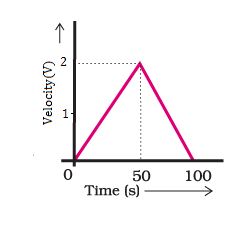
14. A girl walks along a straight path to drop a letter in the letterbox and comes back to her initial position. Her displacement–time graph is shown in Fig.8.4. Plot a velocity-time graph for the same.
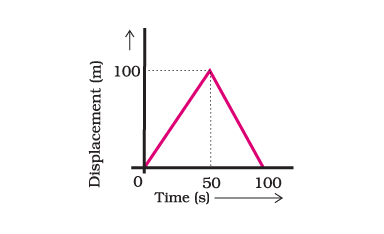
Soln:
15. A car starts from rest and moves along the x-axis with a constant acceleration of 5 m/s2 for 8 seconds. If it then continues with constant velocity, what distance will the car cover in 12 seconds since it started from the rest?
Soln:
Car Starts from rest hence Initial velocity u=o acceleration a=5 m/s2 and time t=8s
v = u+at
v = 0+5×8
v = 40ms-1
From second equation
s = ut +
s = 0x8 +
s =
s =
s = 5×32 =160 is the distance covered in 8 seconds.
Therefore, the total distance covered in 12 seconds is 160+160=320m
16. A motorcyclist drives from A to B with a uniform speed of 30 km/h and returns back with a speed of 20 km h–1. Find its average speed.
Soln:
Let the distance from A to B is D kms.
Distance for the entire journey is 2D kms.
The time taken to go from A to B is D/30 hr, and that of B to A is D/20 hr. So, the total time taken T is
T = (D/30) + (D/20). By solving, we will get,
T = D/12 hrs.
Average speed = Total distance/Total time.
Av.speed = 2D ÷ D/12
=> 2D x 12/D = 24 km/h.
Hence Average speed of the motorcycle is 24 km/h.
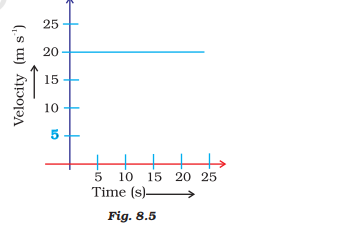
17. The velocity-time graph (Fig. 8.5) shows the motion of a cyclist. Find (i) its acceleration, (ii) its velocity, and (iii) the distance covered by the cyclist in 15 seconds
Soln:
(i) As velocity is constant, acceleration is 0 m/s2
(ii) Here, the velocity is constant, hence v=20m/s
(iii) s = v x t
= 20 x 15
= 300 m
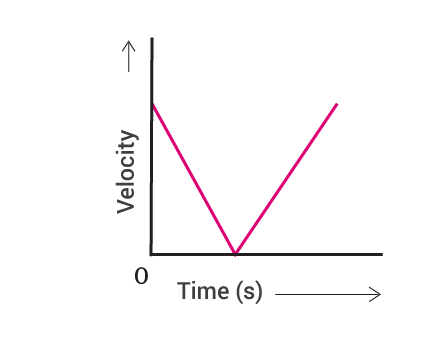
18. Draw a velocity versus time graph of a stone thrown vertically upwards and then coming downwards after attaining the maximum height.
Soln:
The velocity versus time graph of a stone thrown upwards vertically is as given below:
19. An object is dropped from rest at a height of 150 m, and simultaneously another object is dropped from rest at a height of 100 m. What is the difference in their heights after 2 s if both the objects drop with the same accelerations? How does the difference in heights vary with time?
Soln:
When two objects fall with the same acceleration simultaneously, after 2 seconds, the difference in their heights will not change, and it remains 50 m.

Therefore the height of the first object after 2 seconds is 130 m.
In the same way, the height of the second object is

Therefore, the height of the second object after 2 seconds is 80 m.
So, the difference is the same, i.e. 50 m.
This concludes that the difference in the height of the two objects does not depend on time and will always be the same.
20. An object starting from rest travels 20 m in first 2 s and 160 m in next 4 s. What will be the velocity after 7 s from the start?
Soln:
Here Object starts from rest hence initial velocity u=0 t =2s and s=20 m
According to the second equation of motion s= ut+at2
S = 0+
20 = 2+
= 20/2
a = 10m/s
According to the first equation of motion velocity after 7 s from the start
V = u+at
V = 0+10×7
V = 70m/s
21. Using the following data, draw time-displacement graph for a moving object:
| Time(s) | 0 | 2 | 4 | 6 | 8 | 10 | 12 | 14 | 16 |
| Displacement(m) | 0 | 2 | 4 | 4 | 4 | 6 | 4 | 2 | 0 |
Use this graph to find the average velocity for the first 4 s, for the next 4 s and for the last 6 s.
Soln:
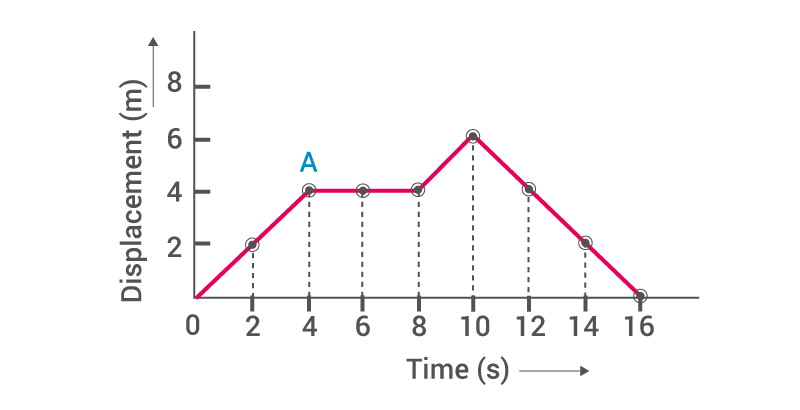
Average velocity for the first 4s =
Average velocity of next 4 s = V =
Average velocity for last 6 s =
22. An electron moving with a velocity of 5 × 10⁴ m/s enters into a uniform electric field and acquires a uniform acceleration of 104 ms-2 in the direction of its initial motion.
(i) Calculate the time in which the electron would acquire a velocity double of its initial velocity.
(ii) How much distance would the electron cover in this time?
Soln:
Given initial velocity, u = 5 × 10⁴ m/s and acceleration, a = 104ms-2
(i) final velocity = v = 2 u = 2 × 5 ×104 m/s =10 × 104 m/s
To find t, use v = at or t = u – u / a = (5 × 10⁴)/104
=5s
(ii) Using s = ut +
= 25 ×104 + 25 /2 ×104
= 37.5×10⁴ m
23. Obtain a relation for the distance travelled by an object moving with a uniform acceleration in the interval between the 4th and 5th seconds.
Soln:
a = dv/dt
Assume that air resistance is nil.
We can directly contain it by using Newton’s equations of motion or from the below-mentioned method:
Thus, the area under the v-t curve and the x-axis where the slope of the curve is the instantaneous acceleration.
In this case, acceleration g is constant, and due to the free-fall condition, the initial velocity is zero. Therefore the v-t curve is a straight line with a slope equal to g equal to 9.81 m/s passing through the origin.
On dividing the total area under the curve into the interval of unit seconds, then we initially obtain a triangle followed by trapeziums of increasing height.
The ratio of the area of the first triangle to the second triangle to the third triangle is equal to the ratio of displacement in the first, second and third second. We get ratio equal to 1:3:5:7:9… and so on.
For the 4th & 5th second, it is 7:9.
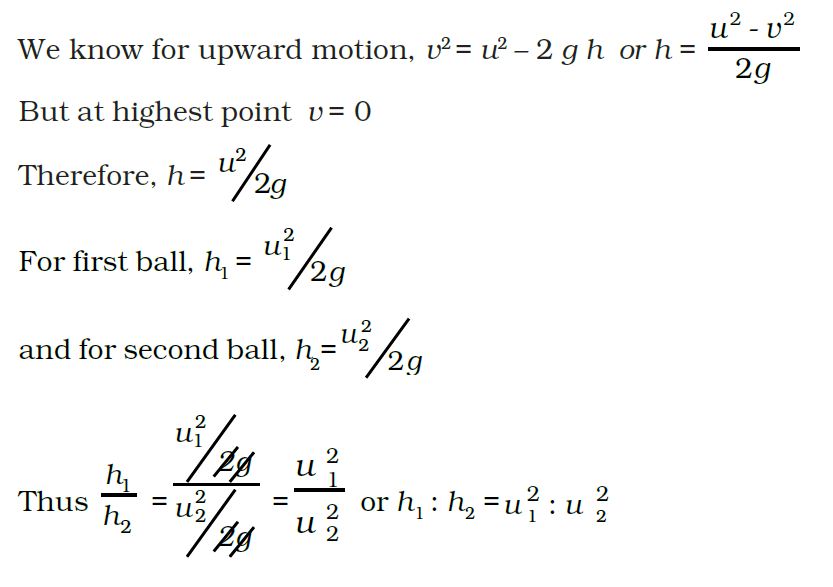
24. Two stones are thrown vertically upwards simultaneously with their initial velocities u1 and u2, respectively. Prove that the heights reached by them would be in the ratio of u1² :u2²
(Assume upward acceleration is –g and downward acceleration is +g ).
Soln:
Show solutionHide solution
Solution coming soon.