My Cart
Your Cart 0

    Your cart is empty.

  • Total (Amount) ₹0.00
NCERT Exemplar · Class 9 · Science

Chapter 4: Structure of the Atom

Practice each question, then open the answer or worked solution.

Long Answer Questions

8 questions
Q36Written answer

Why do Helium, Neon and Argon have a zero valency?

Show solutionHide solution
Worked solution

Ans: Helium's lone energy shell has two electrons. The valence shells of Argon and Neon each have eight electrons. The elements have little tendency to mix with other elements because they have the most electrons in their valence shells (resulting in duplet and octet configurations). As a result, the valency of Helium, Neon, and Argon is zero.


Q37Written answer

The ratio of the radii of hydrogen atom and its nucleus is ~ \[{10^5}\]. Assuming the atom and the nucleus to be spherical, (i) What will be the ratio of their sizes? (ii) If the atom is represented by planet earth \['{R_e}' = 6.4 \times {10^6}m\], estimate the size of the nucleus.

Show solutionHide solution
Worked solution

Ans: (i) Volume of a sphere is given by $\text{V}=\frac{4}{3}\pi {{r}^{3}}$

Let "R" be the radius of the atom and "r" be that of the nucleus.

The ratio of the radii of hydrogen atom and its nucleus is ~ \[{10^5}\]

$\Rightarrow \text{R}={{10}^{5}}\text{r}$ 

Volume of the atom

$=\frac{4}{3}\pi {{R}^{3}}=\frac{4}{3}\text{ }\!\!\pi\!\!\text{ }{{\left( {{10}^{5}}\text{r} \right)}^{3}}\left( \because \text{R}={{10}^{5}}\text{r} \right)$ 

$=\frac{4}{3}\pi {{r}^{3}}\times {{10}^{15}}$

Volume of the nucleus\[ = \dfrac{4}{3}\pi {r^3}\]

Ratio of the size of the atom to that of the nucleus

\[\dfrac{{ = \dfrac{4}{3} \times {{10}^{15}} \times \pi {r^3}}}{{\dfrac{4}{3}\pi {r^3}}} = {10^{15}}\]

(ii) If the atom is represented by the planet Earth, then the radius of the nucleus would be given by :-

\[{r_n} = \dfrac{{{R_6}}}{{{{10}^5}}}\]

${{\text{r}}_{\text{n}}}=\frac{6.4\times {{10}^{6}}~\text{m}}{{{10}^{5}}}\left( {{\text{R}}_{\text{ }\!\!\varepsilon\!\!\text{ }}}=6.4\times {{10}^{6}}~\text{m} \right)$

\[ = 6.4 \times 10m\]

\[ = {\mathbf{64}}{\text{ }}{\mathbf{m}}\]

Q38Written answer

Enlist the conclusions drawn by Rutherford from his α-ray scattering experiment.

Show solutionHide solution
Worked solution

Ans: Rutherford concluded from the α-particle scattering experiment that :–

(i) Because most -particles passed through the gold foil with no deflection, the majority of the space inside the atom was vacant.

(ii) Because only a few particles deviated from their course, the positive charge occupied very little space inside the atom.

(iii) Small fraction of α-particles were deflected by \[180^\circ \], this shows that the positive charge as well as the mass of the gold atom were concentrated in a very small volume within the atom. 

From the data he also calculated that the radius of the nucleus was about \[{10^5}\] times smaller than the radius of the atom.


Q39Written answer

In what way is Rutherford's atomic model different from that of Thomson’s atomic model?

Show solutionHide solution
Worked solution

Ans: Rutherford suggested a model in which electrons moved in well-defined orbits around the nucleus. There is a positively charged centre (later called "nucleus") in an atom. He also proposed that the nucleus is extremely small in comparison to the size of the atom, and that the nucleus contains virtually all of an atom's mass. The model of an atom proposed by Thomson was similar to that of a Christmas pudding. The electrons are strewn about like currants in a positively charged pudding spherical, and the atom's mass was expected to be spread evenly.


Q40Written answer

What were the drawbacks of Rutherford’s model of an atom?

Show solutionHide solution
Worked solution

Ans: Rutherford suggested a model in which the electrons moved in well-defined orbits around the nucleus. However, it was believed that the electron's orbital revolution would not be stable. Any charged particle in a circular orbit would accelerate and emit energy. As a result, the spinning electrons lose energy and fall into the nucleus. The atom would become extremely unstable as electrons whirled about it, and matter would cease to exist. This, however, goes against what we've seen before.


Q41Written answer

What are the postulates of Bohr’s model of an atom?

Show solutionHide solution
Worked solution

Ans: The following are Neils Bohr's postulates regarding the model of an atom::-

(i) Only certain special orbits known as discrete orbits, are allowed inside the atom. These discrete orbits are called energy levels. Concentric circles depict the energy levels in an atom. The letters K, L, M, N,..., or the integers n = 1, 2, 3, 4,...., are used to indicate these orbits. 

(ii) While revolving in the discrete orbits, the electrons do not radiate any energy.


Q42Written answer

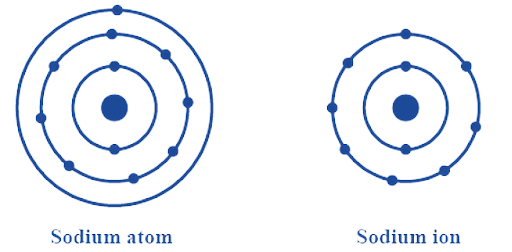
Show diagramatically the electron distributions in a sodium atom and a sodium ion and also give their atomic number.


seo images


Show solutionHide solution
Worked solution

Ans: The number of protons in an atom determines an element's atomic number (Z). The sodium atom has 11 protons because its atomic number is 11. Number of electrons = number of protons = 11 since the atom as a whole is electrically neutral. A positively charged sodium ion  (Na+) is formed by the removal of one electron from a sodium atom. So, a sodium ion has 11-1=10 electrons. As a result, the sodium ion's electronic distribution will be 2,8. Because both the sodium atom and the sodium ion have the same amount of protons, the atomic number of both the sodium atom and the sodium ion is 11.


Q43Written answer

In the Gold foil experiment of Geiger and Marsden, that paved the way for

Rutherford’s model of an atom, ~ \[1.00\% \] of the α-particles were found to deflect at angles  \[ > 50^\circ \]. If one mole of α-particles were bombarded on the gold foil, compute the number of α-particles that would deflect at angles less than \[50^\circ \]. 

Show solutionHide solution
Worked solution

Ans: Percentage of α-particles deflected by more than \[50^\circ  = {\text{ }}1\% \] of total α-particles. 

% of α-particles deflected by less than \[50^\circ  = {\text{ }}100\% {\text{ }}-{\text{ }}1\% {\text{ }} = {\text{ }}99\% \] of total α-particles. 

1 mole = number of α-particles blasted on gold foil

The number of particles that were deflected by an angle of less than \[50^\circ \]

$=\frac{99}{100}\times 6.022\times {{10}^{23}}$

$=\frac{596.178}{100}\times {{10}^{23}}$ 

$=5.96\times {{10}^{23}}$