My Cart
Your Cart 0

    Your cart is empty.

  • Total (Amount) ₹0.00
NCERT Exemplar · Class 9 · Science

Chapter 4: Structure of the Atom

Practice each question, then open the answer or worked solution.

Short Answer Questions

17 questions
Q19Written answer

Is it possible for the atom of an element to have one electron, one proton and no neutron? If so, name the element.

Show solutionHide solution
Worked solution

Ans: Yes, this is true for protium, a common and stable hydrogen isotope which is

represented as \[{}_1^1H\].


Q20Written answer

Write any two observations which support the fact that atoms are divisible.

Show solutionHide solution
Worked solution

Ans: The discovery of electrons and protons bolsters the idea that atoms are divisible. During a chemical reaction, electrons are transferred or shared between distinct atoms, causing atoms to rearrange.


Q21Written answer

Will \[{}^{35}Cl\] and \[{}^{37}Cl\] have different valencies? Justify your answer.

Show solutionHide solution
Worked solution

Ans: \[{}^{35}Cl\]and \[{}^{37}Cl\] are isotopes of the same element - chlorine. Isotopes have the same number of electrons. Hence, their valencies do not differ. They have the same valency.


Q22Written answer

Why did Rutherford select a gold foil in his α–ray scattering experiment?

Show solutionHide solution
Worked solution

Ans: Rutherford sought a metal sheet that could be as thin as feasible for the scattering experiment. The most malleable of all known metals is gold. It's simple to make very thin sheets out of it. Rutherford chose gold foil for his alpha-ray scattering experiment as a result.


Q23Written answer

Find out the valency of the atoms represented by the Fig. 4.3 (a) and (b).


(a)

seo images


(b)

seo images
Show solutionHide solution
Worked solution

Ans: Because it has 8 electrons in the valence shell and has acquired a stable conformation, atom (a) has zero valency. Because it has seven electrons in its valence shell, atom (b) has a valence of one. In order to obtain a stable (octet) configuration, atom (b) can receive more electrons.


Q24Written answer

One electron is present in the outermost shell of the atom of an element X. What would be the nature and value of charge on the ion formed if this electron is removed from the outermost shell?

Show solutionHide solution
Worked solution

Ans: When the single electron present in the outermost shell of the atom of an element X is removed, the atom loses negative charge and forms a positively charged ion with + 1 charge. The amount of charge present on one electron equals the value of the net charge on the ion.


Q25Written answer

Write down the electron distribution of chlorine atoms. How many electrons are there in the L shell? (Atomic number of chlorine is 17).

Show solutionHide solution
Worked solution

Ans: Chlorine's electrical configuration will be 2, 8, 7 since its atomic number (Z) is 17. The L shell consists of eight electrons (second shell).


Q26Written answer

In the atom of an element X, 6 electrons are present in the outermost shell. If it acquires a noble gas configuration by accepting a requisite number of electrons, then what would be the charge on the ion so formed?

Show solutionHide solution
Worked solution

Ans: Since 6 electrons are already present in the outermost shell of the atom, this element requires two more electrons in order to acquire the noble gas configuration. When the atom accepts 2 more electrons , the charge on the ion formed would be -2.


Q27Written answer

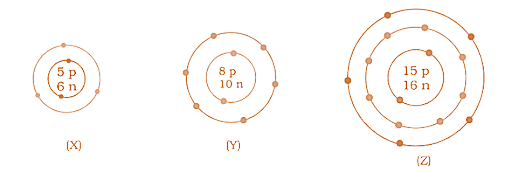
What information do you get from the given figure about the atomic number, mass number and valency of atoms X, Y and Z? Give your answer in a tabular form.


seo images


Show solutionHide solution
Worked solution

Ans: The atomic number, mass number and valency of the atoms X, Y and Z are given on the table below:-


Atomic No.

Mass No. 

Valency

X

5

11

3

Y

8

18

2

Z

15

31

3,5


Q28Written answer

In response to a question, a student stated that in an atom, the number of protons is greater than the number of neutrons, which in turn is greater than the number of electrons. Do you agree with the statement? Justify your answer.

Show solutionHide solution
Worked solution

Ans: The statement of the student is not correct. The number of protons in an atom can never be greater than the number of neutrons. The number of protons will be equal to or less than the number of neutrons. In a neutral atom, the number of electrons and protons is always the same.