My Cart
Your Cart 0

    Your cart is empty.

  • Total (Amount) ₹0.00
NCERT Exemplar · Class 9 · Science

Chapter 4: Structure of the Atom

Practice each question, then open the answer or worked solution.

Multiple Choice Questions

18 questions
Q1Multiple choice

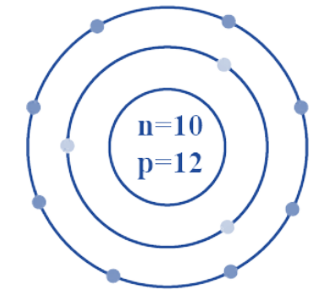
Which of the following correctly represent the electronic distribution in the Mg atom?

Show answerHide answer
Correct option: B
Show solutionHide solution
Worked solution

Ans: (b) 2, 8, 2

Explanation: At most two electrons can be found in the first shell. Hence option ‘b’ is correct while options (a) and (d) are incorrect.
Q2Multiple choice

Rutherford’s ‘alpha (α) particles scattering experiment’ resulted in the discovery of:

Show answerHide answer
Correct option: C
Show solutionHide solution
Worked solution

Ans: (c) Nucleus in the atom

Explanation: The presence of a nucleus at the center of an atom was demonstrated by the discovery that some alpha particles returned on their original route.


Q3Multiple choice

The number of electrons in an element X is 15 and the number of neutrons is 16. Which of the following is the correct representation of the element?

Show answerHide answer
Correct option: A
Show solutionHide solution
Worked solution

Ans: (a)${}_{15}^{31}{\text{X}}$

Explanation: The atomic number (Z) of an element is equal to the number of protons. An atom's number of protons equals its number of electrons. The atomic number (Z) is written in the subscript while the mass number (A) is written in the superscript before the symbol of the element.


Q4Multiple choice

Dalton’s atomic theory successfully explained:

(i) Law of conservation of mass

(ii) Law of constant composition

(iii) Law of radioactivity

(iv) Law of multiple proportions

Show answerHide answer
Correct option: D
Show solutionHide solution
Worked solution

Ans: (d) (i), (ii) and (iv)

Explanation: Dalton’s theory explained the law of conservation of mass, the law of constant composition and the law of multiple proportions. Dalton’s theory did not talk about any law of radioactivity.


Q5Multiple choice

Which of the following statements about Rutherford’s model of atom are correct?

(i) considered the nucleus was positively charged.

(ii) established that the α–particles are four times as heavy as a hydrogen atom.

(iii) can be compared to the solar system.

(iv) was in agreement with Thomson’s model.

Show answerHide answer
Correct option: A
Show solutionHide solution
Worked solution

Ans: (a) (i) and (iii)

Explanation: Alpha particles are positively charged and are deflected by the nucleus. This showed that the nucleus is positively charged. Rutherford also proposed that electrons in an atom are organized around the nucleus in the same way that planets in the Milky Way are clustered around the Sun.


Q6Multiple choice

Which of the following are true for an element?

(i) Atomic number = number of protons + number of electrons

(ii) Mass number = number of protons + number of neutrons

(iii) Atomic mass = number of protons = number of neutrons

(iv) Atomic number = number of protons = number of electrons

Show answerHide answer
Correct option: D
Show solutionHide solution
Worked solution

Ans: (d) (ii) and (iv)

Explanation: Atomic number (Z) = number of protons = number of electrons. Since an electron has negligible mass, the mass of protons and the mass of neutrons are taken into consideration while calculating the mass number (A).

Mass number (A) = number of protons + number of neutrons = number of nucleons


Q7Multiple choice

In Thomson's model of atoms, which of the following statements are correct?

(i) the mass of the atom is assumed to be uniformly distributed over the atom.

(ii) the positive charge is assumed to be uniformly distributed over the atom.

(iii) the electrons are uniformly distributed in the positively charged sphere.

(iv) the electrons attract each other to stabilize the atom.

Show answerHide answer
Correct option: A
Show solutionHide solution
Worked solution

Ans: (a) (i), (ii) and (iii)

Explanation: Thomson proposed that negatively charged electrons are stabilized by positively charged nuclei. Hence, option (iv) is not correct as ike charges cannot attract each other. The rest of the options are correct according to Thomson's model of atom.


Q8Multiple choice

Rutherford’s ɑ- particle scattering experiment showed that:

(i) electrons have negative charge.

(ii) the mass and positive charge of the atom is concentrated in the nucleus.

(iii) neutrons exist in the nucleus.

(iv) most of the space inside an atom is empty.

Which of the above statements are correct?

Show answerHide answer
Correct option: B
Show solutionHide solution
Worked solution

Ans: (b) (ii) and (iv)

Explanation: The mass and positive charge of the atom are concentrated in the nucleus, and most of the atom's space is empty, according to Rutherford's particle scattering experiment.


Q9Multiple choice

The ion of an element has 3 positive charges. Mass number of the atom is 27 and the number of neutrons is 14. What is the number of electrons in the ion?

Show answerHide answer
Correct option: B
Show solutionHide solution
Worked solution

Ans: (b) 10

Explanation: Mass number (A) of the element = 27

Number of neutrons in the atom =14

Hence, the number of electrons in atom

=Mass number(A) – number of neutrons in atom 

=27 – 14 = 13

Since the ion of the element has 3 positive charges, so number of electrons in the ion is 

13 - 3.

The number of electrons in the ion is 10.


Q10Written answer

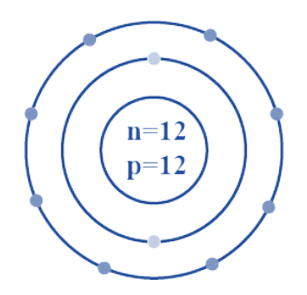
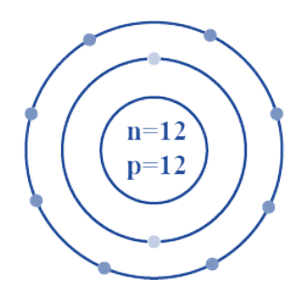
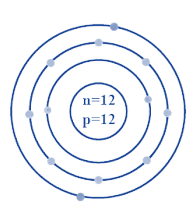
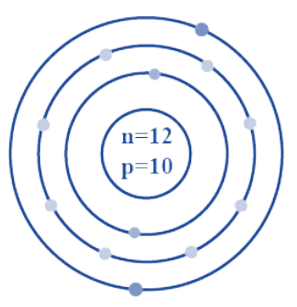
Identify the \[{\text{M}}{{\text{g}}^{2 + }}\]  ion from the Fig.4.1 where "n" and "p" represent the number of neutrons and the number of protons respectively.


(a)

seo images


(b)

seo images


(c)

seo images


(d)

seo images


Show solutionHide solution
Worked solution

Ans: (d)

seo images


Explanation: The atomic number (Z) of magnesium is 12 and the mass number (A) is 24 (\[p{\text{ }} = 12\] and \[n{\text{ }} = {\text{ }}A{\text{ }} - {\text{ }}Z{\text{ }} = {\text{ }}24{\text{ }} - {\text{ }}12{\text{ }} = {\text{ }}12\])  Electronic configuration of Mg atom is 2, 8, 2. So, the electronic configuration of  \[Mg^{2+}\] ion is 2, 8 (Two electrons are lost, resulting in a positive charge.). The number of protons and neutrons inside the magnesium atom are unchanged by the magnesium atom's creation of a magnesium ion. Option (b) and option (c) do not appropriately indicate the number of neutrons (n) and protons (p).