My Cart
Your Cart 0

    Your cart is empty.

  • Total (Amount) ₹0.00
NCERT Exemplar · Class 9 · Science

Chapter 3: Atoms and Molecules

Practice each question, then open the answer or worked solution.

Explanation

4 questions
Q45Written answer

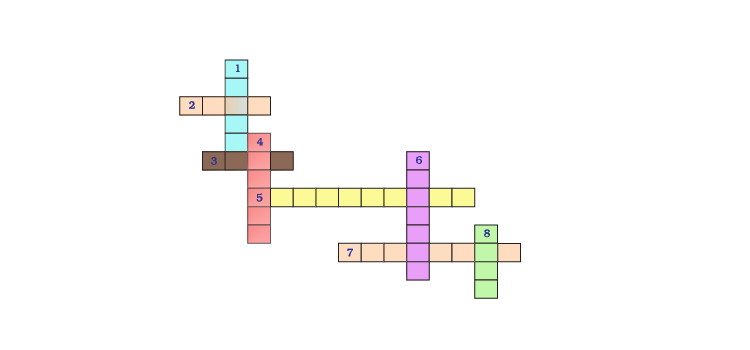
Complete the following crossword puzzle (Fig. 3.1) by using the name of the chemical elements. Use the data given in Table 3.2.

Across Down
The element used by Rutherford during his α–scattering experiment A white lustrous metal used for making ornaments and which tends to get tarnished black in the presence of moist air
An element which forms rust on exposure to moist air Both brass and bronze are alloys of the element
A very reactive non–metal stored under water The metal which exists in the liquid state at room temperature
Zinc metal when treated with dilute hydrochloric acid produces a gas of this element which when tested with burning splinter produces a pop sound. An element with symbol Pb

crossword puzzle

Show solutionHide solution
Worked solution
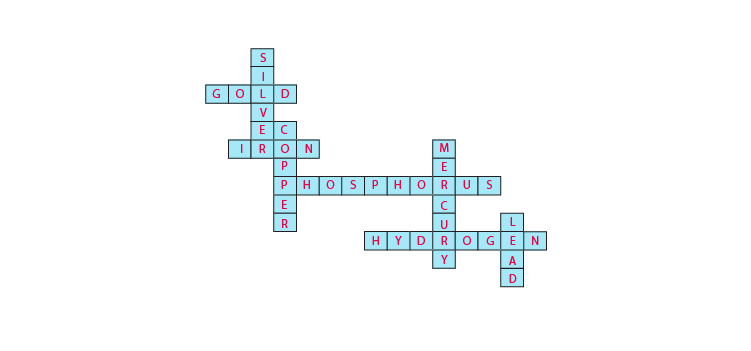
crossword puzzle solution

Q46Written answer

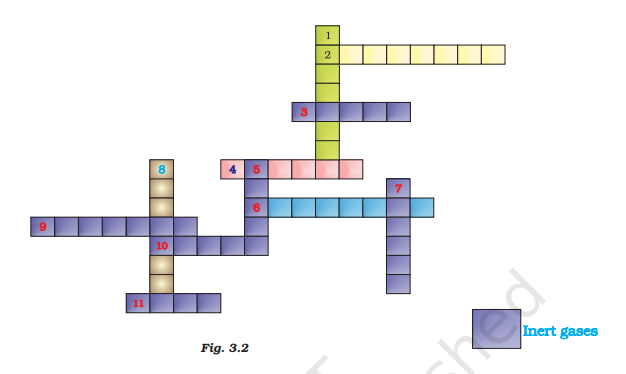
(a) In this crossword puzzle (Fig 3.2), names of 11 elements are hidden. Symbols of these are given below. Complete the puzzle. 1. Cl 7. He 2. H 8. F 3. Ar 9. Kr 4. O 10. Rn 5. Xe 11. Ne 6. N

crossword puzzle

Show solutionHide solution
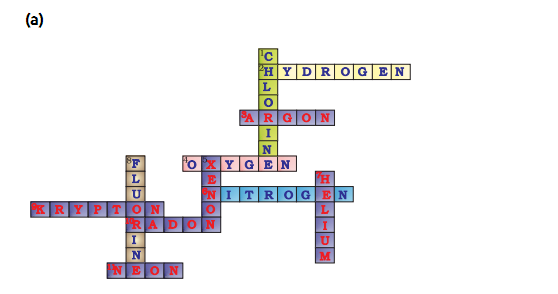
Worked solution
crossword puzzle solution

b) Six : Helium (He); Neon ( Ne); Argon (Ar); Krypton (Kr); Xenon (Xe); Radon (Rn).

Q47Written answer

Write the formulae for the following and calculate the molecular mass for each one of them.

(a) Caustic potash

(b) Baking powder

(c) Limestone

(d) Caustic soda

(e) Ethanol

(f) Common salt

Show solutionHide solution
Worked solution
The formulae for the following and calculate the molecular mass for each one of them.

Ser. No. Compound Formula Molecular mass
A Caustic Potash KOH 39+16+1=56u
B Baking powder NaHCO3 23+1+12+3×16=84u
C Limestone CaCO3 40+12+3×16=100u
D Caustic soda NaOH 23+16+1=40u
E Ethanol C2H5OH 2×2+5×1+16+1=46u
F Common Salt NaCl 23+35.5=58.5
Q48Written answer

In photosynthesis, 6 molecules of carbon dioxide combine with an equal number of water molecules through a complex series of reactions to give a molecule of glucose having a molecular formula C6H12O6. How many grams of water would be required to produce 18 g of glucose? Compute the volume of water so consumed assuming the density of water to be 1 g cm-3.

Show solutionHide solution
Worked solution

Solution coming soon.