My Cart
Your Cart 0

    Your cart is empty.

  • Total (Amount) ₹0.00
NCERT Exemplar · Class 9 · Maths

Chapter 13: Surface Areas and Volumes

Practice each question, then open the answer or worked solution.

Exercise 13.2

Textbook page 124 · 5 questions
Q1Written answer

The volume of a sphere is equal to two-third of the volume of a cylinder whose height and diameter are equal to the diameter of the sphere.

Show solutionHide solution
Worked solution

True

Justification:

Let the radius of the sphere = r.

According to the question,

height and diameter of cylinder = diameter of sphere.

So, the radius of the cylinder = r

And, the height of the cylinder = 2r

We know that,

Volume of sphere = 2/3 volume of cylinder
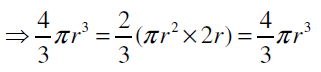
NCERT Exemplar Solutions Class 9 Maths Chapter 13- Ex.13.2-1

Hence, the given statement “the volume of a sphere is equal to two-third of the volume of a cylinder whose height and diameter are equal to the diameter of the sphere” is true.

Q2Written answer

If the radius of a right circular cone is halved and height is doubled, the volume will remain unchanged.

Show solutionHide solution
Worked solution

False

Justification:

Let the original radius of the cone = r

Let height of the cone = h.

The volume of cone = 1/3 πr2h

Now, when radius of a height circular cone is halved and height is doubled, then

NCERT Exemplar Solutions Class 9 Maths Chapter 13- Ex.13.2-2

We can observe that the new volume = half of the original volume.

Hence, the given statement “if the radius of a right circular cone is halved and height is doubled, the volume will remain unchanged” is false.

Q3Written answer

In a right circular cone, height, radius and slant height do not always be sides of a right triangle.

Show solutionHide solution
Worked solution

Consider a right circular cone, with

Height = h

Radius = r

And slant height = l

We know, right triangle = one angle 90°

Using Pythagoras theorem in

⇒ l2 = h2 + r2

This justifies that height, radius and slant height of cone can always be the sides of a right triangle.

Hence, the given statement “in a right circular cone, height, radius and slant height do not always be sides of a right triangle” is true.

Q4Written answer

If the radius of a cylinder is doubled and its curved surface area is not changed, the height must be halved.

Show solutionHide solution
Worked solution

True

Justification:

Let radius of the cylinder = r

Height of the cylinder = h

Then, curved surface area of the cylinder, CSA = 2πrh

According to the question,

Radius is doubled and curved surface area is not changed.

New radius of the cylinder, R = 2r

New curved surface area of the cylinder, CSA’ = 2πrh …(i)

Alternate case:

When R = 2r and CSA’ = 2πrh

But curved surface area of cylinder in this case, CSA’= 2πRh = 2π(2r)h = 4πrh …(ii)

Comparing equations (i) and (ii),

We get,

Since, 2πrh ≠ 4πrh

equation (i) ≠ equation (ii)

Thus, if h = h/2 (height is halved)

Then,

CSA’ = 2π(2r)(h/2) = 2πrh

Hence, the given statement “If the radius of a cylinder is doubled and its curved surface area is not changed, the height must be halved” is true.

Q5Written answer

The volume of the largest right circular cone that can be fitted in a cube whose edge is 2r equals to the volume of a hemisphere of radius r.

Show solutionHide solution
Worked solution

According to the question,

Edge of cube, l = 2r

Then, diameter of the cone = 2r

⇒ radius of the cone = 2r/2

= r

Height of the cone, h = height of the cube

= 2r

Volume of the cone is given by,

Volume of cone = 1/3 πr2h

= 1/3 πr2(2r)

= 2/3 πr3

= Volume of hemisphere of radius r

Hence, the given statement “the volume of the largest right circular cone that can be fitted in a cube whose edge is 2r equals to the volume of a hemisphere of radius r” is true.