My Cart
Your Cart 0

    Your cart is empty.

  • Total (Amount) ₹0.00
NCERT Exemplar · Class 7 · Maths

Chapter 6: Triangles

Practice each question, then open the answer or worked solution.

Questions

80 questions
Q41Written answer

In ∆ABC, ∠Α = 50°, ∠B = 70° and the bisector of ∠C meets AB in D (Fig. 6.17). The measure of ∠ADC is
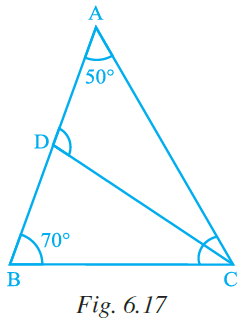
NCERT Exemplar Class 7 Maths Solutions Chapter 6 Image 17

(a) 50° (b) 100° (c) 30° (d) 70°

Show solutionHide solution
Worked solution

Solution:-

(b) 100o

From the figure,

Consider the ΔABC,

We know that, sum of angles of triangle is equal to 180o.

So, ∠Α + ∠B + ∠C = 180o

50o + 70o + ∠C = 180o

∠C + 120o = 180o

∠C = 180o – 120o

∠C = 60o

Since CD bisects ∠C,

So, ∠DCB = ∠ΑCD = ½ ∠C

= 60o/2

= 30o

Now, consider ΔBDC

From exterior angle property, ∠ADC = ∠DBC + ∠DCB

∠ADC = 70o + 30o

= 100o
Q42Written answer

If for ∆ABC and ∆DEF, the correspondence CAB ↔ EDF gives a congruence, then which of the following is not true?

(a) AC = DE (b) AB = EF (c) ∠A = ∠D (d) ∠C = ∠E

Show solutionHide solution
Worked solution

Solution: –

(b) AB = EF

Because, for ∆ABC and ∆DEF AB = DF

Q43Written answer

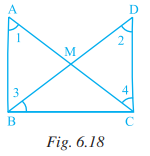
In Fig. 6.18, M is the mid-point of both AC and BD. Then

(a) ∠1 = ∠2 (b) ∠1 = ∠4 (c) ∠2 = ∠4 (d) ∠1 = ∠3

NCERT Exemplar Class 7 Maths Solutions Chapter 6 Image 18

Show solutionHide solution
Worked solution

Solution: –

(b) ∠1 = ∠4

From the figure, M is the mid-point of both AC and BD.

By the corresponding parts of congruent triangles, ∠1 = ∠4.

Q44Written answer

If D is the mid-point of the side BC in ∆ABC where AB = AC, then ∠ADC is

(a) 60° (b) 45° (c) 120s° (d) 90°

Show solutionHide solution
Worked solution

Solution:-

(d) 90o

We know that, in an isosceles triangle, altitude and median are the same.

From the question, if D is the mid-point of the side BC in ∆ABC

Where, D is midpoint of BC joining from point A gives AD as median.

It possess 90o angle on BC

Therefore, ∠ADC = 90o

Q45Written answer

Two triangles are congruent, if two angles and the side included between them in one of the triangles are equal to the two angles and the side included between them of the other triangle. This is known as the

(a) RHS congruence criterion

(b) ASA congruence criterion

(c) SAS congruence criterion

(d) AAA congruence criterion

Show solutionHide solution
Worked solution

Solution:-

(b) ASA congruence criterion

Q46Written answer

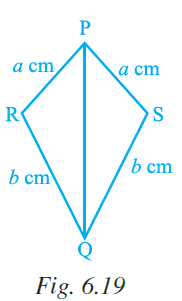
By which congruency criterion, the two triangles in Fig. 6.19 are congruent?

(a) RHS (b) ASA (c) SSS (d) SAS

NCERT Exemplar Class 7 Maths Solutions Chapter 6 Image 19

Show solutionHide solution
Worked solution

Solution:-

(c) SSS

Under a given correspondence, two triangles are congruent, if the three sides of the one are equal to the three sides of the other.

Q47Written answer

By which of the following criterion two triangles cannot be proved congruent?

(a) AAA (b) SSS (c) SAS (d) ASA

Show solutionHide solution
Worked solution

Solution: –

(a) AAA

In AAA criterion, two triangles cannot be proved congruent.

Q48Written answer

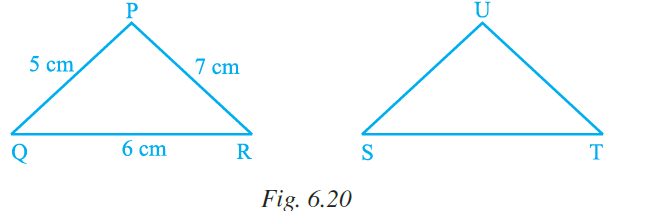
If ∆PQR is congruent to ∆STU (Fig. 6.20), then what is the length of TU?

(a) 5 cm (b) 6 cm (c) 7 cm (d) cannot be determined

NCERT Exemplar Class 7 Maths Solutions Chapter 6 Image 20

Show solutionHide solution
Worked solution

Solution:-

(b) 6 cm

From the question it is given that,

Δ PQR ≅ Δ STU

So,

PQR ↔ STU

∴ QR = TU

TU = 6cm

Q49Written answer

If ∆ABC and ∆DBC are on the same base BC, AB = DC and AC = DB (Fig. 6.21), then which of the following gives a congruence relationship?

(a) ∆ ABC ≅ ∆ DBC (b) ∆ ABC ≅ ∆CBD

(c) ∆ ABC ≅ ∆ DCB (d) ∆ ABC ≅ ∆BCD

Show solutionHide solution
Worked solution

Solution:-

(c) ∆ ABC ≅ ∆ DCB

Consider the ΔABC and ΔDCB,

From the question it is given that, AB = DC and AC = DB

BC = BC … [because common side]

Therefore, ∆ ABC ≅ ∆ DCB

In questions 50 to 69, fill in the blanks to make the statements true.

Q50Written answer

The triangle always has altitude outside itself.

Show solutionHide solution
Worked solution

Solution:-

The Obtuse triangle always has altitude outside itself.