(2/5) ×
is equal to:
(a) 26/25 (b) 52/25 (c) 2/5 (d) 6
Show solutionHide solution
Solution:-
(b) 52/25
First, we have to convert the mixed fraction into an improper fraction

= 26/5
Then, (2/5) × (26/5)
= 52/25
Your cart is empty.
Practice each question, then open the answer or worked solution.
(2/5) ×
is equal to:
(a) 26/25 (b) 52/25 (c) 2/5 (d) 6
Solution:-
(b) 52/25
First, we have to convert the mixed fraction into an improper fraction

= 26/5
Then, (2/5) × (26/5)
= 52/25
3¾ ÷ ¾ is equal to:
(a) 3 (b) 4 c) 5 (d) 45/16
Solution:-
c) 5
First, we have to convert the mixed fraction into improper fraction 3¾ = 15/4
Then, 15/4 ÷ ¾
= (15/4)/ (¾)
= (15/4) × (4/3)
= (15 × 4)/ (4 ×3)
= (5 × 1)/ (1 ×1)
= 5
A ribbon of length 5¼ m is cut into small pieces, each of length ¾m. The number of pieces will be:
(a) 5 (b) 6 (c) 7 (d) 8
Solution:-
(c) 7
First, we have to convert the mixed fraction into improper fraction 5¼ = 21/4
Then, 21/4 ÷ ¾
= (21/4)/ (¾)
= (21/4) × (4/3)
= (21 × 4)/ (4 × 3)
= (7 × 1)/ (1 × 1)
= 7
The ascending arrangement of (2/3), (6/7), (13/21) is:
(a) 6/7, 2/3, 13/21 (b) 13/21, 2/3, 6/7
(c) 6/7, 13/21, 2/3 (d) 2/3, 6/7, 13/21
Solution:-
(b) 13/21, 2/3, 6/7
LCM of 21, 3, 7 = 21
Now, let us change each of the given fractions into an equivalent fraction having 21 as the denominator.
Clearly,
(13/21) < (14/21) < (18/21)
Hence,
(13/21) < (2/3) < (6/7)
Hence, the given fractions in ascending order are (13/21), (2/3), (6/7)
Reciprocal of the fraction 2/3 is:
(a) 2 (b) 3 (c) 2/3 (d) 3/2
Solution:-
(d) 3/2
The reciprocal of a non-zero fraction is obtained by interchanging its numerator and denominator.
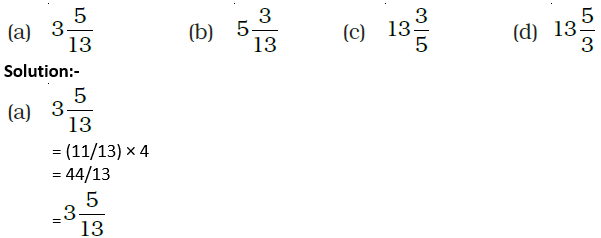
The product of 11/13 and 4 is:


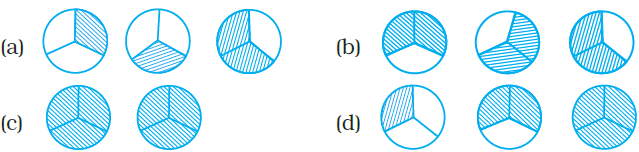
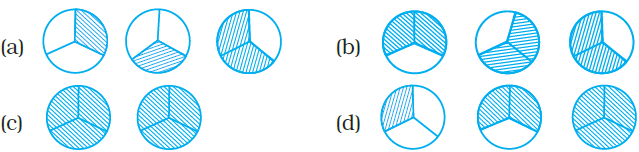
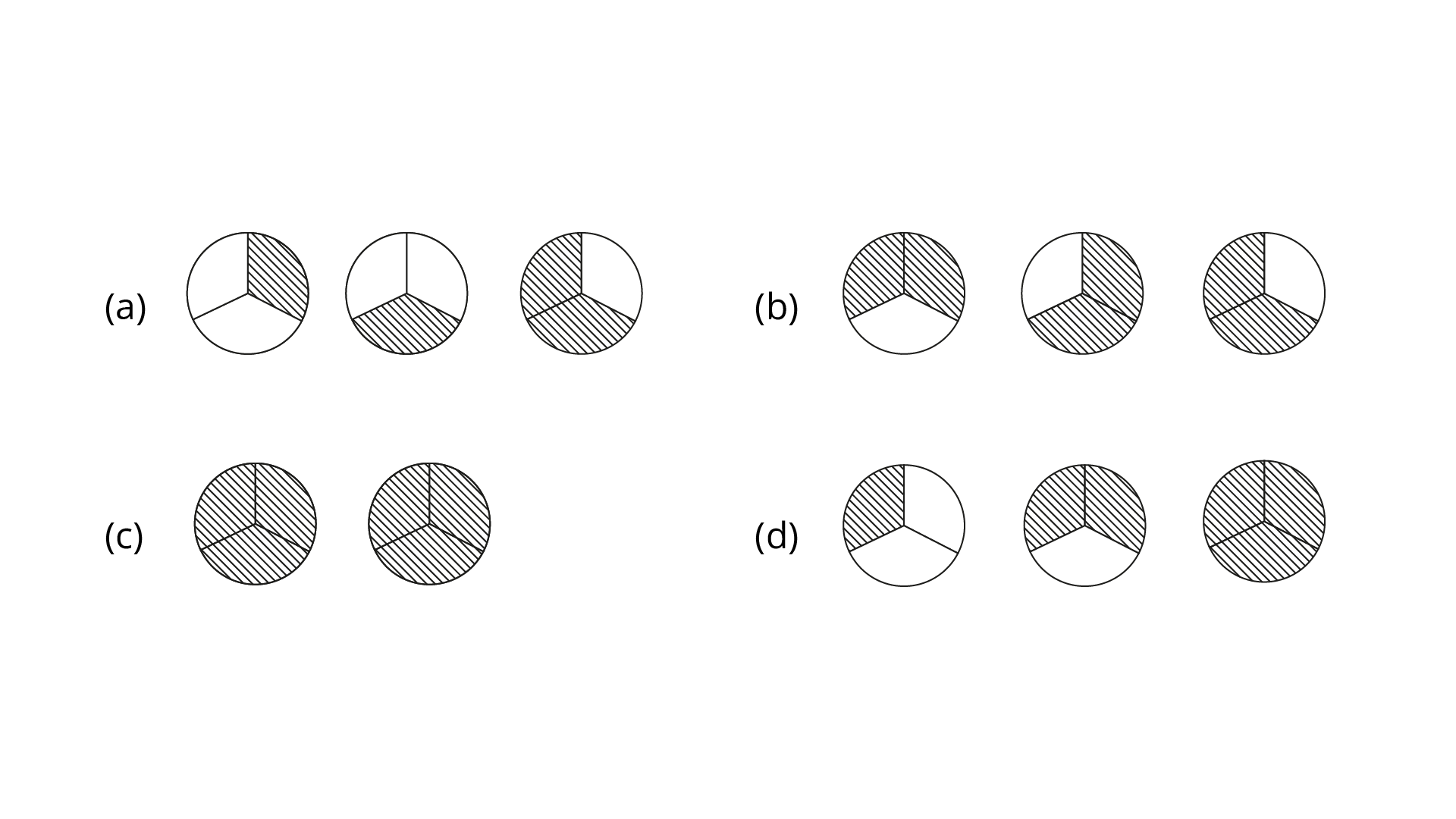
8. Pictorial representation of 3 × 2/3 is:

Solution:-

In the above figure, three circles are divided into 3 equal parts.
Out of 3 equal parts 2 equal parts are hatched.
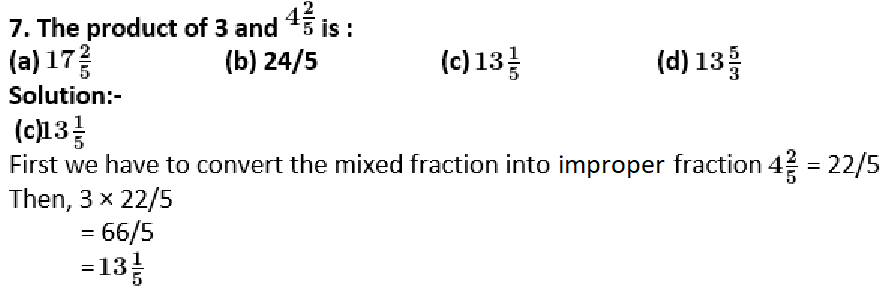
The product of \[{\mathbf{3}}\] and ${\mathbf{4}}\dfrac{{\mathbf{2}}}{{\mathbf{5}}}$ is.:
Ans: Option (c) is correct.
First, we have to convert the mixed fraction into improper fraction $4\dfrac{2}{5} = \dfrac{{22}}{5}$
$ \Rightarrow 3 \times 4\dfrac{2}{5} = 3 \times \dfrac{{22}}{5}=\dfrac{{66}}{5}$
$= 13\dfrac{1}{5}$
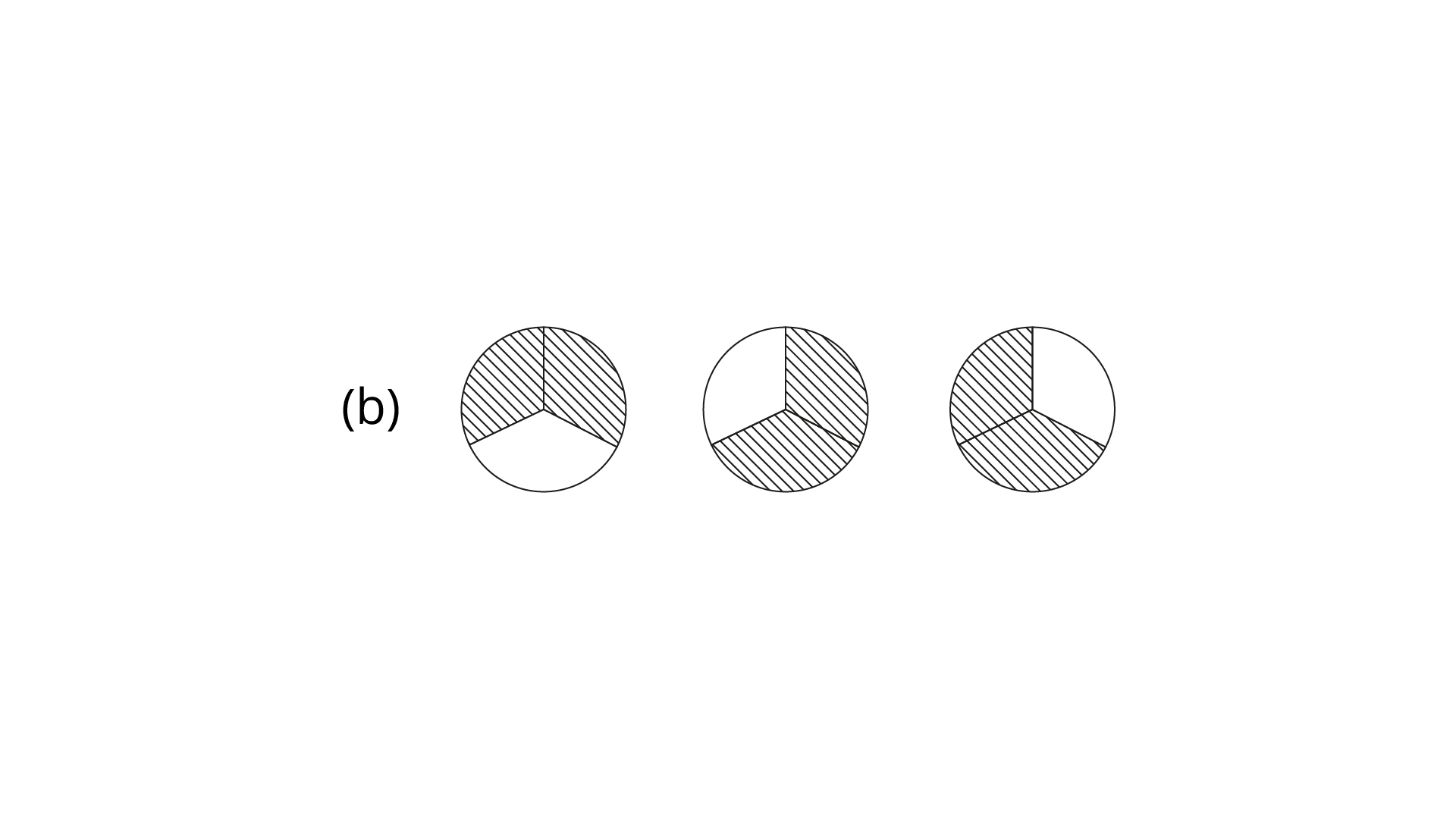
Pictorial representation of ${\mathbf{3}} \times \dfrac{{\mathbf{2}}}{{\mathbf{3}}}$ is:
Ans: Option (b) is correct.
$3 \times \dfrac{2}{3} = \dfrac{2}{3} + \dfrac{2}{3} + \dfrac{2}{3}$
Therefore, pictorial representation is

1/5 ÷ 4/5 equal to:
(a) 4/5 (b) 1/5 (c) 5/4 (d) ¼
Solution:-
(d) ¼
= 1/5 ÷ 4/5
= (1/5)/ (4/5)
= (1/5) × (5/4)
= 5/20 … [divide both numerator and denominator by 5]
= ¼
The product of 0.03 × 0.9 is:
(a) 2.7 (b) 0.27 (c) 0.027 (d) 0.0027
Solution:-
(c) 0.027
0.03 × 0.9 can be written as = (3/100) × (9/10)
= 27/1000
On dividing a decimal by 1000, the decimal point is shifted to the left by three places.
= 0.027