My Cart
Your Cart 0

    Your cart is empty.

  • Total (Amount) ₹0.00
NCERT Exemplar · Class 7 · Maths

Chapter 6: Triangles

Practice each question, then open the answer or worked solution.

Questions

80 questions
Q1Written answer

The sides of a triangle have lengths (in cm) 10, 6.5 and a, where a is a whole number. The minimum value that a can take is

(a) 6 (b) 5 (c) 3 (d) 4

Show solutionHide solution
Worked solution

Solution:-

(d) 4

In the question two sides are given, 10 and 6.5.

We know that, the sum of the lengths of any two sides of a triangle is always greater than the length of the third side.

So, 6.5 + a = 10

a > 10 – 6.5

a > 3.5 i.e. 4
Q2Written answer

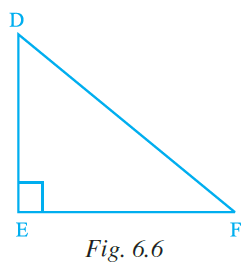
Triangle DEF of Fig. 6.6 is a right triangle with ∠E = 90°. What type of angles are ∠D and ∠F?

NCERT Exemplar Class 7 Maths Solutions Chapter 6 Image 1

(a) They are equal angles

(b) They form a pair of adjacent angles

(c) They are complementary angles

(d) They are supplementary angles

Show solutionHide solution
Worked solution

Solution: –

(c) They are complementary angles

Q3Written answer

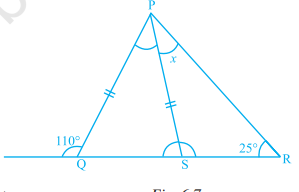
In Fig. 6.7, PQ = PS. The value of x is

(a) 35o (b) 45o (c) 55o (d) 70o

NCERT Exemplar Class 7 Maths Solutions Chapter 6 Image 2

Show solutionHide solution
Worked solution

Solution:-

(b) 45o

From the given figure,

In triangle PQS, ∠PSQ + ∠QPS = 110o … [from exterior angle property of a triangle]

We know that, sum of all angles of the triangle is equal to 180o.

So, ∠PSQ + ∠QPS + ∠PQS = 180o

∠PQS = 180o – 110o

∠PQS = 70o

Now, consider the triangle PRS,

∠PSQ = x + 25o … [from the exterior angle property of a triangle]

x = 70o – 25o

x = 45o

Q4Written answer

In a right-angled triangle, the angles other than the right angle are

(a) obtuse (b) right (c) acute (d) straight

Show solutionHide solution
Worked solution

Solution:-

(c) acute

Q5Written answer

In an isosceles triangle, one angle is 70°. The other two angles are of

(i) 55° and 55° (ii) 70° and 40° (iii) any measure

In the given option(s), which of the above statement(s) are true?

(a) (i) only (b) (ii) only (c) (iii) only (d) (i) and(ii)

Show solutionHide solution
Worked solution

Solution:-

(d) (i) and(ii)

From the question it is given that,

One angle of an isosceles triangle is 70o.

We know that, in an isosceles triangle 2 angles are equal corresponding with 2 equal sides,

If 70o is 3rd angle of triangle,

70o + x + x = 180o

2x + 70o = 180o

2x = 180o – 70o

x = (110o/2)

x = 55o

So, both angles are 55o

Consider the 70o as base angle of an isosceles triangle

Then, 70o + 70o + x = 180o

x = 180o – 140o

x = 40o

So, one angle is 40o and another is 70o

Q6Written answer

In a triangle, one angle is of 90°. Then

(i) The other two angles are of 45° each

(ii) In the remaining two angles, one angle is 90° and other is 45°

(iii) Remaining two angles are complementary In the given option(s) which is true?

(a) (i) only (b) (ii) only (c) (iii) only (d) (i) and (ii)

Show solutionHide solution
Worked solution

Solution:-

(c) (iii) only

Q7Written answer

Lengths of the sides of a triangle are 3 cm, 4 cm and 5 cm. The triangle is

(a) Obtuse angled triangle (b) Acute-angled triangle

(c) Right-angled triangle (d) An Isosceles right triangle

Show solutionHide solution
Worked solution

Solution:-

(c) Right-angled triangle

Q8Written answer

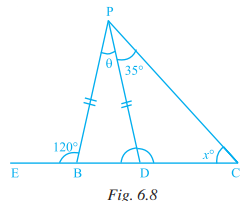
In Fig. 6.8, PB = PD. The value of x is

(a) 85o (b) 90o (c) 25o (d) 35o

NCERT Exemplar Class 7 Maths Solutions Chapter 6 Image 3

Show solutionHide solution
Worked solution

Solution:-

(c) 25o

The exterior angle of a triangle is equal to the sum of 2 opposite interior angles.

As BC is a straight line

∠PBD + 120° = 180°

∠PBD = 180° – 120°

∠PBD = 60°

Given in an isosceles ΔPBD, PB = PD

∴ ∠PBD = ∠PDB

With exterior angle ∠PSQ equal to the sum of opposite interior angles

∠PDB = ∠DPC + ∠PCD [Exterior Angle Property]

60° = x + 35°

x = 60° – 35°

x = 25°

Q9Written answer

In ∆PQR,

(a) PQ – QR > PR

(b) PQ + QR < PR

(c) PQ – QR< PR

(d) PQ + PR< QR

Show solutionHide solution
Worked solution

Solution:-

(c) PQ – QR < PR

The difference between the lengths of any two sides of a triangle is always smaller than the length of the third side.

Q10Written answer

In ∆ ABC,

(a) AB + BC > AC

(b) AB + BC < AC

(c) AB + AC < BC

(d) AC + BC < AB

Show solutionHide solution
Worked solution

Solution:-

(a) AB + BC > AC

The sum of the lengths of any two sides of a triangle is always greater than the length of the third side.