My Cart
Your Cart 0

    Your cart is empty.

  • Total (Amount) ₹0.00
NCERT Exemplar · Class 7 · Maths

Chapter 6: Triangles

Practice each question, then open the answer or worked solution.

Questions

80 questions
Q11Written answer

The top of a broken tree touches the ground at a distance of 12 m from its base. If the tree is broken at a height of 5 m from the ground then the actual height of the tree is

(a) 25 m (b) 13 m (c) 18 m (d) 17 m

Show solutionHide solution
Worked solution

Solution: –

(c) 18 m

From the question it is given that,

The top of a broken tree touches the ground at a distance of 12 m from its base

The broken height of the tree = 5 m

By using Pythagoras theorem,

Hypotenuse2 = Base2 + Height2

Hypotenuse2 = 122 + 52

Hypotenuse2 = 144 + 25

Hypotenuse2 = 169

Hypotenuse = √169

Hypotenuse = 13

So, the total height of tree = 5 + 13 = 18 m
Q12Written answer

The triangle ABC formed by AB = 5 cm, BC = 8 cm, AC = 4 cm is

(a) an isosceles triangle only (b) a scalene triangle only

(c) an isosceles right triangle (d) scalene as well as a right triangle

Show solutionHide solution
Worked solution

Solution: –

(b) a scalene triangle only

A scalene triangle is a triangle that has three unequal sides.

Q13Written answer

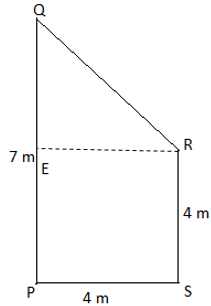
Two trees 7 m and 4 m high stand upright on a ground. If their bases (roots) are 4 m apart, then the distance between their tops is

(a) 3 m (b) 5 m (c) 4 m (d) 11 m

Show solutionHide solution
Worked solution

Solution:-

(b) 5 m

NCERT Exemplar Class 7 Maths Solutions Chapter 6 Image 4

Consider PQ is the tree of height 7m and RS is the tree of height 4 m.

So, consider the triangle QRE, from the Pythagoras theorem,

QR2 = QE2 + ER2

QR2 = 32 + 42

QR2 = 9 + 16

QR2 = 25

QR = √25

QR = 5

Therefore, the distance between the top of the two trees is 5m.

Q14Written answer

If in an isosceles triangle, each of the base angles is 40°, then the triangle is

(a) Right-angled triangle (b) Acute angled triangle

(c) Obtuse angled triangle (d) Isosceles right-angled triangle

Show solutionHide solution
Worked solution

Solution: –

(c) Obtuse angled triangle

We know that, sum of interior angles of triangle is equal to 180o.

Let us assume the 3rd angle be Q,

Then, 40o + 40o + Q = 180o

80o + Q = 180o

Q = 180 – 80

Q = 100o

An obtuse triangle (or obtuse-angled triangle) is a triangle with one obtuse angle (greater than 90°) and two acute angles. Since a triangle’s angles must sum to 180o.

Q15Written answer

If two angles of a triangle are 60° each, then the triangle is

(a) Isosceles but not equilateral (b) Scalene

(c) Equilateral (d) Right-angled 

Show solutionHide solution
Worked solution

Solution:-

(c) Equilateral

In an equilateral triangle, each angle has measure 60o.

Q16Written answer

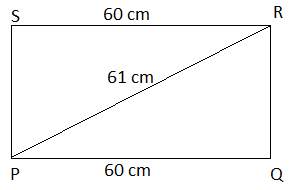
The perimeter of the rectangle whose length is 60 cm and a diagonal is 61 cm is

(a) 120 cm (b) 122 cm (c) 71 cm (d) 142 cm

Show solutionHide solution
Worked solution

Solution:-

(d) 142 cm

NCERT Exemplar Class 7 Maths Solutions Chapter 6 Image 5

Consider the rectangle PQRS,

Given, length of rectangle PQ = 60 cm, Diagonal of the rectangle = 61 cm.

To find out the height of the rectangle, consider the right angled triangle PQR.

From the Pythagoras theorem, PR2 = PQ2 + RQ2

612 = 602 + RQ2

3721 = 3600 + RQ2

RQ2 = 3721 – 3600

RQ2 = 121

RQ = √121

RQ = 11 cm

Then, the perimeter of the rectangle PQRS = 2 (Length + Breadth)

= 2 (60 + 11)

= 2 (71)

= 142 cm

Q17Written answer

In ∆PQR, if PQ = QR and ∠Q = 100o, then ∠R is equal to

(a) 40o (b) 80o (c) 120o (d) 50o

Show solutionHide solution
Worked solution

Solution: –

(a) 40o

Given, In ∆PQR, PQ = QR so it is an isosceles triangle.

Then, ∠P = ∠R

So, let us assume two angles be x

x + x + 100o = 180o

2x = 180o – 100o

2x = 80o

x = 80o/2

x = 40o

Therefore, x = ∠P = ∠R = 40o

Q18Multiple choice

Which of the following statements is not correct?

Show solutionHide solution
Worked solution

Solution: –

(d) Difference of any two sides of a triangle is greater than the third side.

The difference of the lengths of any two sides of a triangle is always smaller than the length of the third side.

Q19Written answer

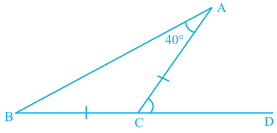
In Fig. 6.9, BC = CA and ∠A = 40. Then, ∠ACD is equal to

(a) 40o (b) 80o (c) 120o (d) 60o

NCERT Exemplar Class 7 Maths Solutions Chapter 6 Image 6

Show solutionHide solution
Worked solution

Solution:-

(b) 80o

We know that, the exterior angle is equal to sum of opposite interior angles.

So, ∠ACD = ∠A + ∠B

As ΔACB is an isosceles triangle with AC = BC

Therefore, ∠A must be equal to ∠B

∠ACD = 40o + 40o

= 80o

Q20Written answer

The length of two sides of a triangle are 7 cm and 9 cm. The length of the third side may lie between

(a) 1 cm and 10 cm

(b) 2 cm and 8 cm

(c) 3 cm and 16 cm

(d) 1 cm and 16 cm

Show solutionHide solution
Worked solution

Solution: –

(c) 3 cm and 16 cm

From the question it is given that, the length of two sides of a triangle are 7 cm and 9 cm.

Let us assume the length of the third side of the triangle be ‘P’.

We Know that, the sum of the two sides of the triangle is greater than the third side.

So, 7 + 9 > P

16 > P

Now, difference between two sides = 9 – 7 = 2

Therefore, the third side is greater than 2 and smaller than 16.

i.e. 3 cm and 16 cm