My Cart
Your Cart 0

    Your cart is empty.

  • Total (Amount) ₹0.00
NCERT Exemplar · Class 12 · Physics

Chapter 2: Electrostatic Potential and Capacitance

Practice each question, then open the answer or worked solution.

Questions

33 questions
Q2.11Written answer

In the circuit shown in the figure, initially, key K1 is closed, and K2 is open. Then K1 is opened, and K2 is closed. Then
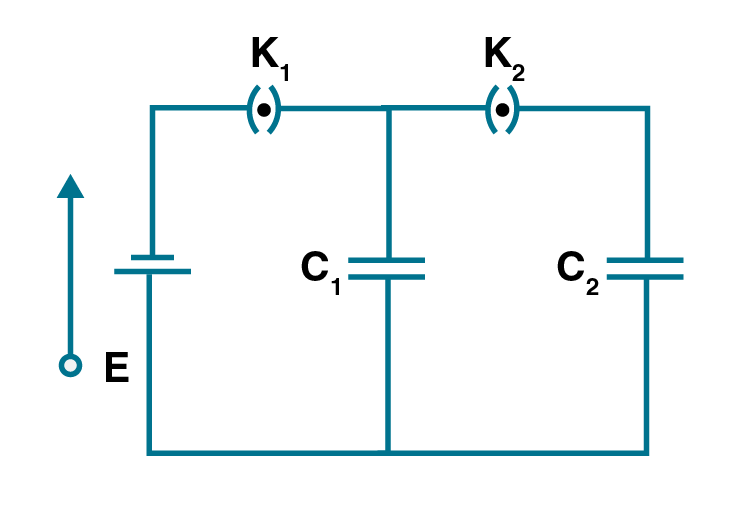
Exemplar Solutions Class 12 Physics Chapter 2 - 4

a) charge on C1 gets redistributed such that V1 = V2

b) charge on C1 gets redistributed such that Q1’ = Q2’

c) charge on C1 gets redistributed such that C1V1 + C2V2 = C1E

d) charge on C1 gets redistributed such that Q1’ + Q2’ = Q

Show solutionHide solution
Worked solution

The correct answer is

a) charge on C1 gets redistributed such that V1 = V2

d) charge on C1 gets redistributed such that Q1’ + Q2’ = Q
Q2.12Written answer

If a conductor has a potential V ≠ 0 and there are no charges anywhere else outside, then

a) there must be charges on the surface or inside itself

b) there cannot be any charge in the body of the conductor

c) there must be charges only on the surface

d) there must be charges inside the surface

Show solutionHide solution
Worked solution

The correct answer is

a) there must be charges on the surface or inside itself

b) there cannot be any charge in the body of the conductor

Q2.13Written answer

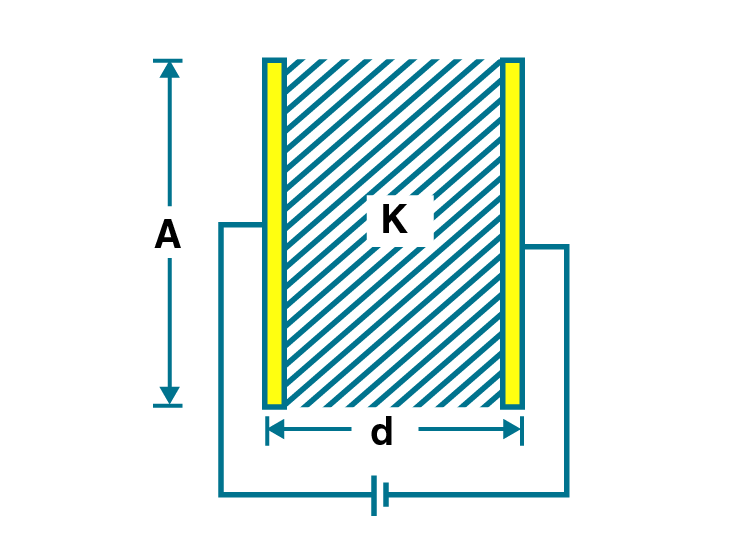
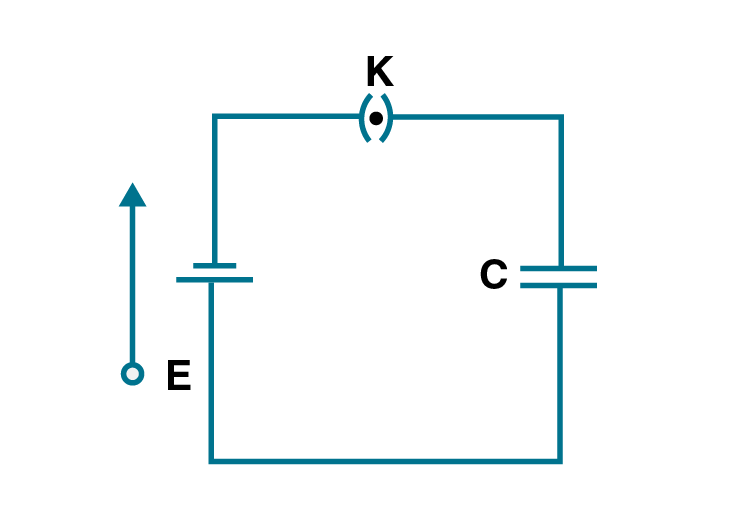
A parallel plate capacitor is connected to a battery, as shown in the figure. Consider two situations:

A: Key K is kept closed, and plates of capacitors are moved apart using the insulating handle

B: Key K is opened, and plates of capacitors are moved apart using the insulating handle

Choose the correct options

Exemplar Solutions Class 12 Physics Chapter 2 - 5

a) In A: Q remains the same but C changes

b) In B: V remains the same, but C changes

c) In A: V remains the same, and hence Q changes

d) In B: Q remains the same, and hence V changes

Show solutionHide solution
Worked solution

The correct answer is

c) In A: V remains the same, and hence Q changes

d) In B: Q remains the same, and hence V changes

Very Short Answers
Q2.14Written answer

Consider two conducting spheres of radii R1 and R2 with R1 > R2. If the two are at the same potential, the larger sphere has more charge than the smaller sphere. State whether the charge density of the smaller sphere is more or less than that of the larger one.

Show solutionHide solution
Worked solution

There are two spheres

Exemplar Solution Class 12 Physics Chapter 2 Img 5

Exemplar Solution Class 12 Physics Chapter 2 Img 6

σ1R1 = σ2R2

σ1/ σ2 = R2/R1

As R2 > R1, that means σ1 > σ2

Therefore, the charge density of the smaller sphere is more than that of the larger sphere.

Q2.15Written answer

Do free electrons travel to a region of higher potential or lower potential?

Show solutionHide solution
Worked solution

The force on the charged particle in the electric field is F = qE

The direction of the electric field and the direction of electrostatic force experienced by the free electrons are in opposite directions

The direction of the electric field is higher than the potential, and therefore, the electrons travel from a lower potential region to a higher potential.

Q2.16Written answer

Can there be a potential difference between two adjacent conductors carrying the same charge?

Show solutionHide solution
Worked solution

Yes, there can be a potential difference between two adjacent conductors carrying the same charge.

Q2.17Written answer

Can the potential function have a maximum or minimum in free space?

Show solutionHide solution
Worked solution

No, the potential function cannot be maximum or minimum in free space as the absence of atmosphere around the conductor prevents the electric discharge.

Q2.18Written answer

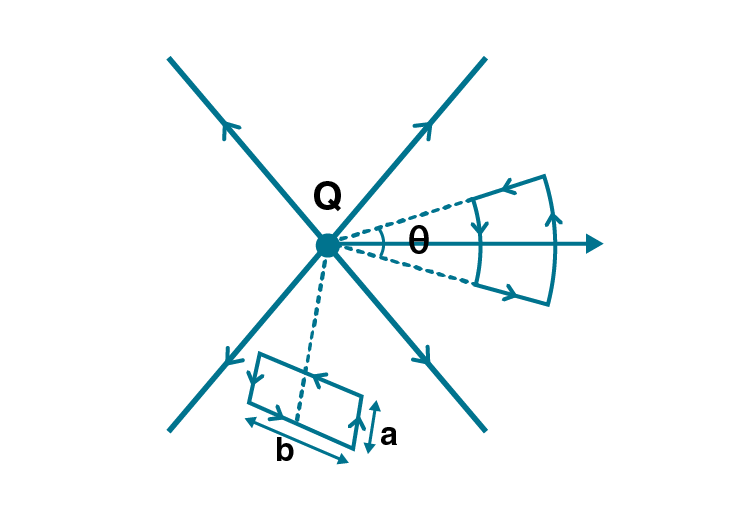
A test charge q is made to move in the electric field of a point charge Q along two different closed paths. The first path has sections along and perpendicular to lines of the electric field, and the second path is a rectangular loop of the same area as the first loop. How does the work done compare in the two cases?

Show solutionHide solution
Worked solution

Exemplar Solutions Class 12 Physics Chapter 2 - 6

Work done is zero in both cases. The work done by the electric force on the charge is in the closed loop, which is equal to zero.

Short Answers
Q2.19Written answer

Prove that a closed equipotential surface with no charge within itself must enclose an equipotential volume.

Show solutionHide solution
Worked solution

In a closed equipotential surface, the potential changes from position to position.

The potential inside the surface is different from the potential gradient caused in the surface that is dV/dr

This also means that the electric field is not equal to zero, and it is given as E = -dV/dr

Therefore, it could be said that the field lines are either pointing inwards or outwards the surface.

So, it can be said that the field lines originate from the charges inside, which contradicts the original assumption. Therefore, the volume inside the surface must be equipotential.

Q2.20Written answer

A capacitor has some dielectric between its plates, and the capacitor is connected to a DC source. The battery is now disconnected, and then the dielectric is removed. State whether the capacitance, energy stored in it, electric field, the charge stored, and voltage will increase, decrease, or remain constant.

Show solutionHide solution
Worked solution
Quantity Battery is removed Battery remains connected
Exemplar Solutions Class 12 Physics Chapter 2 - 7 Exemplar Solutions Class 12 Physics Chapter 2 - 8
Capacity C’ = KC C’ = KC
Charge Q’ = Q Q’ = KQ
Potential V’ = V/K V’ V
Intensity E’ = E/K E’ = E
Energy U’ = U/K U’ = UK