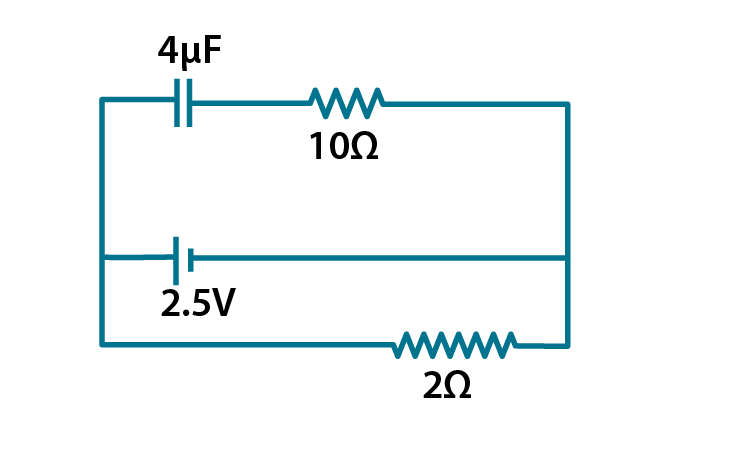
A capacitor of 4μF is connected, as shown in the circuit. The internal resistance of the battery is 0.5Ω. The amount of charge on the capacitor plates will be
a) 0
b) 4μC
c) 16μC
d) 8μC
Show solutionHide solution
The correct answer is d) 8μC
Your cart is empty.
Practice each question, then open the answer or worked solution.
A capacitor of 4μF is connected, as shown in the circuit. The internal resistance of the battery is 0.5Ω. The amount of charge on the capacitor plates will be

a) 0
b) 4μC
c) 16μC
d) 8μC
The correct answer is d) 8μC
A positively charged particle is released from rest in a uniform electric field. The electric potential energy of the charge
a) remains a constant because the electric field is uniform
b) increases because the charge moves along the electric field
c) decreases because the charge moves along the electric field
d) decreases because the charge moves opposite to the electric field
The correct answer is c) decreases because the charge moves along the electric field
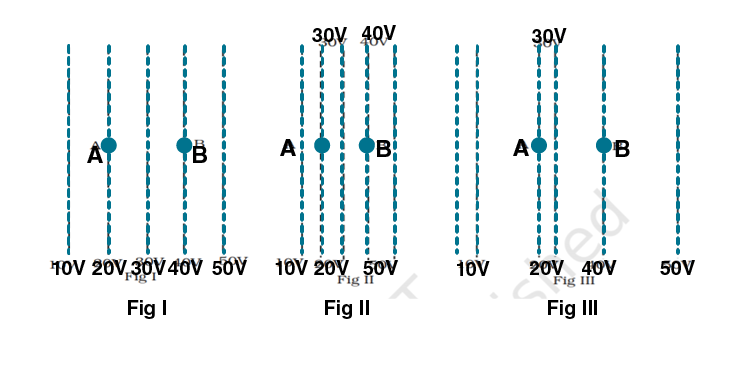
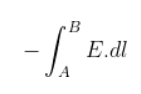
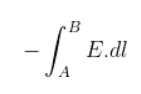
Figure shows some equipotential lines distributed in space. A charged object is moved from point A to point B.

a) the work done in fig (i) is the greatest
b) the work done in fig (ii) is the least
c) the work done is the same in fig (i), fig (ii), and fig (iii)
d) the work done in fig (iii) is greater than fig (ii) but equal to that in fig (i)
The correct answer is c) the work done is the same in fig (i), fig (ii), and fig (iii)
The electrostatic potential on the surface of a charged conducting sphere is 100V. Two statements are made in this regard:
S1: At any point inside the sphere, the electric intensity is zero
S2: At any point inside the sphere, the electrostatic potential is 100V
Which of the following is a correct statement?
a) S1 is true but S2 is false
b) Both S1 and S2 are false
c) S1 is true, S2 is also true, and S1 is the cause of S2
d) S1 is true, and S2 is also true, but the statements are independent
The correct answer is c) S1 is true, S2 is also true, and S1 is the cause of S2
Equipotential at a great distance from a collection of charges whose total sum is not zero are approximately
a) spheres
b) planes
c) paraboloids
d) ellipsoids
The correct answer is a) spheres
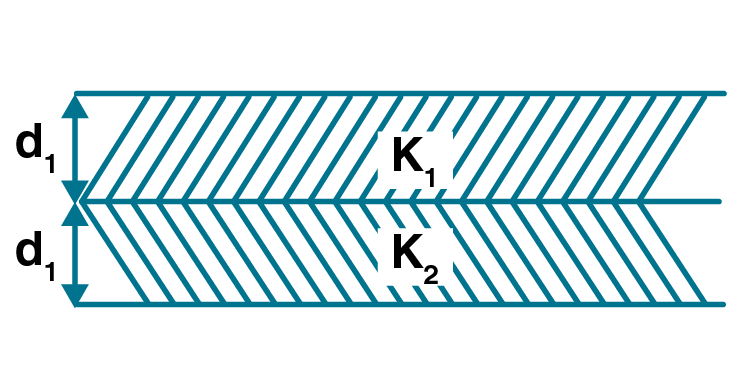
A parallel plate capacitor is made of two dielectric blocks in series. One of the blocks has thickness d1 and dielectric constant k1, and the other has thickness d2 and dielectric constant k2 as shown in the figure. This arrangement can be thought of as a dielectric slab of thickness d = d1 + d2 and effective dielectric constant k. The k is

a) k1d1 + k2d2/d1+d2
b) k1d1 + k2d2/k1 + k2
c) k1k2 (d1 + d2)/(k1d1 + k2d2)
d) 2k1k2/k1 + k2
The correct answer is c) k1k2 (d1 + d2)/(k1d1 + k2d2)
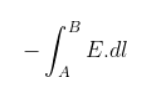
Multiple Choice Questions IIConsider a uniform electric field in the
direction. The potential is a constant
a) in all space
b) for any x for a given z
c) for any y for a given z
d) on the x-y plane for a given z
The correct answer is
b) for any x for a given z
c) for any y for a given z
d) on the x-y plane for a given z
Equipotential surfaces
a) are closer in regions of large electric fields compared to regions of lower electric fields
b) will be more crowded near the sharp edges of a conductor
c) will be more crowded near regions of large charge densities
d) will always be equally spaced
The correct answer is
a) are closer in regions of large electric fields compared to regions of lower electric fields
b) will be more crowded near the sharp edges of a conductor
c) will be more crowded near regions of large charge densities
The work done to move a charge along an equipotential from A to B
a) cannot be defined as

b) must be defined as

c) is zero
d) can have a non-zero value
The correct answer is
b) must be defined as

c) is zero
In a region of constant potential
a) the electric field is uniform
b) the electric field is zero
c) there can be no charge inside the region
d) the electric field shall necessarily change if a charge is placed outside the region
The correct answer is
b) the electric field is zero
c) there can be no charge inside the region