Taking the Bohr radius as a0 = 53pm, the radius of Li++ ion in its ground state, on the basis of Bohr’s model, will be about
(a) 53 pm
(b) 27 pm
(c) 18 pm
(d) 13 pm
Show solutionHide solution
(c) 18 pm
Your cart is empty.
Practice each question, then open the answer or worked solution.
Taking the Bohr radius as a0 = 53pm, the radius of Li++ ion in its ground state, on the basis of Bohr’s model, will be about
(a) 53 pm
(b) 27 pm
(c) 18 pm
(d) 13 pm
(c) 18 pm
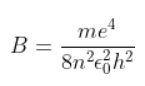
The binding energy of an H-atom, considering an electron moving around a fixed nucleus (proton), is
(m = electron mass). If one decides to work in a frame of reference where the electron is at rest, the proton would be moving around it. By similar arguments, the binding energy would be
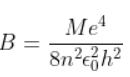
(M = proton mass) This last expression is not correct because
(c) the frame in which the electron is at rest is not inertial
The simple Bohr model cannot be directly applied to calculate the energy levels of an atom with many electrons. This is because
(a) of the electrons not being subject to a central force
(b) of the electrons colliding with each other
(c) of screening effects
(d) the force between the nucleus and an electron will no longer be given by Coulomb’s law
(a) of the electrons not being subject to a central force
For the ground state, the electron in the H-atom has an angular momentum = ℏ, according to the simple Bohr model. Angular momentum is a vector and hence there will be infinitely many orbits with the vector pointing in all possible directions. In actuality, this is not true,
(a) because Bohr model gives incorrect values of angular momentum
O2 molecule consists of two oxygen atoms. In the molecule, nuclear force between the nuclei of the two atoms
(a) is not important because nuclear forces are short-ranged
(b) is as important as an electrostatic force for binding the two atoms
(c) cancels the repulsive electrostatic force between the nuclei
(d) is not important because the oxygen nucleus have an equal number of neutrons and protons
(a) is not important because nuclear forces are short-ranged
Two H atoms in the ground state collide inelastically. The maximum amount by which their combined kinetic energy is reduced is
(a) 10.20 eV
A set of atoms in an excited state decays.
(a) in general to any of the states with lower energy
(b) into a lower state only when excited by an external electric field
(c) all together simultaneously into a lower state
(d) to emit photons only when they collide
(a) in general to any of the states with lower energy
Multiple Choice Questions IIAn ionised H-molecule consists of an electron and two protons. The protons are separated by a small distance of the order of angstrom. In the ground state,
(a) the electron would not move in circular orbits
(b) the energy would be (2)4 times that of an H-atom
(c) the electrons, the orbit would go around the protons
(d) the molecule will soon decay in a proton and an H-atom
(a) the electron would not move in circular orbits
(c) the electrons, the orbit would go around the protons
Consider aiming a beam of free electrons towards free protons. When they scatter, an electron and a proton cannot combine to produce an H-atom,
(a) because of energy conservation
(b) without simultaneously releasing energy in the form of radiation
(c) because of momentum conservation
(d) because of angular momentum conservation
(a) because of energy conservation
(b) without simultaneously releasing energy in the form of radiation
The Bohr model for the spectra of an H-atom
(a) will not be applicable to hydrogen in the molecular from
(b) will not be applicable as it is for a He-atom
(c) is valid only at room temperature
(d) predicts continuous as well as discrete spectral lines
(a) will not be applicable to hydrogen in the molecular from
(b) will not be applicable as it is for a He-atom