My Cart
Your Cart 0

    Your cart is empty.

  • Total (Amount) ₹0.00
NCERT Exemplar · Class 12 · Physics

Chapter 11: Dual Nature of Radiation and Matter

Practice each question, then open the answer or worked solution.

Questions

29 questions
Q11.21Written answer

Assuming an electron is confined to a 1nm wide region, find the uncertainty in momentum using the Heisenberg Uncertainty principle. You can assume the uncertainty in position ∆x as 1nm. Assuming p = ∆p, find the energy of the electron in electron volts.

Show solutionHide solution
Worked solution

As the electrons rotate in a circular path, ∆r = 1 nm = 10-9 m

∆p = h/∆x

∆p = (331/314) × 10-25

E = 1/2 mv2 = ∆p2/2m

E = 3.8 × 10⁻² eV

Q11.22Written answer

Two monochromatic beams A and B of equal intensity I, hit a screen. The number of photons hitting the screen by beam A is twice that by beam B. Then what inference can you make about their frequencies?

Show solutionHide solution
Worked solution

Let nA be the no.of photons falling per second from beam A and nB be the no.of photons falling per second from beam B.

Given,

No.of photons hitting the screen by A is twice that of B

Therefore, nA = 2nB

Energy from the beam A = hvA

Energy from the beam B = hvB

Intensity = I = nAvA = nBvB

vB = 2vA

Q11.23Written answer

Two particles A and B of de Broglie wavelengths λ1 and λ2 combine to form a particle C. The process conserves momentum. Find the de Broglie wavelength of the particle C. (The motion is one dimensional).

Show solutionHide solution
Worked solution

According to de-Broglie wavelengths,

λ=h/p

p=h/ λ

p1 = h/ λ1

p2 = h/ λ2

p3 = h/ λ3

There are 4 possible cases and they are:

Case 1: When p1 and p2 are positive, then λ3 = λ1 λ1/ λ1+ λ2

Case 2: When p1 and p2 are negative, then λ3 = λ1 λ2/ λ1+ λ2

Case 3: When p1 > 0 and p2 < 0, then λ3 = λ1 λ2/ λ2 – λ1

Case 4: When p1 < 0 and p2 > 0, then λ3 = λ1 λ2/ λ1- λ2

Q11.24Written answer

A neutron beam of energy E scatters from atoms on a surface with a spacing d = 0.1nm. The first maximum of intensity in the reflected beam occurs at θ = 30°. What is the kinetic energy E of the beam in eV?

Show solutionHide solution
Worked solution

From Bragg’s law, 2d sin θ = nλ

p = h/λ = 6.6 × 10⁻²⁴ kg m/s

E = 1/2 mv2 = p2/2m

E = 0.085 eV

Long Answers
Q11.25Written answer

Consider a thin target (10–2m square, 10–3m thickness) of sodium, which produces a photocurrent of 100µA when a light of intensity 100W/m2 (λ = 660nm) falls on it. Find the probability that a photoelectron is produced when a photon strikes a sodium atom. [Take density of Na = 0.97 kg/m3].

Show solutionHide solution
Worked solution

Area = 10-4 m2

Thickness = 10-3 m

Current = 10-4 A

Intensity = 100 W/m2

Mass = (volume)(density) = 0.97 × 10⁻⁴ gm

No.of target atoms = 0.254 × 10¹⁹

Total energy = nhv

Where n = 3.3 × 10¹⁶

The probability of emission of photoelectrons is 7.5 × 10⁻²¹

Q11.26Written answer

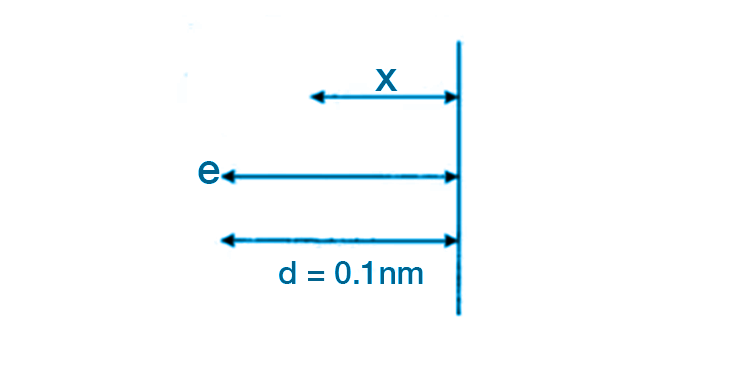
Consider an electron in front of the metallic surface at a distance d (treated as an infinite plane surface). Assume the force of attraction by the plate is given as 2 2 0 1 4 4 q πε d Calculate work in taking the charge to an infinite distance from the plate. Taking d = 0.1nm, find the work done in electron volts. [Such a force law is not valid for d < 0.1nm].

Show solutionHide solution
Worked solution

Exemplar Solutions Physics Class 12 Chapter 11 - 15

The figure shows that an electron is displaced slowly. The distance covered by the electron is x and this happens by the means of an external force

F = q2/4×4πε0d2

d = 0.1 nm = 10-10 m

Let x be the distance of the electron and the force of attraction on it be

Fx = q2/4×4πε0d2

Therefore, work done by the external force is integral of force from d to infinity.

Therefore, work done = 3.6 eV

Q11.27Written answer

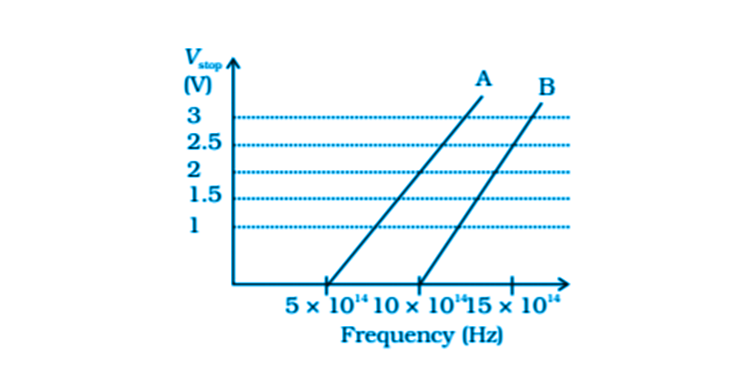
A student performs an experiment on the photoelectric effect, using two materials A and B. A plot of Vstop vs ν is given in the figure.

(i) Which material A or B has a higher work function?

(ii) Given the electric charge of an electron = 1.6 × 10⁻¹⁹ C, find the value of h obtained from the experiment for both A and B. Comment on whether it is consistent with Einstein’s theory

Exemplar Solutions Physics Class 12 Chapter 11 - 16

Show solutionHide solution
Worked solution

i) The threshold frequency of A is

vOA = 5 × 10¹⁴ Hz

The threshold frequency of B is

vOB = 10 × 1014 Hz

Work function is ϕ = hv0

ϕOA/ ϕOB = 5 × 10¹⁴/10 × 1014 < 1

ϕOA < ϕOB

Q11.28Written answer

A particle A with a mass mA is moving with a velocity v and hits a particle B (mass mB) at rest (one dimensional motion). Find the change in the de Broglie wavelength of the particle A. Treat the collision as elastic.

Show solutionHide solution
Worked solution

According to the law of conservation of momentum,

mAv + mB0 = mAv1 + mBv2

mA(v-v1) = mBv2

1/2 mAv2 = 1/2 mAv12 + 1/2mBv22

mA(v-v1)(v+v1) = mBv22

v1 = (mA-mB/mA+mB)v

v2 = (2mA/mA+mB)v

λinitial = h/mAv

λfinal = h/mAv1

∆λ = λfinal – λinitial = h/mAv(mA+mB/mA-mB)-1

Q11.29Written answer

Consider a 20 W bulb emitting light of wavelength 5000 A ° and shining on a metal surface kept at a distance 2m. Assume that the metal surface has work function of 2 eV and that each atom on the metal surface can be treated as a circular disk of radius 1.5 A ° .

(i) Estimate no. of photons emitted by the bulb per second. [Assume no other losses]

(ii) Will there be photoelectric emission?

(iii) How much time would be required by the atomic disk to receive energy equal to work function (2 eV)?

(iv) How many photons would atomic disk receive within time duration calculated in (iii) above?

(v) Can you explain how photoelectric effect was observed instantaneously?

Show solutionHide solution
Worked solution

Given,

P = 20W

λ = 5000 Ao = 5000 × 10-10 m

d = 2m

ϕ0 = 2 eV

r = 1.5 × 10⁻¹⁰ m

No.of photon emitted per second by the bulb = n’ = dN/dt

i) No.of photon emitted by bulb per second = n’ = p λ/hc = 5 × 10¹⁹ sec

ii) Energy of the incident photon = hc/ λ = 2.48 eV

iii) Time required by the atomic disk to receive energy is = 28.4 sec

iv) No.of photons received by the atomic disk = 2

v) Photoelectric emission is instantaneous as the collision time between the free electron and the incident photon is very less.

The chapter Dual Nature of Radiation and Matter introduces students to the concept of matter that propagates through radiation. Under the close observation of a microscope, we can see that matter exists as both a wave, as well as a particle.

Some of the major topics covered in this chapter are

  1. Einstein’s Photoelectric Emission
  2. Emission of Electrons
  3. Nature of Matter – Wave and Particle
  4. Study of Photoelectric Effect through Experimentation
  5. Davisson and Germer Experiment