My Cart
Your Cart 0

    Your cart is empty.

  • Total (Amount) ₹0.00
NCERT Exemplar · Class 11 · Maths

Chapter 12: Introduction to Three Dimensional Geometry

Practice each question, then open the answer or worked solution.

Short Answer Questions

50 questions
Q21Written answer

What are the coordinates of the vertices of a cube whose edge is $2\, units$, one of whose vertices coincides with the origin and the three edges passing through the origin, coincides with the positive direction of the axes through the origin?

Show solutionHide solution
Worked solution

Ans: Given: Edge length of the cube $= 2{\text{ units}}$

One of the vertices coincides with the origin.

Three edges passing through the origin coincides with the positive direction of the axes.

Draw a diagram of the cube according to the conditions given. Start from the origin and use the sign convention of the coordinates in a specific quadrant to find the vertices.

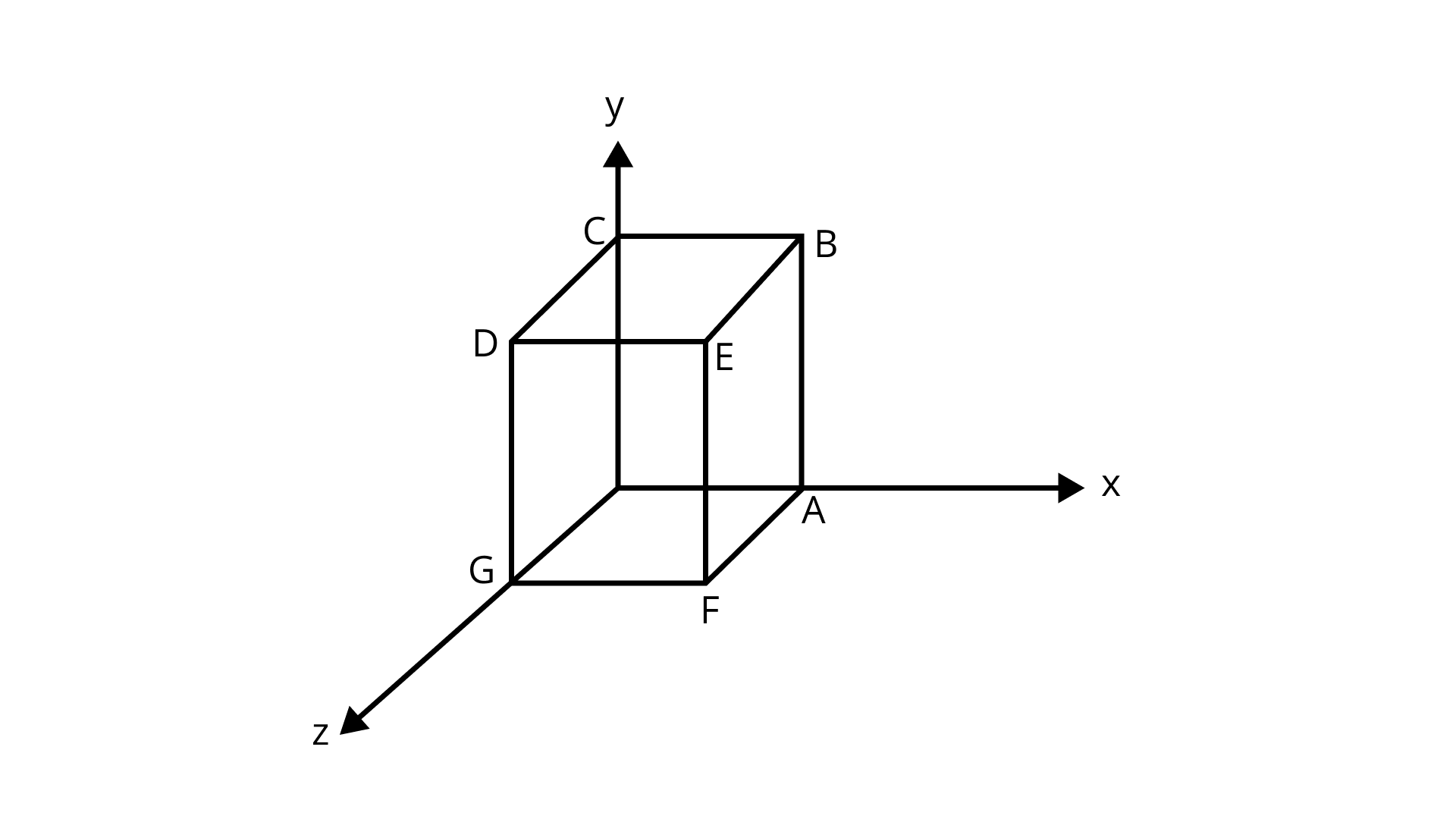
The diagram of the cube according to the given conditions can be shown below: -
seo images


Here one of the vertices is the origin $O$, so its coordinate is $\left( {0,{\text{ }}0,{\text{ }}0} \right)$.

Since point $A$ lies on the $x$ axis so its coordinate is $\left( {2,{\text{ }}0,{\text{ }}0} \right)$.

Point $C$ lies on the $y$ axis so its coordinate is $\left( {0,{\text{ }}2,{\text{ }}0} \right)$.

Point $G$ lies on the $z$ axis so its coordinate is $\left( {0,{\text{ }}0,{\text{ }}2} \right)$.

Since point $B$ lies in the $xy$ plane so its coordinate is $\left( {2,{\text{ }}2,{\text{ }}0} \right)$.

Point $D$ lies in the $yz$ plane so its coordinate is $\left( {0,{\text{ }}2,{\text{ }}2} \right)$.

Point $F$ lies in the $xz$ plane so its coordinate is $\left( {2,{\text{ }}0,{\text{ }}2} \right)$.

Now, the point $E$ lies in the $3 - D$ space so its coordinate is $\left( {2,{\text{ }}2,{\text{ }}2} \right)$.


Q22Written answer

The distance of point $P\left( {3, 4, 5} \right)$ from the $yz$ plane is

(a) 3 units

(b) 4 units

(c) 5 units

(d) 550 units

Show solutionHide solution
Worked solution

Ans: Option (c)

Given:The point $P\left( {3,{\text{ }}4,{\text{ }}5} \right)$.

Use the fact that the distance of a point $P\left( {{x_1},{\text{ }}{y_1},{\text{ }}{z_1}} \right)$ from the $yz$ plane is its $x$ coordinate.

The distance of a point $P\left( {{x_1},{\text{ }}{y_1},{\text{ }}{z_1}} \right)$ from the $yz$ plane is its $x$ coordinate ${x_1}$.

Therefore, the distance of the point $P\left( {3,{\text{ }}4,{\text{ }}5} \right)$ from the $yz$ plane $= 3{\text{ units}}$.


Q23Written answer

What is the length of the perpendicular foot drawn from the point $P\left( {3, 4, 5} \right)$ on $y$ axis?

(a) \[\sqrt {41}\]

(b) \[\sqrt {34}\]

(c) 5

(d) None of these

Show solutionHide solution
Worked solution

Ans: Option (b)

Given: The point $P\left( {3,{\text{ }}4,{\text{ }}5} \right)$.

The length of foot of perpendicular from a point $P\left( {{x_1},{\text{ }}{y_1},{\text{ }}{z_1}} \right)$ on the $y$ axis is $\sqrt {{x_1}^2 + {z_1}^2}$.

Therefore, the length of foot of perpendicular from the point $P\left( {3,{\text{ }}4,{\text{ }}5} \right)$ on the $y$ axis

$= \sqrt {{3^2} + {5^2}}$

$= \sqrt {34}$ 


Q24Written answer

Distance of the point $\left( {3, 4, 5} \right)$ from the origin is

(a) \[\sqrt {50}\]

(b) 3

(c) 4

(d) 5

Show solutionHide solution
Worked solution

Ans: Option (a)

Given:The origin and the point $\left( {3,{\text{ }}4,{\text{ }}5} \right)$.

Use the formula of the distance between the two points $\left( {{x_1},{\text{ }}{y_1},{\text{ }}{z_1}} \right)$ and $\left( {{x_2},{\text{ }}{y_2},{\text{ }}{z_2}} \right)$ given as $\sqrt {{{\left( {{x_2} - {x_1}} \right)}^2} + {{\left( {{y_2} - {y_1}} \right)}^2} + {{\left( {{z_2} - {z_1}} \right)}^2}}$.

The origin is given by the coordinates $\left( {0,{\text{ }}0,{\text{ }}0} \right)$. Let us assume the distance between the points $\left( {0,{\text{ }}0,{\text{ }}0} \right)$ and $\left( {3,{\text{ }}4,{\text{ }}5} \right)$ is $d$.

The distance between the two points having coordinates $\left( {{x_1},{\text{ }}{y_1},{\text{ }}{z_1}} \right)$ and $\left( {{x_2},{\text{ }}{y_2},{\text{ }}{z_2}} \right)$ is given as $\sqrt {{{\left( {{x_2} - {x_1}} \right)}^2} + {{\left( {{y_2} - {y_1}} \right)}^2} + {{\left( {{z_2} - {z_1}} \right)}^2}}$.

$\Rightarrow d = \sqrt {{{\left( {3 - 0} \right)}^2} + {{\left( {4 - 0} \right)}^2} + {{\left( {5 - 0} \right)}^2}}$

$\Rightarrow d = \sqrt {9 + 16 + 25}$

$\Rightarrow d = \sqrt {50}$ 


Q25Written answer

If the distance between the points $\left( {a,{\text{ }}0,{\text{ }}1} \right)$ and $\left( {0,{\text{ }}1,{\text{ }}2} \right)$ is $\sqrt {27}$, then the value of $a$ is

(a) 5

(b) \[\pm 5\]

(c) - 5

(d) None of these

Show solutionHide solution
Worked solution

Ans: Option (b)

Given: The points $\left( {a,{\text{ }}0,{\text{ }}1} \right)$ and $\left( {0,{\text{ }}1,{\text{ }}2} \right)$.

Distance between the two points $= \sqrt {27}$

The distance between the two points having coordinates $\left( {{x_1},{\text{ }}{y_1},{\text{ }}{z_1}} \right)$ and $\left( {{x_2},{\text{ }}{y_2},{\text{ }}{z_2}} \right)$ is given as $\sqrt {{{\left( {{x_2} - {x_1}} \right)}^2} + {{\left( {{y_2} - {y_1}} \right)}^2} + {{\left( {{z_2} - {z_1}} \right)}^2}}$. Therefore, for the points $\left( {a,{\text{ }}0,{\text{ }}1} \right)$ and $\left( {0,{\text{ }}1,{\text{ }}2} \right)$,

$\Rightarrow d = \sqrt {27}$

$\Rightarrow \sqrt {{{\left( {0 - a} \right)}^2} + {{\left( {1 - 0} \right)}^2} + {{\left( {2 - 1} \right)}^2}}  = \sqrt {27}$

$\Rightarrow {a^2} + 2 = 27$

$\Rightarrow{a^2} = 25$ 

Taking square root both the sides,

$\Rightarrow a =  \pm 5$


Q26Written answer

$x -$ axis is the intersection of two planes
(a) xy and xz                                           
(b) yz and zx
(c) xy and yz                                           
(d) none of these

Show solutionHide solution
Worked solution

Ans: Option (a)

Given: $x -$ axis is the intersection of two planes.

Three dimensional geometry involves the mathematics of shapes in $3D$ space and the three coordinates in $XYZ$ plane.

On the $xy$ and $xz$ planes , the line of intersection is the $x -$ axis.

Hence, the two planes are $xy$ and $xz$.


Q27Written answer

Equation of $y$ - axis is considered as
(a) x = 0, y = 0                                          
(b) y = 0, z = 0
(c) z = 0, x = 0
(d) none of these

Show solutionHide solution
Worked solution

Ans: Option (c)

Given: $y -$ axis.

Three dimensional geometry involves the mathematics of shapes in $3D$ space and the three coordinates in $XYZ$ plane.

On the $y -$ axis: $z = 0$, $x = 0$

Hence $z = 0$, $x = 0$.


Q28Written answer

The point $( - 2, - 3, - 4)$ lies  in the

(a) First octant                                           
(b) Seventh octant  
(c) Second octant  
(d) Eighth octant  

Show solutionHide solution
Worked solution

Ans: Option (b)

Given: $( - 2, - 3, - 4)$

Three dimensional geometry involves the mathematics of shapes in $3D$ space and the three coordinates in $XYZ$ plane.

$( - 2, - 3, - 4)$ lies in the seventh octant.

Hence seventh octant is the correct answer.


Q29Written answer

A plane is parallel to $yz -$ plane so it is perpendicular to

(a) x - axis
(b) y - axis
(c) z - axis
(d) none of these 

Show solutionHide solution
Worked solution

Ans: Option (a)

Given: A plane is parallel to $yz -$ plane.

Three dimensional geometry involves the mathematics of shapes in $3D$ space and the three coordinates in $XYZ$ plane.

As the plane is parallel to $yz -$ plane, it is perpendicular to $x -$ axis.

Hence, the plane is perpendicular to $x -$ axis.


Q30Written answer

The locus of a point for which $y = 0$, $z = 0$ is

(a) equation of $x -$ axis
(b) equation of $y -$ axis
(c) equation of $z -$ axis
(d) none of these 

Show solutionHide solution
Worked solution

Ans: Option (a)

Given: $y = 0$, $z = 0$.

Three dimensional geometry involves the mathematics of shapes in $3D$ space and the three coordinates in $XYZ$ plane.

$y = 0$, $z = 0$ is the equation of $x -$ axis.

Hence, the locus is the equation of $x -$ axis.