My Cart
Your Cart 0

    Your cart is empty.

  • Total (Amount) ₹0.00
NCERT Exemplar · Class 11 · Maths

Chapter 4: Principle of Mathematical Induction

Practice each question, then open the answer or worked solution.

Exercise · Page 70

Textbook page 70 · 14 questions
Q2Written answer

Give an example of a statement P(n) which is true for all n. Justify your answer.

Show solutionHide solution
Worked solution

According to the question,

P(n) which is true for all n.

Let P(n) be,
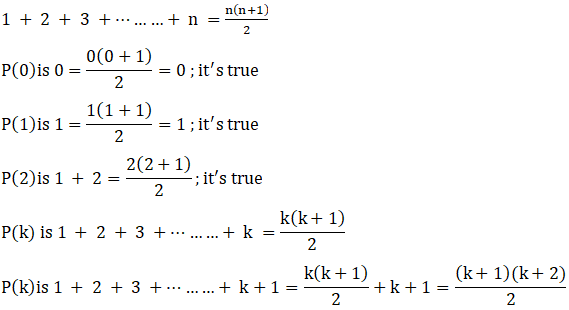
NCERT Exemplar Solutions Class 11 Maths Chapter 4-1

⇒ P(k) is true for all k.

Therefore, P(n) is true for all n.

Prove each of the statements in Exercises 3 to 16 by the Principle of Mathematical Induction:

Q3Written answer

4n – 1 is divisible by 3, for each natural number n.

Show solutionHide solution
Worked solution

According to the question,

P(n) = 4n – 1 is divisible by 3.

So, substituting different values for n, we get,

P(0) = 40 – 1 = 0 which is divisible by 3.

P(1) = 41 – 1 = 3 which is divisible by 3.

P(2) = 42 – 1 = 15 which is divisible by 3.

P(3) = 43 – 1 = 63 which is divisible by 3.

Let P(k) = 4k – 1 be divisible by 3,

So, we get,

⇒ 4k – 1 = 3x.

Now, we also get that,

⇒  P(k+1) = 4k+1 – 1

= 4(3x + 1) – 1

= 12x + 3 is divisible by 3.

⇒ P(k+1) is true when P(k) is true

Therefore, by Mathematical Induction,

P(n) = 4n – 1 is divisible by 3 is true for each natural number n.

Q4Written answer

23n – 1 is divisible by7, for all natural numbers n.

Show solutionHide solution
Worked solution

According to the question,

P(n) = 23n – 1 is divisible by 7.

So, substituting different values for n, we get,

P(0) = 20 – 1 = 0 which is divisible by 7.

P(1) = 23 – 1 = 7 which is divisible by 7.

P(2) = 26 – 1 = 63 which is divisible by 7.

P(3) = 29 – 1 = 512 which is divisible by 7.

Let P(k) = 23k – 1 be divisible by 7

So, we get,

⇒ 23k – 1 = 7x.

Now, we also get that,

⇒  P(k+1) = 23(k+1) – 1

= 23(7x + 1) – 1

= 56x + 7

= 7(8x + 1) is divisible by 7.

⇒ P(k+1) is true when P(k) is true.

Therefore, by Mathematical Induction,

P(n) = 23n – 1 is divisible by7, for all natural numbers n.

Q5Written answer

n3 – 7n + 3 is divisible by 3, for all natural numbers n.

Show solutionHide solution
Worked solution

According to the question,

P(n) = n3 – 7n + 3 is divisible by 3.

So, substituting different values for n, we get,

P(0) = 03 – 7×0 + 3 = 3 which is divisible by 3.

P(1) = 13 – 7×1 + 3 = −3 which is divisible by 3.

P(2) = 23 – 7×2 + 3 = −3 which is divisible by 3.

P(3) = 33 – 7×3 + 3 = 9 which is divisible by 3.

Let P(k) = k3 – 7k + 3 be divisible by 3

So, we get,

⇒ k3 – 7k + 3 = 3x.

Now, we also get that,

⇒  P(k+1) = (k+1)3 – 7(k+1) + 3

= k3 + 3k2 + 3k + 1 – 7k – 7 + 3

= 3x + 3(k2 + k – 2) is divisible by 3.

⇒ P(k+1) is true when P(k) is true.

Therefore, by Mathematical Induction,

P(n) = n3 – 7n + 3 is divisible by 3, for all natural numbers n.

Q6Written answer

32n – 1 is divisible by 8, for all natural numbers n.

Show solutionHide solution
Worked solution

According to the question,

P(n) = 32n – 1 is divisible by 8.

So, substituting different values for n, we get,

P(0) = 30 – 1 = 0 which is divisible by 8.

P(1) = 32 – 1 = 8 which is divisible by 8.

P(2) = 34 – 1 = 80 which is divisible by 8.

P(3) = 36 – 1 = 728 which is divisible by 8.

Let P(k) = 32k – 1 be divisible by 8

So, we get,

⇒ 32k – 1 = 8x.

Now, we also get that,

⇒  P(k+1) = 32(k+1) – 1

= 32(8x + 1) – 1

= 72x + 8 is divisible by 8.

⇒ P(k+1) is true when P(k) is true.

Therefore, by Mathematical Induction,

P(n) = 32n – 1 is divisible by 8, for all natural numbers n.

Q7Written answer

For any natural number n, 7n – 2n is divisible by 5.

Show solutionHide solution
Worked solution

According to the question,

P(n) = 7n – 2n is divisible by 5.

So, substituting different values for n, we get,

P(0) = 70 – 20 = 0 Which is divisible by 5.

P(1) = 71 – 21 = 5 Which is divisible by 5.

P(2) = 72 – 22 = 45 Which is divisible by 5.

P(3) = 73 – 23 = 335 Which is divisible by 5.

Let P(k) = 7k – 2k be divisible by 5

So, we get,

⇒ 7k – 2k = 5x.

Now, we also get that,

⇒  P(k+1)= 7k+1 – 2k+1

= (5 + 2)7k – 2(2k)

= 5(7k) + 2 (7k – 2k)

= 5(7k) + 2 (5x) Which is divisible by 5.

⇒ P(k+1) is true when P(k) is true.

Therefore, by Mathematical Induction,

P(n) = 7n – 2n is divisible by 5 is true for each natural number n.

Q8Written answer

For any natural number n, xn – yn is divisible by x – y, where x integers with x ≠ y.

Show solutionHide solution
Worked solution

According to the question,

P(n) = xn – yn is divisible by x – y, x integers with x ≠ y.

So, substituting different values for n, we get,

P(0) = x0 – y0 = 0 Which is divisible by x − y.

P(1) = x − y Which is divisible by x − y.

P(2) = x2 – y2

= (x +y)(x−y) Which is divisible by x−y.

P(3) = x3 – y3

= (x−y)(x2+xy+y2) Which is divisible by x−y.

Let P(k) = xk – yk be divisible by x – y;

So, we get,

⇒ xk – yk = a(x−y).

Now, we also get that,

⇒  P(k+1) = xk+1 – yk+1

= xk(x−y) + y(xk−yk)

= xk(x−y) +y a(x−y) Which is divisible by x − y.

⇒ P(k+1) is true when P(k) is true.

Therefore, by Mathematical Induction,

P(n) xn – yn is divisible by x – y, where x integers with x ≠ y which is true for any natural number n.

Q9Written answer

n3 – n is divisible by 6, for each natural number n ≥ 2.

Show solutionHide solution
Worked solution

According to the question,

P(n) = n3 – n is divisible by 6.

So, substituting different values for n, we get,

P(0) = 03 – 0 = 0 Which is divisible by 6.

P(1) = 13 – 1 = 0 Which is divisible by 6.

P(2) = 23 – 2 = 6 Which is divisible by 6.

P(3) = 33 – 3 = 24 Which is divisible by 6.

Let P(k) = k3 – k be divisible by 6.

So, we get,

⇒ k3 – k = 6x.

Now, we also get that,

⇒  P(k+1) = (k+1)3 – (k+1)

= (k+1)(k2+2k+1−1)

= k3 + 3k2 + 2k

= 6x+3k(k+1) [n(n+1) is always even and divisible by 2]

= 6x + 3×(2y) Which is divisible by 6, where y = k(k+1)

⇒ P(k+1) is true when P(k) is true.

Therefore, by Mathematical Induction,

P(n) = n3 – n is divisible by 6, for each natural number n.

Q10Written answer

n(n2 + 5) is divisible by 6, for each natural number n.

Show solutionHide solution
Worked solution

According to the question,

P(n) = n(n2 + 5) is divisible by 6.

So, substituting different values for n, we get,

P(0) = 0(02 + 5) = 0 Which is divisible by 6.

P(1) = 1(12 + 5) = 6 Which is divisible by 6.

P(2) = 2(22 + 5) = 18 Which is divisible by 6.

P(3) = 3(32 + 5) = 42 Which is divisible by 6.

Let P(k) = k(k2 + 5) be divisible by 6.

So, we get,

⇒ k(k2 + 5) = 6x.

Now, we also get that,

⇒  P(k+1) = (k+1)((k+1)2 + 5) = (k+1)(k2+2k+6)

= k3 + 3k2 + 8k + 6

= 6x+3k2+3k+6

= 6x+3k(k+1)+6[n(n+1) is always even and divisible by 2]

= 6x + 3×2y + 6 Which is divisible by 6.

⇒ P(k+1) is true when P(k) is true.

Therefore, by Mathematical Induction,

P(n) = n(n2 + 5) is divisible by 6, for each natural number n.

Q11Written answer

n2 < 2n for all natural numbers n ≥ 5.

Show solutionHide solution
Worked solution

According to the question,

P(n) is n2 < 2n  for n≥5

Let P(k) = k2 < 2k be true;

⇒ P(k+1) = (k+1)2

= k2 + 2k + 1

2k+1 = 2(2k) > 2k2

Since, n2 > 2n + 1 for n ≥3

We get that,

k2 + 2k + 1 < 2k2

⇒ (k+1)2 < 2(k+1)

⇒ P(k+1) is true when P(k) is true.

Therefore, by Mathematical Induction,

P(n) = n2 < 2n is true for all natural numbers n ≥ 5.