My Cart
Your Cart 0

    Your cart is empty.

  • Total (Amount) ₹0.00
NCERT Exemplar · Class 11 · Maths

Chapter 4: Principle of Mathematical Induction

Practice each question, then open the answer or worked solution.

Exercise · Page 70

Textbook page 70 · 14 questions
Q12Written answer

2n < (n + 2)! for all natural number n.

Show solutionHide solution
Worked solution

According to the question,

P(n) is 2n < (n + 2)!

So, substituting different values for n, we get,

P(0) ⇒ 0 < 2!

P(1) ⇒ 2 < 3!

P(2) ⇒ 4 < 4!

P(3) ⇒ 6 < 5!

Let P(k) = 2k < (k + 2)! is true;

Now, we get that,

⇒ P(k+1) = 2(k+1) ((k+1)+2))!

We know that,

But, we also know that,

= 2(k+1) × (k+3)(k+2)……………3×1 > 2(k+1)

Therefore, 2(k+1) < ((k+1) + 2)!

⇒ P(k+1) is true when P(k) is true.

Therefore, by Mathematical Induction,

P(n) = 2n < (n + 2)! Is true for all natural number n.
Q13Written answer

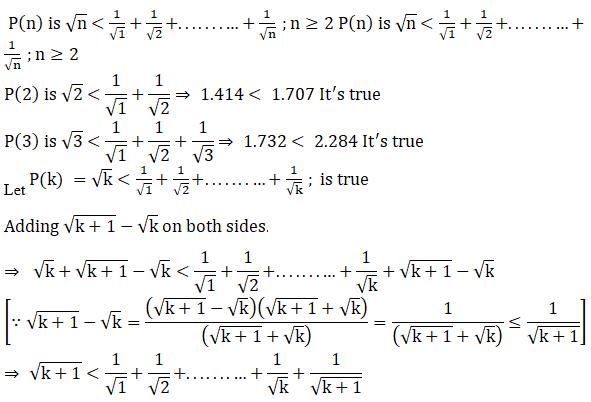
√n < 1/√1 + 1/√2 + … 1/√n, for all natural numbers n ≥ 2.

Show solutionHide solution
Worked solution

According to the question,

NCERT Exemplar Solutions Class 11 Maths Chapter 4-2

⇒ P(k+1) is true when P(k) is true.

Therefore, by Mathematical Induction,

√n < 1/√1 + 1/√2 + … 1/√n, for all natural numbers n ≥ 2

Q14.2Written answer

14. 2 + 4 + 6 + …+ 2n = n2 + n for all natural numbers n.

Show solutionHide solution
Worked solution

According to the question,

P(n) is 2 + 4 + 6 + …+ 2n = n2 + n.

So, substituting different values for n, we get,

P(0) = 0 = 02 + 0 Which is true.

P(1) = 2 = 12 + 1 Which is true.

P(2) = 2 + 4 = 22 + 2 Which is true.

P(3) = 2 + 4 + 6 = 32 + 2 Which is true.

Let P(k) = 2 + 4 + 6 + …+ 2k = k2 + k be true;

So, we get,

⇒ P(k+1) is 2 + 4 + 6 + …+ 2k + 2(k+1) = k2 + k + 2k +2

= (k2 + 2k +1) + (k+1)

= (k + 1)2 + (k + 1)

⇒ P(k+1) is true when P(k) is true.

Therefore, by Mathematical Induction,

2 + 4 + 6 + …+ 2n = n2 + n is true for all natural numbers n.

Q15.1Written answer

15. 1 + 2 + 22 + … 2n = 2n+1 – 1 for all natural numbers n.

Show solutionHide solution
Worked solution

According to the question,

P(n) is 1 + 2 + 22 + … 2n = 2n+1 – 1.

So, substituting different values for n, we get,

P(0) = 1 = 20+1 − 1 Which is true.

P(1) = 1 + 2 = 3 = 21+1 − 1 Which is true.

P(2) = 1 + 2 + 22 = 7 = 22+1 − 1 Which is true.

P(3) = 1 + 2 + 22 + 23 = 15 = 23+1 − 1 Which is true.

Let P(k) = 1 + 2 + 22 + … 2k = 2k+1 – 1 be true;

So, we get,

⇒ P(k+1) is 1 + 2 + 22 + … 2k + 2k+1 = 2k+1 – 1 + 2k+1

= 2×2k+1 – 1

= 2(k+1)+1 – 1

⇒ P(k+1) is true when P(k) is true.

Therefore, by Mathematical Induction,

1 + 2 + 22 + … 2n = 2n+1 – 1 is true for all natural numbers n.