My Cart
Your Cart 0

    Your cart is empty.

  • Total (Amount) ₹0.00
NCERT Exemplar · Class 11 · Maths

Chapter 12: Introduction to Three Dimensional Geometry

Practice each question, then open the answer or worked solution.

Short Answer Questions

50 questions
Q11Written answer

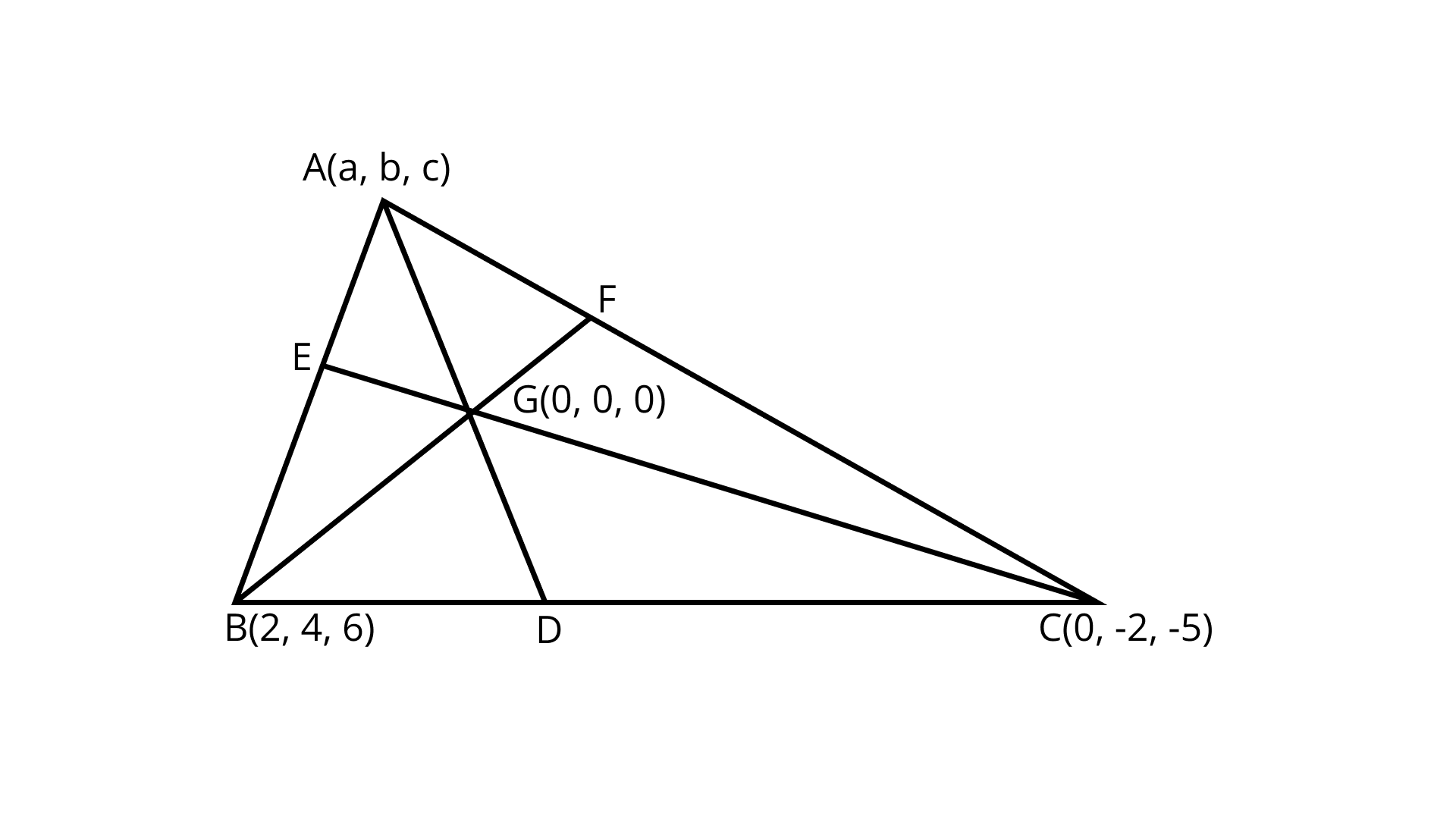
Find the third vertex of triangle whose centroid is origin and two vertices are $\left( {2,4,6} \right)$ and $\left( {0,-2,-5} \right).$

seo images


Show solutionHide solution
Worked solution

Ans: Given:Triangle ${\text{ABC}}$

Two vertices ${\text{B}} = \left( {2,4,6} \right)$ and ${\text{C}} = \left( {0,-2,-5} \right).$

Let the coordinates of the third vertex ${\text{A}}$ be $(a,b,c)$. 

Since the centroid is at origin $(0,0,0)$

Hence, the $x$ coordinate is $\dfrac{{a + 2 + 0}}{3} = 0$

$a + 2 = 0$

$\Rightarrow a =  - 2$

Hence, the $y$ coordinate is $\dfrac{{b + 4 - 2}}{3} = 0$

$b + 2 = 0$

$\Rightarrow b =  - 2$

Hence, the $z$coordinate is $\dfrac{{c + 6 - 5}}{3} = 0$

$c + 1 = 0$

$\Rightarrow c =  - 1$

The third vertex of the triangle is $( - 2, - 2, - 1)$


Q12Written answer

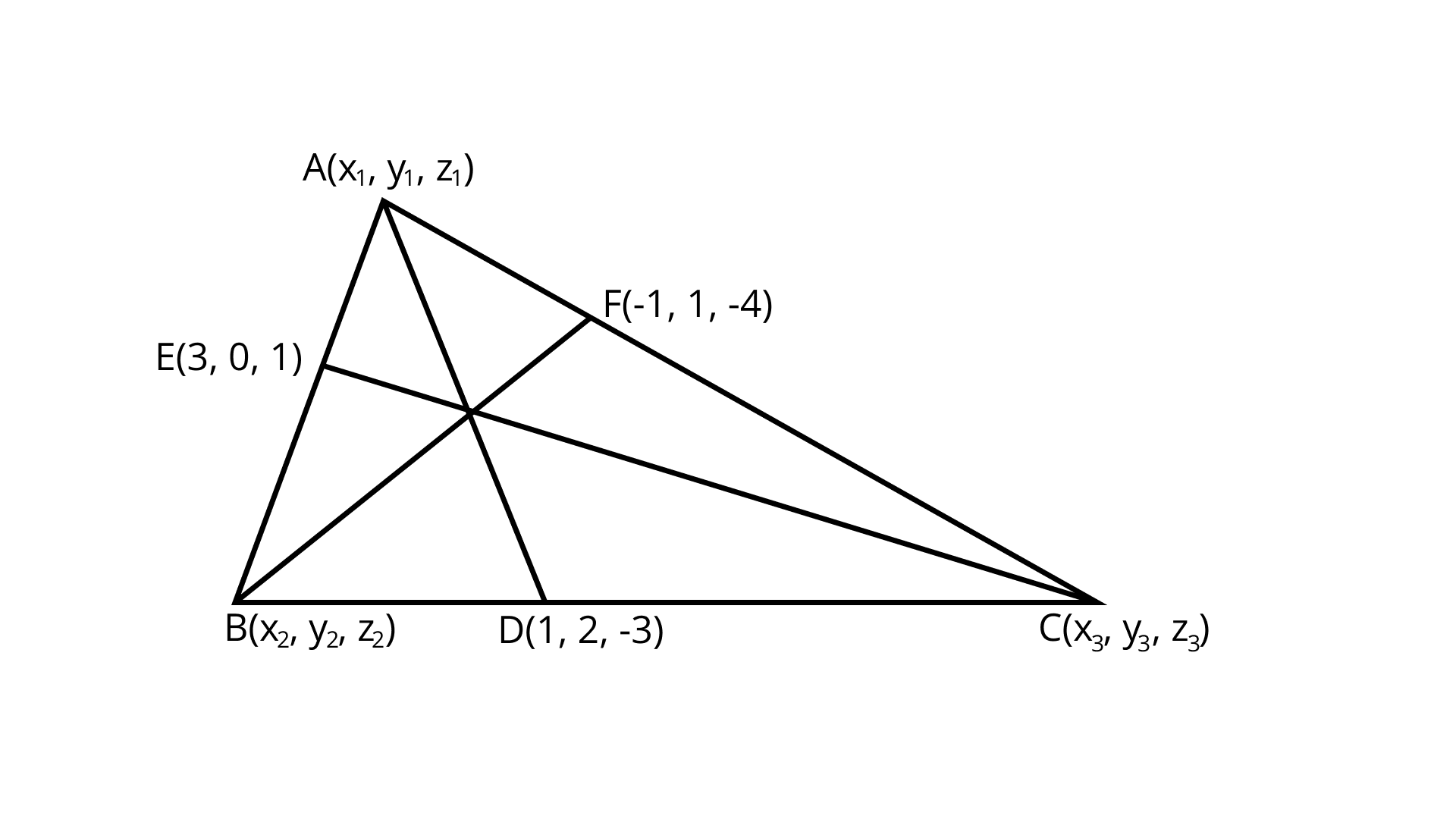
Find the centroid of a triangle, the mid-point of whose sides are $D\left( {1,2,-3} \right),{\kern 1pt} {\kern 1pt} {\kern 1pt} {\kern 1pt} E\left( {3,0,1} \right)$ and $F\left( {-1,1,-4} \right).$

seo images


Show solutionHide solution
Worked solution

Ans: Given: In Triangle $ABC$

Midpoint $D\left( {1,{\text{ }}2,-{\text{ }}3} \right)$

$E\left( {3,0,1} \right)$

$F\left( {-1,1,-4} \right).$

Let the coordinates of the vertices of $\vartriangle {\text{ABC}}$be ${\text{A}}\left( {{x_1},{y_1},{z_1}} \right),{\kern 1pt} {\kern 1pt} {\kern 1pt} {\kern 1pt} {\kern 1pt} {\text{B}}\left( {{x_2},{y_{{2^\prime }}},{z_2}} \right)$ and ${\text{C}}\left( {{x_3},{y_3},{z_3}} \right)$

Midpoint of $BC = (1,2, - 3)$

$1 = \dfrac{{{x_2} + {x_3}}}{2}$

${x_2} + {x_3} = 2$$.....{\text{(1)}}$

$2 = \dfrac{{{y_2} + {y_3}}}{2}$

${y_2} + {y_3} = 4$$.....(2)$

Similarly,

$- 3 = \dfrac{{{z_2} + {z_3}}}{2}$

${z_2} + {z_3} =  - 6$$.....(3)$

Midpoint of ${\text{AB}} = (3,0,1)$

$3 = \dfrac{{{x_1} + {x_2}}}{2}$

${x_1} + {x_2} = 6$$.....(4)$

So,

$0 = \dfrac{{{y_1} + {y_2}}}{2}$

${y_1} + {y_2} = 0$$.....(5)$

Similarly,

$1 = \dfrac{{{z_1} + {z_2}}}{2}$

${z_1} + {z_2} = 2$$.....(6)$

Similarly, midpoint of ${\text{AC}} = ( - 1,1, - 4)$

$- 1{\text{  = }}\dfrac{{{x_1} + {x_3}}}{2}$

${x_1} + {x_3} =  - 2$$.....(7)$

Similarly,

$1 = \dfrac{{{y_1} + {y_3}}}{2}$

${y_1} + {y_3} = 2$$.....(8)$

So,

$- 4 = \dfrac{{{z_1} + {z_3}}}{2}$

${z_1} + {z_3} =  - 8$$.....(9)$

Adding the equation of $(1),\,{\kern 1pt} {\kern 1pt} (4){\kern 1pt} {\kern 1pt} {\kern 1pt} a{\text{nd}}{\kern 1pt} {\kern 1pt} {\kern 1pt} (7)$ get

$2{x_1} + 2{x_2} + 2{x_3} = 2 + 6 - 2 = 6$

${x_1} + {x_2} + {x_3} = 3$

$6 + {x_3} = 3$

$\Rightarrow {x_3} =  - 3$

Again,

${x_1} + 2 = 3$

${x_1} = 1$

Let,

${x_2} - 2 = 3$

${x_2} = 5$

So, ${x_1} = 1,{x_2} = 5$ and ${x_3} =  - 3.$

Similarly, 

Adding the equation $(2),{\kern 1pt} {\kern 1pt} {\kern 1pt} (5),\,{\kern 1pt} a{\text{nd}}{\kern 1pt} {\kern 1pt} {\kern 1pt} (8)$get

$2\left( {{y_1} + {y_2} + {y_3}} \right) = 4 + 0 + 2 = 6$

${y_1} + {y_2} + {y_3} = 3$

${y_1} + 4 = 3$

${y_1} =  - 1$

$0 + {y_3} = 3$

${y_3} = 3$

${y_2} + 2 = 3$

$\Rightarrow {y_2} = 1$

So, ${y_1} =  - 1,{\kern 1pt} {\kern 1pt} {y_2} = 1,{\kern 1pt} {\kern 1pt} {y_3} = 3$

Adding the equation $(3),{\kern 1pt} {\kern 1pt} {\kern 1pt} (6){\kern 1pt} {\kern 1pt} \,a{\text{nd}}{\kern 1pt} {\kern 1pt} {\kern 1pt} (8)$get

$2\left( {{z_1} + {z_2} + {z_3}} \right) =  - 6 + 2 - 8 =  - 12$

${z_1} + {z_2} + {z_3} =  - 6$

${z_1} - 6 =  - 6$

${z_1} = 0$

$2 + {z_3} =  - 6$

${z_3} =  - 8$

${z_3} =  - 8$

${z_2} - 8 =  - 6$

$\Rightarrow {z_2} = 2$

And

${z_1} = 1,{\kern 1pt} {\kern 1pt} {z_2} = 1,{\kern 1pt} {\kern 1pt} {z_3} =  - 8.$

So, the points are ${\text{A}}(1, - 1,0),{\kern 1pt} {\kern 1pt} {\kern 1pt} {\text{B}}(5,1,2)$ and ${\text{C}}( - 3,3, - 8)$.

Centroid of the triangle

$G = \left( {\dfrac{{1 + 5 - 3}}{3},\dfrac{{ - 1 + 1 + 3}}{3},\dfrac{{0 + 2 - 8}}{3}} \right)$

$= (1,1, - 2)$

Hence, the required coordinates $\left( {1,1, - 2} \right).$

Q13Written answer

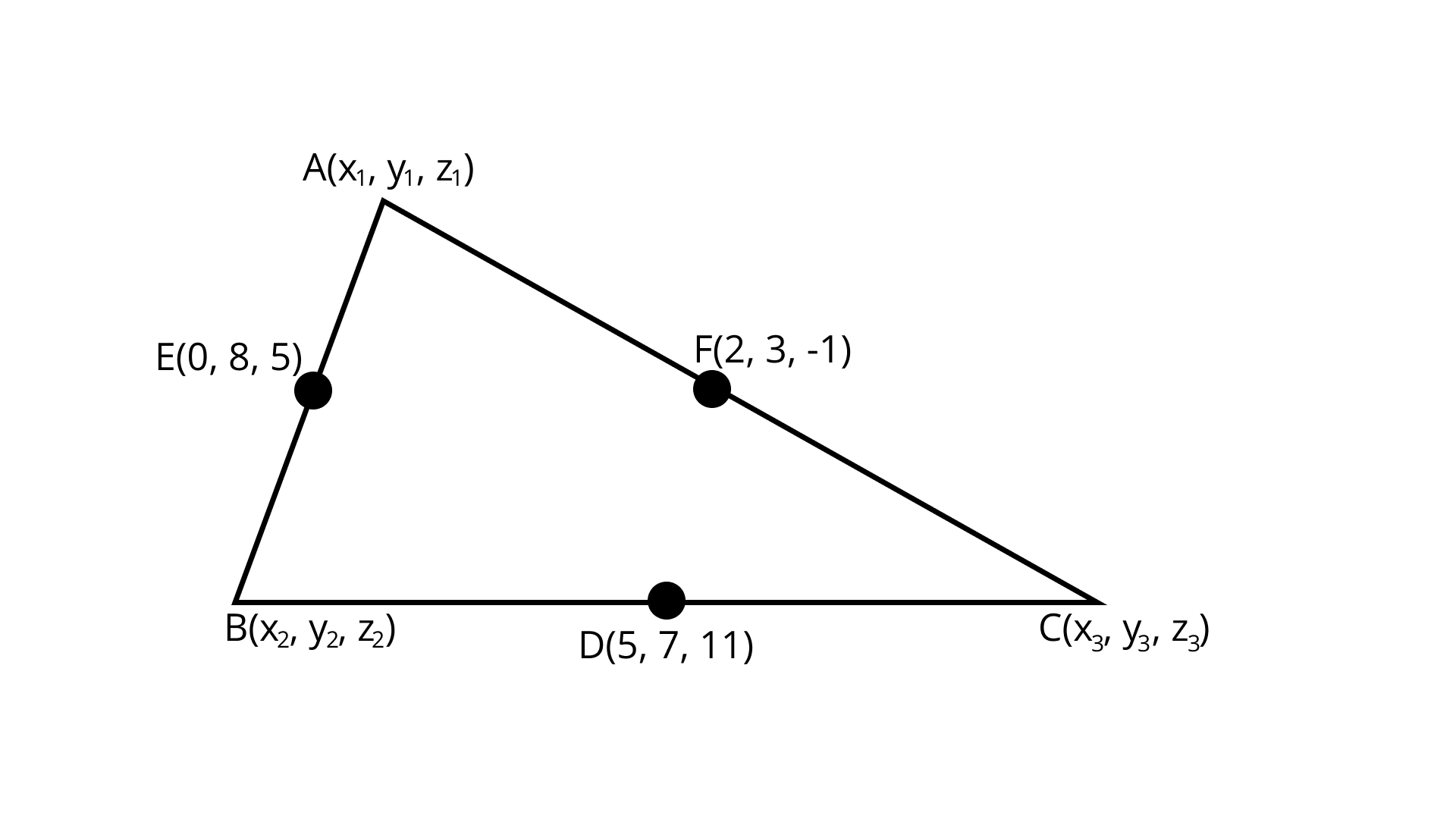
The mid-points of the sides of a triangle are $\left( {5,7,11} \right),{\kern 1pt} {\kern 1pt} {\kern 1pt} {\kern 1pt} {\kern 1pt} \left( {0,8,5} \right)$ and $\left( {2, 3,-1} \right).$ Find its vertices.

Show solutionHide solution
Worked solution

Ans: Given:In Triangle $ABC$

Midpoints are $\left( {5,7,11} \right),{\kern 1pt} {\kern 1pt} {\kern 1pt} {\kern 1pt} \left( {0,8,5} \right)$ and $\left( {2,{\text{ }}3,-1} \right).$

Let the coordinates of the vertices be ${\text{A}}\left( {{x_1},{y_1},{z_1}} \right),{\kern 1pt} {\kern 1pt} {\kern 1pt} {\kern 1pt} {\text{B}}\left( {{x_{{2^\prime }}}{y_{{2^\prime }}}{z_2}} \right)$ and ${\text{C}}\left( {{x_3},{y_3},{z_3}} \right)$ respectively.

seo images


Since ${\text{D}}(5,7,11)$ is the midpoint of ${\text{BC}}$ 

$5 = \dfrac{{{x_2} + {x_3}}}{2}$

${x_2} + {x_3} = 10$$.....(1)$

$7 = \dfrac{{{y_2} + {y_3}}}{2}$

${y_2} + {y_3} = 14$$.....(2)$

$11 = \dfrac{{{z_2} + {z_3}}}{2}$

${z_2} + {z_3} = 22$$.....(3)$

${\text{E}}(0,8,5)$ is the midpoint of ${\text{AB}}$

$0 = \dfrac{{{x_1} + {x_2}}}{2}$

${x_1} + {x_2} = 0$$.....(4)$

$8 = \dfrac{{{y_1} + {y_2}}}{2}$

${y_1} + {y_2} = 16$$.....(5)$

$5 = \dfrac{{{z_1} + {z_2}}}{2}$

${z_1} + {z_2} = 10$$.....(6)$

Similarly, $F(2,3, - 1)$ is the midpoint of $AC$

$2 = \dfrac{{{x_1} + {x_3}}}{2}$

${x_1} + {x_3} = 4$$.....(7)$

$3 = \dfrac{{{y_1} + {y_3}}}{2}$

${y_1} + {y_3} = 6$$.....(8)$

and $- 1 = \dfrac{{{z_1} + {z_3}}}{2}$

${z_1} + {z_3} =  - 2$$.....(9)$

Adding the equation $(1),{\kern 1pt} {\kern 1pt} {\kern 1pt} (4){\kern 1pt} {\kern 1pt} {\text{and}}{\kern 1pt} {\kern 1pt} (7)$

$2\left( {{x_1} + {x_2} + {x_3}} \right) = 10 + 0 + 4$

${x_1} + {x_2} + {x_3} = 7$$.....(10)$

Subtracting $(1)$ from $(10)$

${x_1} = 7 - 10 =  - 3$

Subtracting $(4)$ from $(10)$

${x_3} = 7 - 0 = 7$

Subtracting $(7)$ from $(10)$

${x_2} = 7 - 4 = 3$

Adding the equation $(2),{\kern 1pt} {\kern 1pt} (5){\kern 1pt} {\kern 1pt} {\text{and}}{\kern 1pt} {\kern 1pt} {\kern 1pt} (8)$

$2\left( {{y_1} + {y_2} + {y_3}} \right) = (14 + 16 + 6)$

${y_1} + {y_2} + {y_3} = 18$$.....(11)$

Subtracting $(2)$ from $(11)$

${y_1} = 18 - 14 = 4$

Subtracting $(5)$from $(11)$

${y_3} = 18 - 16 = 2$

Subtracting$(8)$ from $(11)$

${y_2} = 18 - 6 = 12$

Now adding the equation$(3),{\kern 1pt} {\kern 1pt} (6){\kern 1pt} {\kern 1pt} {\kern 1pt} {\text{and}}{\kern 1pt} {\kern 1pt} {\kern 1pt} (9)$

$2\left( {{z_1} + {z_2} + {z_3}} \right) = 22 + 10 - 2$

${z_1} + {z_2} + {z_3} = 15$$.....(12)$

Subtracting $(3)$ from $(12)$

${z_1} = 15 - 22 =  - 7$

Subtracting $(6)$ from $(12)$

${z_3} = 15 - 10 = 5$

Subtracting $(9)$ from $(12)$

${z_2} = 15 + 2 = 17$

So, the required coordinates are ${\text{A}}\left( {{x_1},{y_1},{z_1}} \right),{\kern 1pt} {\kern 1pt} {\kern 1pt} {\kern 1pt} {\text{B}}\left( {{x_2},{y_2},{z_2}} \right)$ and ${\text{C}}\left( {{x_3},{y_3},{z_3}} \right).$

That is ${\text{A}}( - 3,4, - 7),{\kern 1pt} {\kern 1pt} {\kern 1pt} {\kern 1pt} {\kern 1pt} {\text{B}}(3,12,17)$ and ${\text{C}}(7,2,5)$.


Q14Written answer

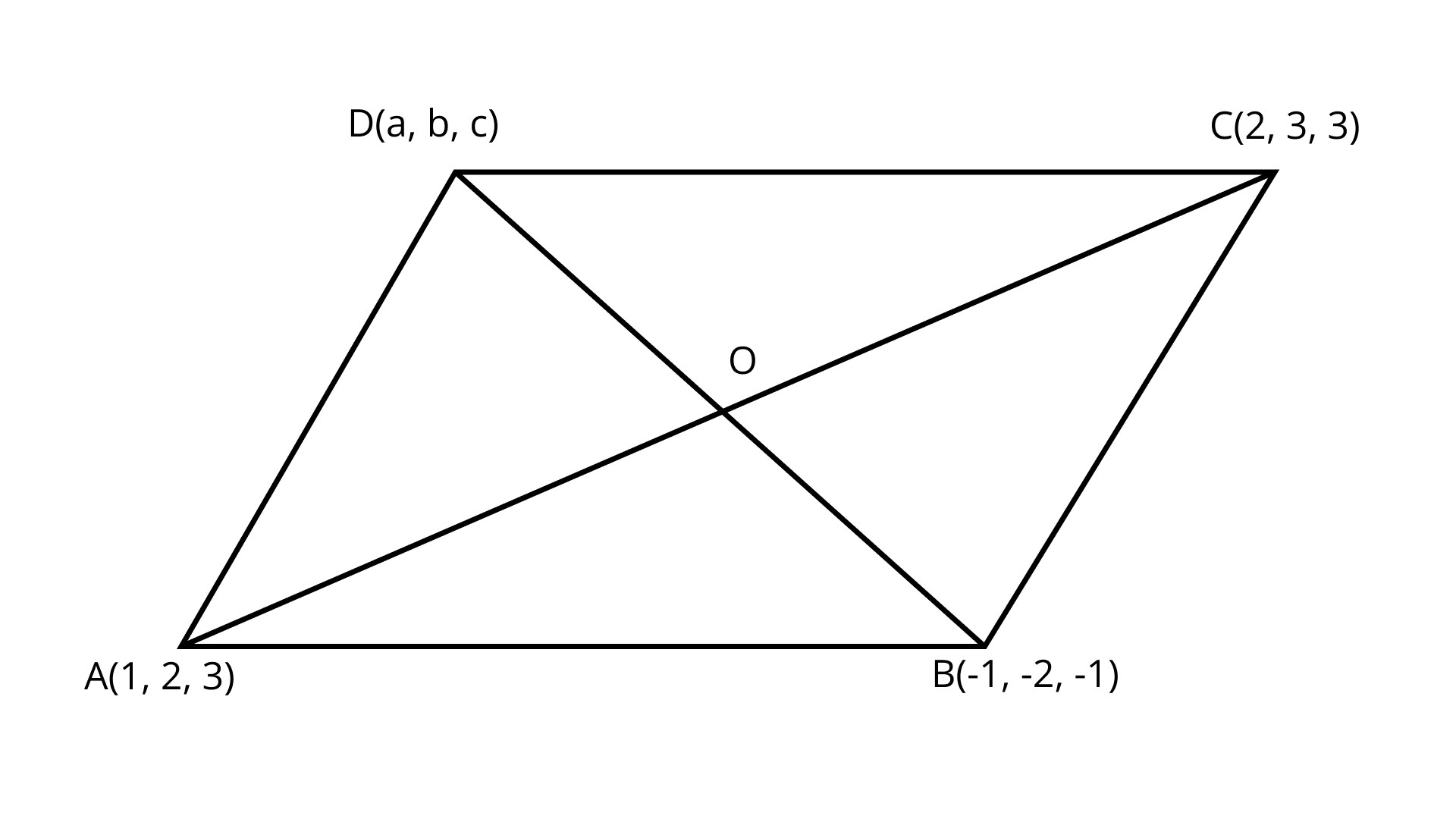
Three vertices of a Parallelogram $ABCD$ are $A\left( {1,2,3} \right), B\left( {- 1,-2,-1} \right)$ and $C\left( {2,3,2} \right).$Find the fourth vertex $D$

Show solutionHide solution
Worked solution

Ans: Given: In parallelogram $ABCD$

${\text{A}}\left( {1,2,3} \right),{\text{ B}}\left( {-{\text{ }}1,-2,-1} \right)$ and$C\left( {2,3,2} \right).$

Let the coordinates of ${\text{D}}$be $\left( {a,{\kern 1pt} {\kern 1pt} {\kern 1pt} b,{\kern 1pt} {\kern 1pt} {\kern 1pt} c} \right).$

The diagonals of a parallelogram bisect each other.

seo images


Midpoint of ${\text{AC}}$

${\text{O}} = \left( {\dfrac{{1 + 2}}{2},\dfrac{{2 + 3}}{2},\dfrac{{3 + 2}}{2}} \right)$ 

$= \left( {\dfrac{3}{2},\dfrac{5}{2},\dfrac{5}{2}} \right)$

Midpoint of $BD$

${\text{O}} = \left( {\dfrac{{a - 1}}{2},\dfrac{{b - 2}}{2},\dfrac{{c - 1}}{2}} \right)$

Equating the corresponding coordinate,

$\dfrac{{a - 1}}{2} = \dfrac{3}{2}$

$\Rightarrow a = 4$

$\dfrac{{b - 2}}{2} = \dfrac{5}{2}$

$\Rightarrow b = 7$

$\dfrac{{c - 1}}{2} = \dfrac{5}{2}$

$\Rightarrow c = 6$

Hence, the coordinates of ${\text{D}} = (4,7,6).$


Q15Written answer

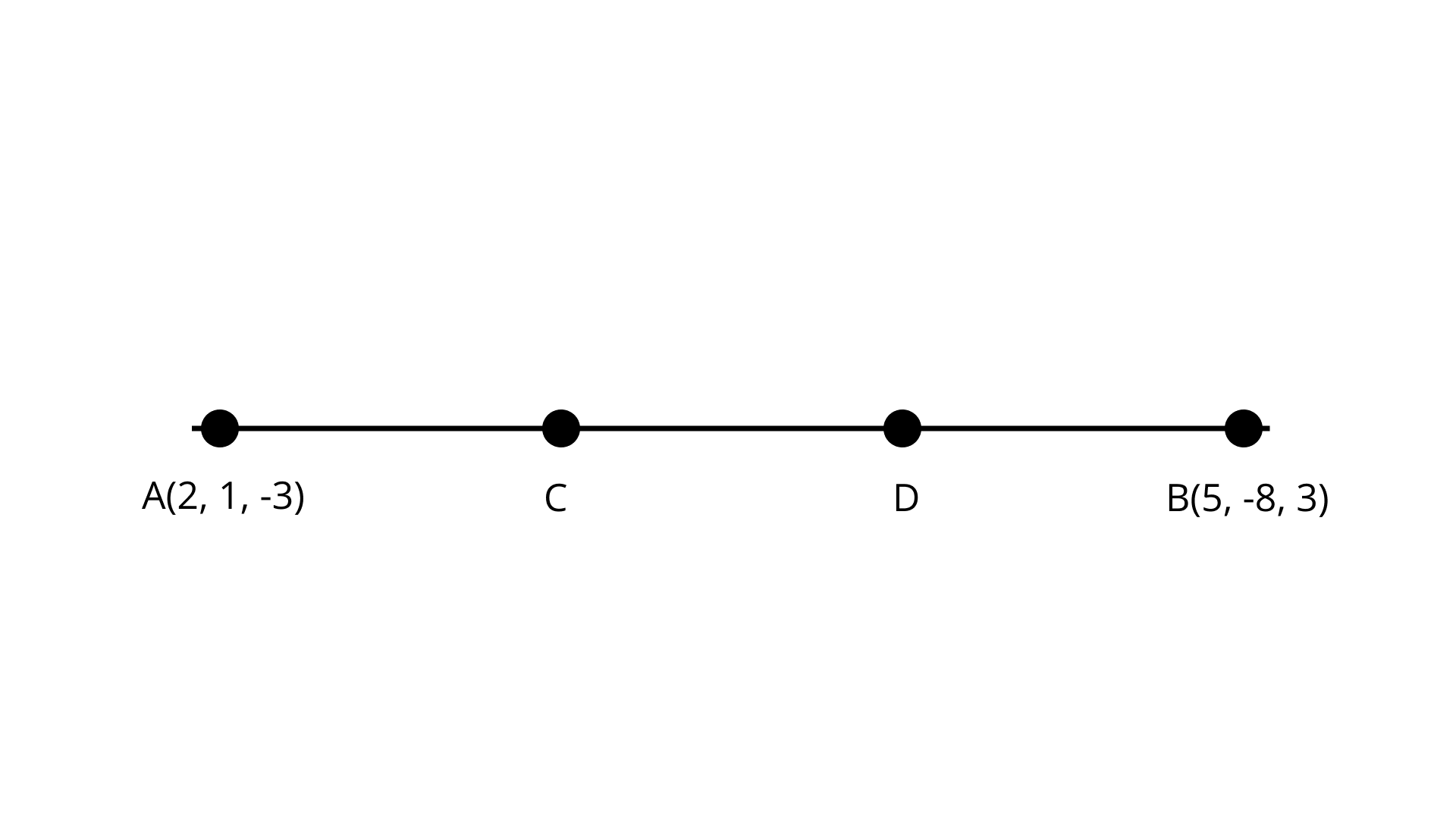
Find the coordinate of the points which trisect the line segment joining the points $A\left( {2,1,-3} \right)$ and$B\left( {5,-8,3} \right)$.

seo images


Show solutionHide solution
Worked solution

Ans: Given: The points ${\text{A}}\left( {2,1,-3} \right)$ and ${\text{B}}\left( {5,-8,3} \right)$.

Let ${\text{C}}$ and ${\text{D}}$be the points which divide the given line ${\text{AB}}$into three equal parts. 

Here ${\text{AC}}:{\text{CB}} = 1:2$

Let $\left( {{x_1},{y_1},{z_1}} \right)$be the coordinates of ${\text{C}}$ 

${x_1} = \dfrac{{1 \times 5 + 2 \times 2}}{{1 + 2}} = 3$

${y_1} = \dfrac{{1 \times  - 8 + 2 \times 1}}{{1 + 2}} =  - 2$

${z_1} = \dfrac{{1 \times 3 + 2 \times  - 3}}{{1 + 2}} =  - 1$

So $C = \left( {3, - 2, - 1} \right).$

Now ${\text{D}}$ is the midpoint $= CB$

Let the coordinates of ${\text{D}}$be $\left( {{x_2},{y_2},{z_2}} \right)$

${x_2} = \dfrac{{3 + 5}}{2} = 4$

${y_2} = \dfrac{{ - 8 - 2}}{2} =  - 5$

${z_2} = \dfrac{{3 - 1}}{2} = 1$

So, ${\text{D}} = (4, - 5,1)$

Hence, the required coordinates are ${\text{C}}(3, - 2, - 1)$ and ${\text{D}}(4, - 5,1).$


Q16Written answer

If the origin is the centroid of a triangle $ABC$ having vertices are $A\left( {a, 1, 3} \right)$, $B\left( { - 2, b,  - 5} \right)$ and $C\left( {4, 7, c} \right)$, find the values of $a$, $b$ and $c$.

Show solutionHide solution
Worked solution

Ans: Given: A triangle $ABC$ whose centroid is the origin.

The vertices of the triangle are $A\left( {a,{\text{ }}1,{\text{ }}3} \right)$, $B\left( { - 2,{\text{ }}b,{\text{ }} - 5} \right)$ and $C\left( {4,{\text{ }}7,{\text{ }}c} \right)$.

Use the formula for the coordinates of a centroid of a triangle given as $\left( {\dfrac{{{x_1} + {x_2} + {x_3}}}{3},{\text{ }}\dfrac{{{y_1} + {y_2} + {y_3}}}{3},{\text{ }}\dfrac{{{z_1} + {z_2} + {z_3}}}{3}} \right)$. Here $\left( {{x_1},{\text{ }}{y_1},{\text{ }}{z_1}} \right)$, $\left( {{x_2},{\text{ }}{y_2},{\text{ }}{z_2}} \right)$ and $\left( {{x_3},{\text{ }}{y_3},{\text{ }}{z_3}} \right)$ are the vertices of the triangle.

Since the centroid of the triangle is the origin, so its coordinates is $\left( {0,{\text{ }}0,{\text{ }}0} \right)$. If a triangle has its vertices $\left( {{x_1},{\text{ }}{y_1},{\text{ }}{z_1}} \right)$, $\left( {{x_2},{\text{ }}{y_2},{\text{ }}{z_2}} \right)$ and $\left( {{x_3},{\text{ }}{y_3},{\text{ }}{z_3}} \right)$ then its centroid is $\left( {\dfrac{{{x_1} + {x_2} + {x_3}}}{3},{\text{ }}\dfrac{{{y_1} + {y_2} + {y_3}}}{3},{\text{ }}\dfrac{{{z_1} + {z_2} + {z_3}}}{3}} \right)$.

$\Rightarrow \left( {\dfrac{{a + \left( { - 2} \right) + 4}}{3},{\text{ }}\dfrac{{1 + b + 7}}{3},{\text{ }}\dfrac{{3 + \left( { - 5} \right) + c}}{3}} \right) = \left( {0,{\text{ }}0,{\text{ }}0} \right)$

$\Rightarrow \left( {\dfrac{{a + 2}}{3},{\text{ }}\dfrac{{b + 8}}{3},{\text{ }}\dfrac{{c - 2}}{3}} \right) = \left( {0,{\text{ }}0,{\text{ }}0} \right)$ 

Equating the respective coordinates and solving,

$a =  - 2$, $b =  - 8$ and $c = 2$


Q17Written answer

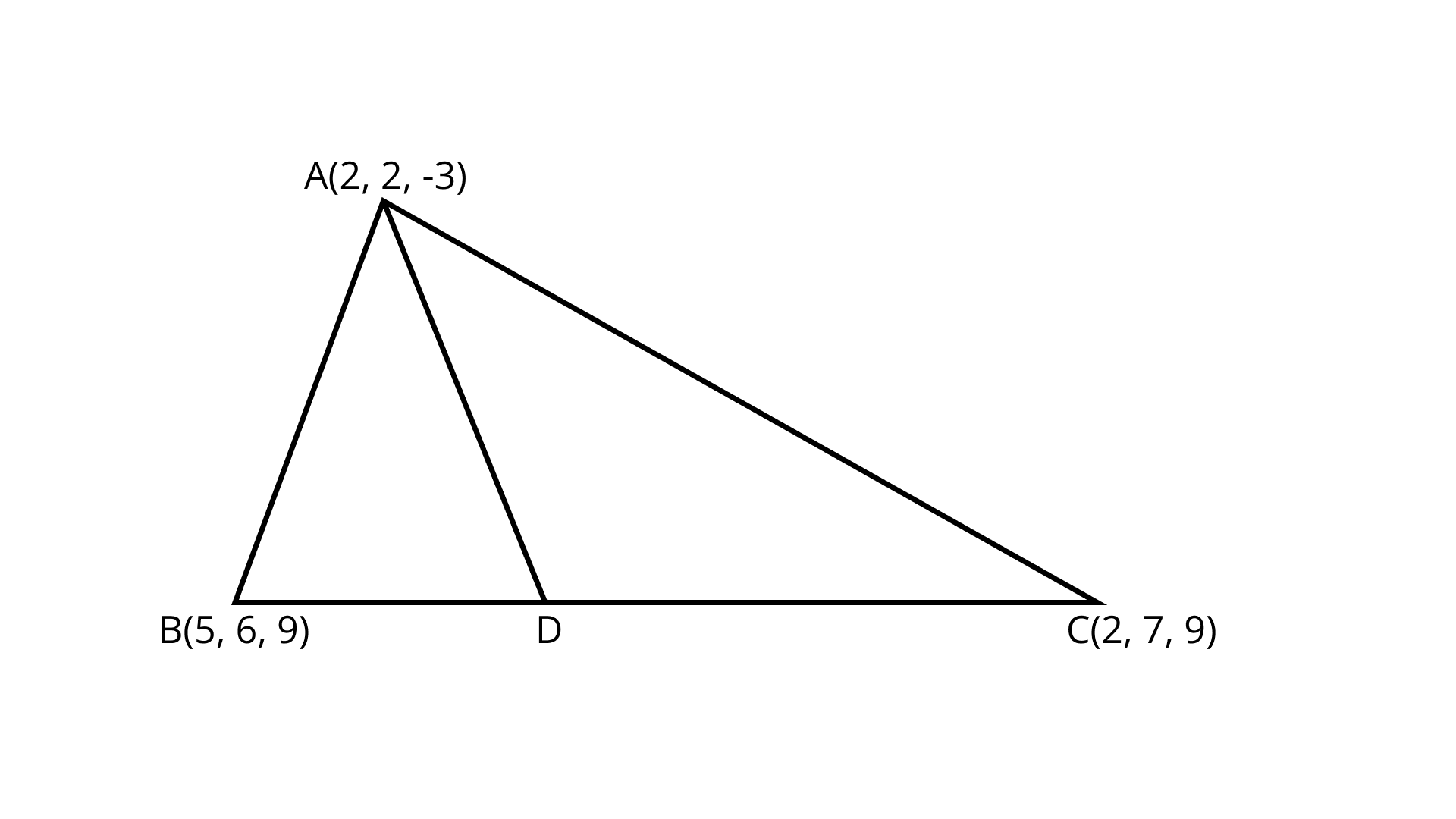
Let $A\left( {2, 2,  - 3} \right)$, $B\left( {5, 6, 9} \right)$ and $C\left( {2, 7, 9} \right)$ be the vertices of a triangle. The internal bisector of the angle $A$ meets $BC$ at point $D$. Find the coordinates of point $D$.

Show solutionHide solution
Worked solution

Ans: Given: The vertices of the triangle are $A\left( {2,{\text{ }}2,{\text{ }} - 3} \right)$, $B\left( {5,{\text{ }}6,{\text{ }}9} \right)$ and $C\left( {2,{\text{ }}7,{\text{ }}9} \right)$. $AD$ is the internal bisector of angle $A$ and meets the side $BC$ at $D$. Assume the coordinates of $D$ as $\left( {x,{\text{ }}y,{\text{ }}z} \right)$. Use the angle bisector theorem given as $\dfrac{{AB}}{{AC}} = \dfrac{{BD}}{{DC}}$ and find the use the distance formula to find $AB$ and $AC$.

Now, use the section formula for the points $B$, $D$ and $C$. If $AD$ is the angle bisector of the angle $A$ and it meets $BC$ at $D$ then by the angle bisector theorem $\dfrac{{AB}}{{AC}} = \dfrac{{BD}}{{DC}}$.

seo images


Using the distance formula the length of $AB$ 

$= \sqrt {{{\left( {5 - 2} \right)}^2} + {{\left( {6 - 2} \right)}^2} + {{\left( {9 - \left( { - 3} \right)} \right)}^2}}$

$= \sqrt {9 + 16 + 144}$

$= 13{\text{ units}}$ 

Similarly, the length of $AC$

$= \sqrt {{{\left( {2 - 2} \right)}^2} + {{\left( {7 - 2} \right)}^2} + {{\left( {9 - \left( { - 3} \right)} \right)}^2}}$

$= \sqrt {25 + 144}$

$= 13{\text{ units}}$ 

Therefore, the ratio $\dfrac{{BD}}{{DC}} = 1$ and so $BD = DC$. Clearly the point $D$ is the midpoint of $BC$. Using the midpoint formula for its coordinates,

$\Rightarrow \left( {x,{\text{ }}y,{\text{ }}z} \right) = \left( {\dfrac{{5 + 2}}{2},{\text{ }}\dfrac{{7 + 6}}{2},{\text{ }}\dfrac{{9 + 9}}{2}} \right)$

$\Rightarrow \left( {x,{\text{ }}y,{\text{ }}z} \right) = \left( {\dfrac{7}{2},{\text{ }}\dfrac{{13}}{2},{\text{ }}9} \right)$ 


Q18Written answer

Show that the three points $A\left( {2, 3, 4} \right)$, $B\left( { - 1, 2,  - 3} \right)$ and $C\left( { - 4, 1,  - 10} \right)$ are collinear and find the ratio in which $C$ divides $AB$.

Show solutionHide solution
Worked solution

Ans: Given: The points $A\left( {2,{\text{ }}3,{\text{ }}4} \right)$, $B\left( { - 1,{\text{ }}2,{\text{ }} - 3} \right)$ and $C\left( { - 4,{\text{ }}1,{\text{ }} - 10} \right)$.

Find the lengths $AB$, $BC$ and $AC$. Check if the sum of two distances is equal to the third distance. If yes then the points are collinear.

To find the required ratio use the section formula for the points $A$, $C$ and $B$. Using the distance formula, the length $AB$ is,

$\Rightarrow AB = \sqrt {{{\left( { - 1 - 2} \right)}^2} + {{\left( {2 - 3} \right)}^2} + {{\left( { - 3 - 4} \right)}^2}}$

$\Rightarrow AB = \sqrt {9 + 1 + 49}$

$\Rightarrow AB = \sqrt {59} {\text{ units}}$ 

Similarly, the length $BC$ is,

$\Rightarrow BC = \sqrt {{{\left( { - 4 - \left( { - 1} \right)} \right)}^2} + {{\left( {1 - 2} \right)}^2} + {{\left( { - 10 - \left( { - 3} \right)} \right)}^2}}$

$\Rightarrow BC = \sqrt {9 + 1 + 49}$

$\Rightarrow BC = \sqrt {59} {\text{ units}}$ 

Also, the length $AC$ is,

$\Rightarrow AC = \sqrt {{{\left( { - 4 - 2} \right)}^2} + {{\left( {1 - 3} \right)}^2} + {{\left( { - 10 - 4} \right)}^2}}$

$\Rightarrow AC = \sqrt {36 + 4 + 196}$

$\Rightarrow AC = 2\sqrt {59} {\text{ units}}$ 

Clearly $AB + BC = AC$, so the three points are collinear.

Now, let us assume the ratio in which $C$ divides $AC$ is $m:n$. Using the section formula for the $x$ coordinates of the points $A$, $C$ and $B$,

$\Rightarrow x$ coordinate of $C = \dfrac{{m \times \left( { - 1} \right) + n \times \left( 2 \right)}}{{m + n}}$

$\Rightarrow  - 4 = \dfrac{{ - m + 2n}}{{m + n}}$

$\Rightarrow  - 4m - 4n =  - m + 2n$

$\Rightarrow  - 3m = 6n$

$\Rightarrow \dfrac{m}{n} = \dfrac{{ - 2}}{1}$ 

Hence, $C$ divides $AB$ externally in the ratio $2:1$.


Q19Written answer

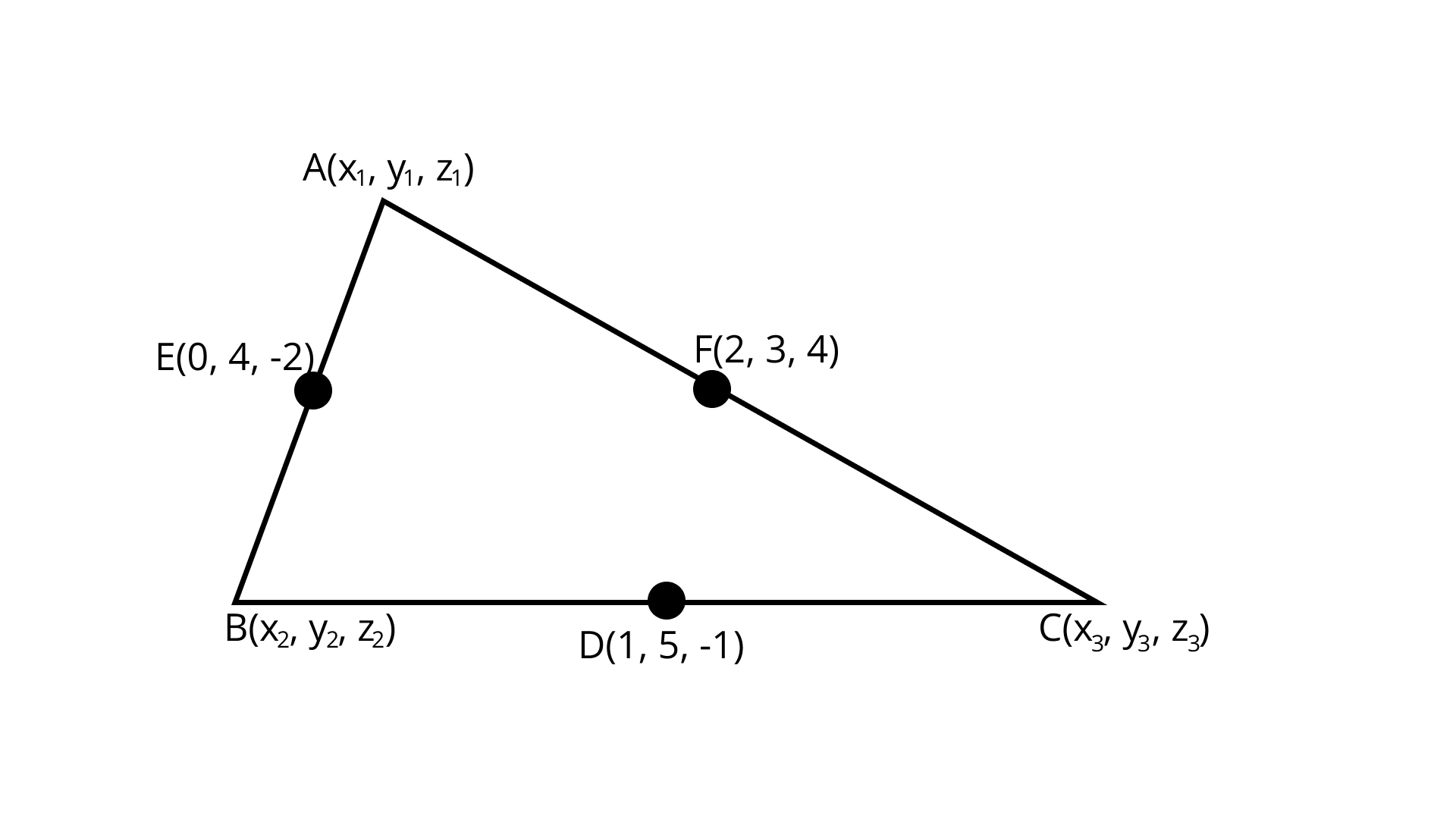
The mid-points of the sides of a triangle are $\left( {1, 5,  - 1} \right)$, $\left( {0, 4,  - 2} \right)$ and $\left( {2, 3, 4} \right)$. Find its vertices. Also find the centroid of the triangle.

Show solutionHide solution
Worked solution

Ans: Given: The mid-points of the sides of a triangle are $\left( {1,{\text{ }}5,{\text{ }} - 1} \right)$, $\left( {0,{\text{ }}4,{\text{ }} - 2} \right)$ and $\left( {2,{\text{ }}3,{\text{ }}4} \right)$

Assume $\left( {{x_1},{\text{ }}{y_1},{\text{ }}{z_1}} \right)$, $\left( {{x_2},{\text{ }}{y_2},{\text{ }}{z_2}} \right)$ and $\left( {{x_3},{\text{ }}{y_3},{\text{ }}{z_3}} \right)$ as the vertices of the triangle.

Use the midpoint formula to form the relations between the coordinates of the mid-points and the vertices.

To find the centroid use the formula $\left( {\dfrac{{{x_1} + {x_2} + {x_3}}}{3},{\text{ }}\dfrac{{{y_1} + {y_2} + {y_3}}}{3},{\text{ }}\dfrac{{{z_1} + {z_2} + {z_3}}}{3}} \right)$.

Let us assume the vertices of the triangle are $A\left( {{x_1},{\text{ }}{y_1},{\text{ }}{z_1}} \right)$, $B\left( {{x_2},{\text{ }}{y_2},{\text{ }}{z_2}} \right)$ and $C\left( {{x_3},{\text{ }}{y_3},{\text{ }}{z_3}} \right)$ whereas the mid-points of the sides $AB$, $BC$ and $CA$ are $D\left( {1,{\text{ }}5,{\text{ }} - 1} \right)$, $E\left( {0,{\text{ }}4,{\text{ }} - 2} \right)$ and $F\left( {2,{\text{ }}3,{\text{ }}4} \right)$ respectively.

seo images


Using the midpoint formula for the $x$ coordinates, 

$x$ coordinate of $D = \dfrac{{{x_1} + {x_2}}}{2}$

$\Rightarrow 1 = \dfrac{{{x_1} + {x_2}}}{2}$ … (i)

$x$ coordinate of $E = \dfrac{{{x_2} + {x_3}}}{2}$

$\Rightarrow 0 = \dfrac{{{x_2} + {x_3}}}{2}$ … (ii)

$x$ coordinate of $F = \dfrac{{{x_3} + {x_1}}}{2}$

$\Rightarrow 2 = \dfrac{{{x_3} + {x_1}}}{2}$ … (iii)

Solving the three equations gives ${x_1} = 3$, ${x_2} =  - 1$ and ${x_3} = 1$.

Similarly for the $y$ coordinates,

$y$ coordinate of $D = \dfrac{{{y_1} + {y_2}}}{2}$

$\Rightarrow 5 = \dfrac{{{y_1} + {y_2}}}{2}$ … (i)

$y$ coordinate of $E = \dfrac{{{y_2} + {y_3}}}{2}$

$\Rightarrow 4 = \dfrac{{{y_2} + {y_3}}}{2}$ … (ii)

$y$ coordinate of $F = \dfrac{{{y_3} + {y_1}}}{2}$

$\Rightarrow 3 = \dfrac{{{y_3} + {y_1}}}{2}$ … (iii)

Solving the three equations gives ${y_1} = 4$, ${y_2} = 6$ and ${y_3} = 2$.

Finally, for the $z$ coordinates,

$z$ coordinate of $D = \dfrac{{{z_1} + {z_2}}}{2}$

$\Rightarrow  - 1 = \dfrac{{{z_1} + {z_2}}}{2}$ … (i)

$z$ coordinate of $E = \dfrac{{{z_2} + {z_3}}}{2}$

$\Rightarrow  - 2 = \dfrac{{{z_2} + {z_3}}}{2}$ … (ii)

$z$ coordinate of $F = \dfrac{{{z_3} + {z_1}}}{2}$

$\Rightarrow 4 = \dfrac{{{z_3} + {z_1}}}{2}$ … (iii)

Solving the three equations gives ${z_1} = 5$, ${z_2} =  - 7$ and ${z_3} = 3$.

Therefore, the vertices of the triangle are $A\left( {3,{\text{ }}4,{\text{ }}5} \right)$, $B\left( { - 1,{\text{ }}6,{\text{ }} - 7} \right)$ and $C\left( {1,{\text{ }}2,{\text{ }}3} \right)$.

Now, the centroid of the triangle is

$= \left( {\dfrac{{{x_1} + {x_2} + {x_3}}}{3},{\text{ }}\dfrac{{{y_1} + {y_2} + {y_3}}}{3},{\text{ }}\dfrac{{{z_1} + {z_2} + {z_3}}}{3}} \right)$

$= \left( {\dfrac{{3 + \left( { - 1} \right) + 1}}{3},{\text{ }}\dfrac{{4 + 6 + 2}}{3},{\text{ }}\dfrac{{5 + \left( { - 7} \right) + 3}}{3}} \right)$

$= \left( {1,{\text{ }}4,{\text{ }}\dfrac{1}{3}} \right)$ 


Q20Written answer

Prove that the points $\left( {0,  - 1,  - 7} \right)$, $\left( {2, 1,  - 9} \right)$ and $\left( {6, 5,  - 13} \right)$ are collinear. Find the ratio in which the first point divides the join of the two points.

Show solutionHide solution
Worked solution

Ans: Given: The points $\left( {0,{\text{ }} - 1,{\text{ }} - 7} \right)$, $\left( {2,{\text{ }}1,{\text{ }} - 9} \right)$ and $\left( {6,{\text{ }}5,{\text{ }} - 13} \right)$.

Assume the points as $A$, $B$ and $C$ respectively. Find the lengths $AB$, $BC$ and $AC$. Check if the sum of two distances is equal to the third distance. If yes then the points are collinear. To find the required ratio use the section formula for the points $B$, $A$ and $C$.

Using the distance formula, the length $AB$ is,

$\Rightarrow AB = \sqrt {{{\left( {2 - 0} \right)}^2} + {{\left( {1 - \left( { - 1} \right)} \right)}^2} + {{\left( { - 9 - \left( { - 7} \right)} \right)}^2}}$

$\Rightarrow AB = \sqrt {4 + 4 + 4}$

$\Rightarrow AB = 2\sqrt 3 {\text{ units}}$ 

Similarly, the length $BC$ is,

$\Rightarrow BC = \sqrt {{{\left( {6 - 2} \right)}^2} + {{\left( {5 - 1} \right)}^2} + {{\left( { - 13 - \left( { - 9} \right)} \right)}^2}}$

$\Rightarrow BC = \sqrt {16 + 16 + 16}$

$\Rightarrow BC = 4\sqrt 3 {\text{ units}}$ 

Also, the length $AC$ is,

$\Rightarrow AC = \sqrt {{{\left( {6 - 0} \right)}^2} + {{\left( {5 - \left( { - 1} \right)} \right)}^2} + {{\left( { - 13 - \left( { - 7} \right)} \right)}^2}}$

$\Rightarrow AC = \sqrt {36 + 36 + 36}$

$\Rightarrow AC = 6\sqrt 3 {\text{ units}}$ 

Clearly $AB + BC = AC$, so the three points are collinear.

Now, let us assume the ratio in which the first point $A$ divides $BC$ is $m:n$. Using the section formula for the $x$ coordinates of the points $B$, $A$ and $C$,

$\Rightarrow x$ coordinate of $A = \dfrac{{m \times 6 + n \times 2}}{{m + n}}$

$\Rightarrow 0 = \dfrac{{6m + 2n}}{{m + n}}$

$\Rightarrow 0 = 6m + 2n$

$\Rightarrow 6m =  - 2n$

$\Rightarrow \dfrac{m}{n} = \dfrac{{ - 1}}{3}$ 

Hence, $A$ divides $BC$ externally in the ratio $1:3$.