My Cart
Your Cart 0

    Your cart is empty.

  • Total (Amount) ₹0.00
NCERT Exemplar · Class 10 · Maths

Chapter 6: Triangles

Practice each question, then open the answer or worked solution.

Exercise 6.4

7 questions
Q1Written answer

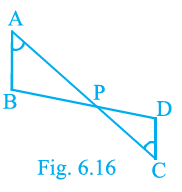
In Fig. 6.16, if ∠A = ∠C, AB = 6 cm, BP = 15 cm, AP = 12 cm and CP = 4 cm, then find the lengths of PD and CD.
NCERT Exemplar Solutions Class 10 Maths Chapter 6 Ex. 6.4-1

Show solutionHide solution
Worked solution

According to the question,

∠A = ∠C,

AB = 6 cm, BP = 15 cm,

AP = 12 cm

CP = 4 cm

From ∆APB and ∆CPD,

∠A = ∠C

∠APB = ∠CPD [vertically opposite angles]

∴ By AAA similarity criteria,

∆APD ∼ ∆CPD

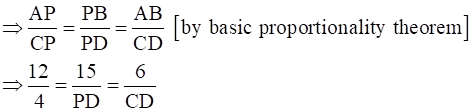
Using basic proportionality theorem,
NCERT Exemplar Solutions Class 10 Maths Chapter 6 Ex. 6.4-2

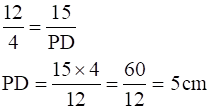
Considering AP/CP = PB/PD, we get,

NCERT Exemplar Solutions Class 10 Maths Chapter 6 Ex. 6.4-3

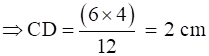
Considering, AP/CP = AB/CD

NCERT Exemplar Solutions Class 10 Maths Chapter 6 Ex. 6.4-4

Therefore,

Length of PD = 5 cm

Length of CD = 2 cm
Q2Written answer

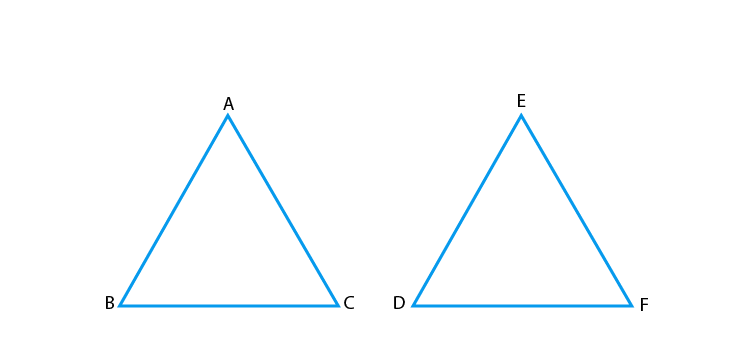
It is given that ∆ ABC ~ ∆ EDF such that AB = 5 cm, AC = 7 cm, DF= 15 cm and DE = 12 cm. Find the lengths of the remaining sides of the triangles.

Show solutionHide solution
Worked solution

NCERT Exemplar Solutions Class 10 Maths Chapter 6 Ex. 6.4-5

According to the question,

∆ABC ∼ ∆EDF

From property of similar triangle,

We know that, corresponding sides of ∆ABC and ∆EDF are in the same ratio.

AB/ED = AC/EF = BC/DF ….(i)

According to the question,

AB = 5cm, AC = 7cm

DF = 15cm and DE = 12cm

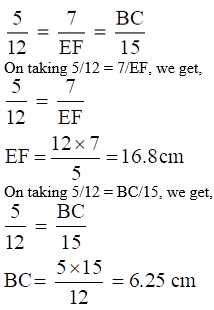
Substituting these values in Equation (i), we get,

NCERT Exemplar Solutions Class 10 Maths Chapter 6 Ex. 6.4-6

Hence, lengths of the remaining sides of the triangles are EF = 16.8 cm and BC = 6.25 cm

Q3Written answer

Prove that if a line is drawn parallel to one side of a triangle to intersect the other two sides, then the two sides are divided in the same ratio.

Show solutionHide solution
Worked solution

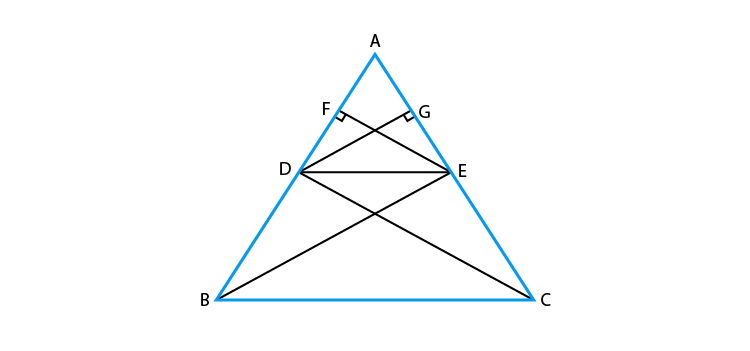
Let a ∆ABC in which a line DE parallel to BC intersects AB at D and AC at E.

To prove DE divides the two sides in the same ratio.

AD/DB = AE/EC

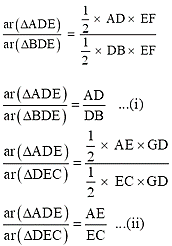
NCERT Exemplar Solutions Class 10 Maths Chapter 6 Ex. 6.4-7

Construction:

Join BE, CD

Draw EF ⊥ AB and DG ⊥ AC.

We know that,

Area of triangle = ½ × base × height

Then,

NCERT Exemplar Solutions Class 10 Maths Chapter 6 Ex. 6.4-8

Since,

∆BDE and ∆DEC lie between the same parallel DE and BC and are on the same base DE.

We have,

area (∆BDE) = area(∆DEC) …..(iii)

From Equation (i), (ii) and (iii),

We get,

AD/DB = AE/EC

Hence proved.

Q4Written answer

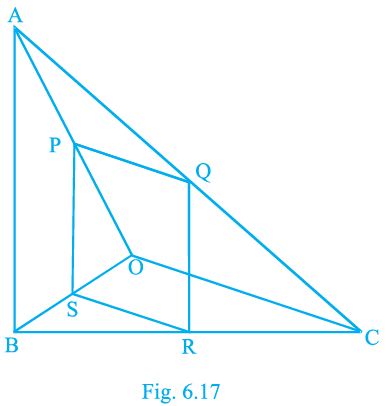
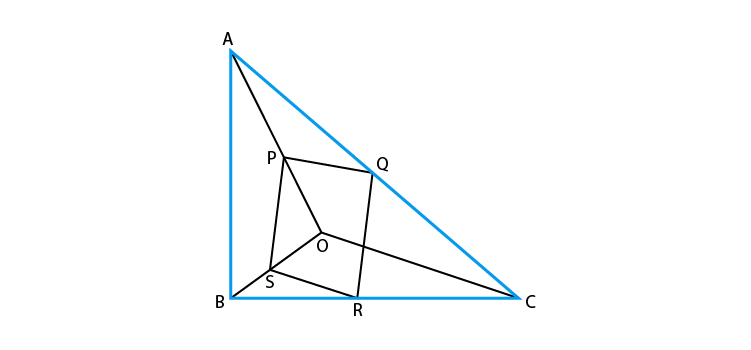
In Fig 6.17, if PQRS is a parallelogram and AB||PS, then prove that OC||SR.

NCERT Exemplar Solutions Class 10 Maths Chapter 6 Ex. 6.4-9

Show solutionHide solution
Worked solution

According to the question,

PQRS is a parallelogram,

Therefore, PQ || SR and PS || QR.

Also given, AB || PS.

NCERT Exemplar Solutions Class 10 Maths Chapter 6 Ex. 6.4-10

To prove:

OC || SR

From ∆OPS and OAB,

PS||AB

∠POS = ∠AOB [common angle]

∠OSP = ∠OBA [corresponding angles]

∆OPS ∼ ∆OAB [by AAA similarity criteria]

Then,

Using basic proportionality theorem,

We get,

PS/AB = OS/OB …(i)

From ∆CQR and ∆CAB,

QR || PS || AB

∠QCR = ∠ACB [common angle]

∠CRQ = ∠CBA [corresponding angles]

∆CQR ∼ ∆CAB

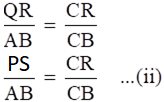
Then, by basic proportionality theorem

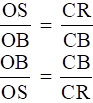
NCERT Exemplar Solutions Class 10 Maths Chapter 6 Ex. 6.4-11

From Equation (i) and (ii),

NCERT Exemplar Solutions Class 10 Maths Chapter 6 Ex. 6.4-12

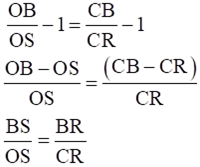
Subtracting 1 from L.H.S and R.H.S, we get,

NCERT Exemplar Solutions Class 10 Maths Chapter 6 Ex. 6.4-13

SR || OC [By converse of basic proportionality theorem]

Hence proved.

Q5Written answer

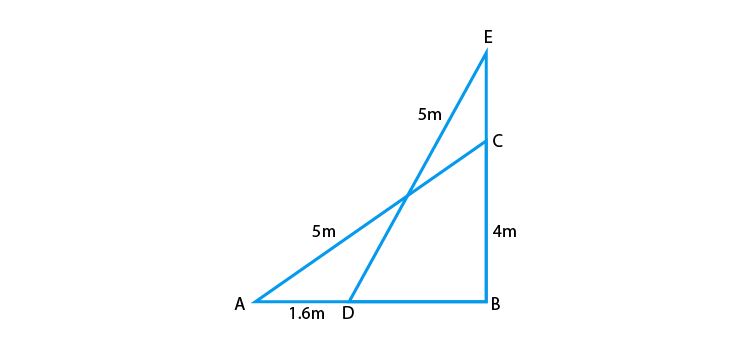
A 5 m long ladder is placed leaning towards a vertical wall such that it reaches the wall at a point 4 m high. If the foot of the ladder is moved 1.6 m towards the wall, then find the distance by which the top of the ladder would slide upwards on the wall.

Show solutionHide solution
Worked solution

Let the length of the ladder = AC = 5 m

Let the height of the wall on which ladder is placed = BC = 4m.
NCERT Exemplar Solutions Class 10 Maths Chapter 6 Ex. 6.4-14

From right angled ∆EBD,

Using the Pythagoras Theorem,

ED2 = EB2 + BD2

(5)2 = (EB)2 + (14)2 [ BD = 1.4]

25 = (EB)2 + 1.96

(EB)2 = 25 –1.96 = 23.04

EB = √23.04 = 4.8

Now, we have,

EC = EB – BC = 4.8 – 4 = 0.8

Hence, the top of the ladder would slide upwards on the wall by a distance of 0.8 m.

Q6Written answer

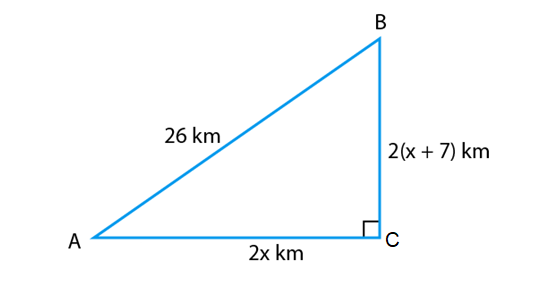
For going to a city B from city A, there is a route via city C such that AC⊥CB, AC = 2 x km and CB = 2 (x + 7) km. It is proposed to construct a 26 km highway which directly connects the two cities A and B. Find how much distance will be saved in reaching city B from city A after the construction of the highway.

Show solutionHide solution
Worked solution

According to the question,

AC⊥CB,

AC = 2x km,

CB = 2 (x + 7) km and AB = 26 km

Thus, we get ∆ ACB right angled at C.

Now, from ∆ACB,

Using Pythagoras Theorem,

AB2 = AC2 + BC2

⇒ (26)2 = (2x)2 + {2(x + 7)}2

⇒ 676 = 4x2 + 4(x2 + 196 + 14x)

⇒ 676 = 4x2 + 4x2 + 196 + 56x

⇒ 676 = 82 + 56x + 196

⇒ 8x2 + 56x – 480 = 0

NCERT Exemplar Solutions Class 10 Maths Chapter 6 Ex. 6.4-15

Dividing the equation by 8, we get,

x2 + 7x – 60 = 0

x2 + 12x – 5x – 60 = 0

x(x + 12)-5(x + 12) = 0

(x + 12)(x – 5) = 0

∴ x = -12 or x = 5

Since the distance can’t be negative, we neglect x = -12

∴ x = 5

Now,

AC = 2x = 10km

BC = 2(x + 7) = 2(5 + 7) = 24 km

Thus, the distance covered to city B from city A via city C = AC + BC

AC + BC = 10 + 24

= 34 km

Distance covered to city B from city A after the highway was constructed = BA = 26 km

Therefore, the distance saved = 34 – 26 = 8 km.

Q7Written answer

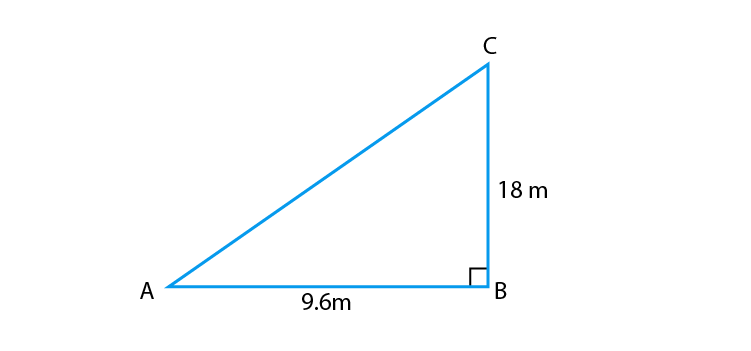
A flag pole 18 m high casts a shadow 9.6 m long. Find the distance of the top of the pole from the far end of the shadow.

Show solutionHide solution
Worked solution

NCERT Exemplar Solutions Class 10 Maths Chapter 6 Ex. 6.4-16

Let MN = 18 m be the flag pole and its shadow be LM = 9.6 m.

The distance of the top of the pole, N from the far end, L of the shadow is LN.

In right angled ∆LMN,

LN2 = LM2 + MN2 [by Pythagoras theorem]

⇒ LN2 = (9.6)2 + (18)2

⇒ LN2 = 9.216 + 324

⇒ LN2 = 416.16

∴ LN = √416.16 = 20.4 m

Hence, the required distance is 20.4 m

To help students master the concepts in the chapter easily, we have offered the free NCERT Exemplar for Class 10 Maths Chapter 6 – Triangles PDF here, which can be downloaded easily. Also, they can make use of exemplar books, notes, question papers and 10th Class Maths NCERT Solutions to get a good grasp of the concepts of each chapter.

Students are advised to check sample papers and previous years’ questions and solve them to get an idea of questions asked from the chapter Triangles in the Class 10 board exam. Also, practise 10th standard Exemplar Solutions for Maths for all chapters. Download BYJU’S – The Learning App and get personalised video lessons to learn about maths concepts, such as triangles.