My Cart
Your Cart 0

    Your cart is empty.

  • Total (Amount) ₹0.00
NCERT Exemplar · Class 10 · Maths

Chapter 6: Triangles

Practice each question, then open the answer or worked solution.

Exercise 6.3

7 questions
Q1Written answer

In a ΔPQR, PR2 – PQ2 = QR2 and M is a point on side PR such that QM ⊥ PR.

Prove that QM2 =PM × MR.

Show solutionHide solution
Worked solution

According to the question,
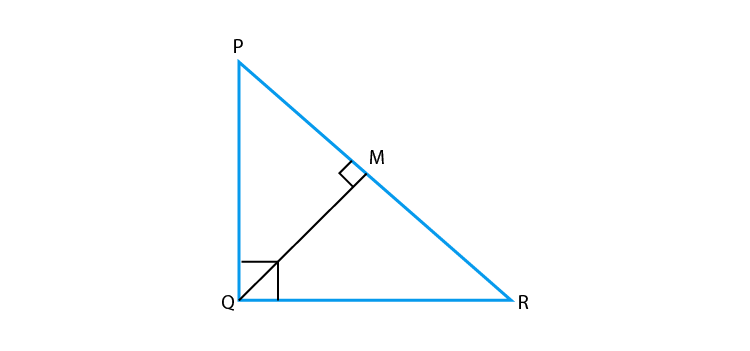
NCERT Exemplar Solutions Class 10 Maths Chapter 6 Ex. 6.3-1

In ∆PQR,

PR2 = QR2 and QM⊥PR

Using Pythagoras theorem, we have,

PR2 = PQ2 + QR2

∆PQR is right angled triangle at Q.

From ∆QMR and ∆PMQ, we have,

∠M = ∠M

∠MQR = ∠QPM [= 90°-∠R]

So, using the AAA similarity criteria,

We have,

∆QMR ∼ ∆PMQ

Also, we know that,

Area of triangles = ½ × base × height

So, by property of area of similar triangles,
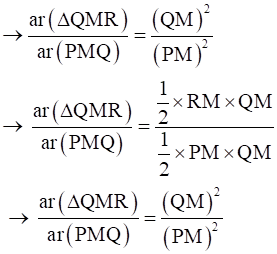
NCERT Exemplar Solutions Class 10 Maths Chapter 6 Ex. 6.3-2

QM2 = PM × RM

Hence proved.
Q2Written answer

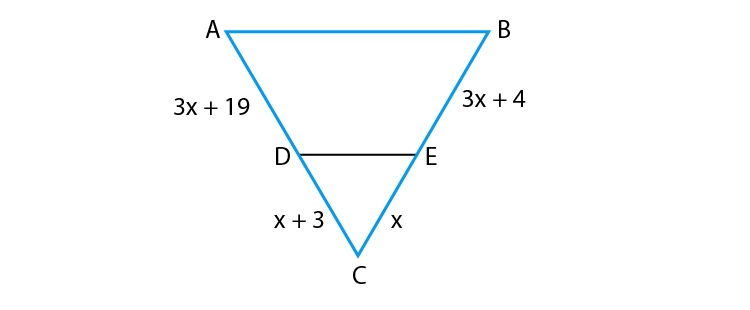
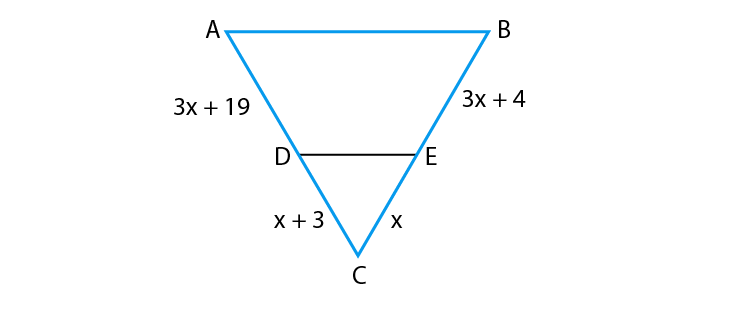
Find the value of x for which DE||AB in given figure.

NCERT Exemplar Solutions Class 10 Maths Chapter 6 Ex. 6.3-3

Show solutionHide solution
Worked solution

According to the question,

DE || AB

Using basic proportionality theorem,

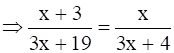
CD/AD = CE/BE

∴ If a line is drawn parallel to one side of a triangle such that it intersects the other sides at distinct points, then, the other two sides are divided in the same ratio.

Hence, we can conclude that, the line drawn is equal to the third side of the triangle.
NCERT Exemplar Solutions Class 10 Maths Chapter 6 Ex. 6.3-4

(x + 3) (3x + 4) = x (3x + 19)

3x2 + 4x + 9x + 12 = 3x2 + 19x

19x – 13x = 12

6x = 12

∴ x = 12/6 = 2

NCERT Exemplar Solutions Class 10 Maths Chapter 6 Ex. 6.3-5

Q3Written answer

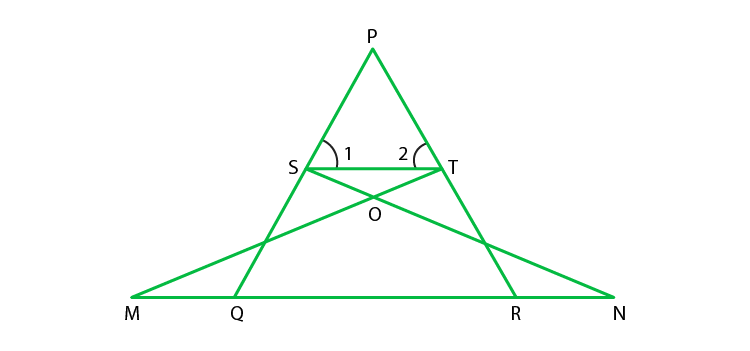
In figure, if ∠1 =∠2 and ΔNSQ = ΔMTR, then prove that ΔPTS ~ ΔPRQ.

NCERT Exemplar Solutions Class 10 Maths Chapter 6 Ex. 6.3-6

Show solutionHide solution
Worked solution

According to the question,

∆ NSQ ≅ ∆MTR

∠1 = ∠2

Since,

∆NSQ = ∆MTR

So,

SQ = TR ….(i)

Also,

∠1 = ∠2 ⇒ PT = PS….(ii)

From Equation (i) and (ii).

PS/SQ = PT/TR

⇒ ST || QR

By converse of basic proportionality theorem, If a line is drawn parallel to one side of a triangle to intersect the other sides in distinct points, the other two sides are divided in the same ratio.

∴ ∠1 = PQR

And

∠2 = ∠PRQ

In ∆PTS and ∆PRQ.

∠P = ∠P [Common angles]

∠1 = ∠PQR (proved)

∠2 = ∠PRQ (proved)

∴ ∆PTS – ∆PRQ

Hence proved.

Q4Written answer

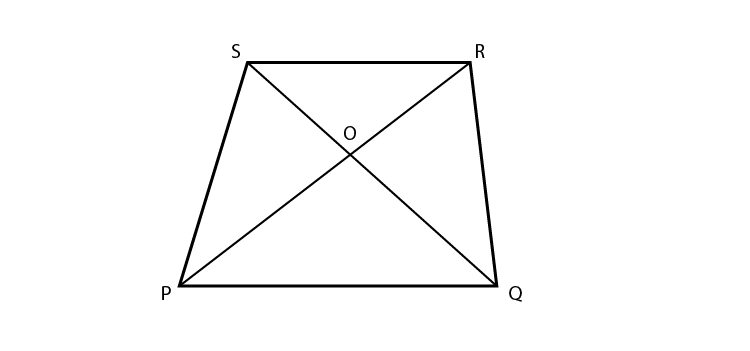
Diagonals of a trapezium PQRS intersect each other at the point 0, PQ || RS and PQ = 3 RS. Find the ratio of the areas of Δ POQ and Δ ROS.

Show solutionHide solution
Worked solution

According to the question,

PQRS is a trapezium in which PQ‖RS and PQ = 3RS

PQ/RS = 3/1 = 3 …(i)

NCERT Exemplar Solutions Class 10 Maths Chapter 6 Ex. 6.3-7

In ∆POQ and ∆ROS,

∠SOR = ∠QOP [vertically opposite angles]

∠SRP = ∠RPQ [alternate angles]

∴ ∆POQ ∼ ∆ROS [by AAA similarity criterion]

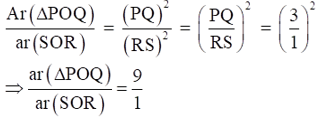
By property of area of similar triangle,

NCERT Exemplar Solutions Class 10 Maths Chapter 6 Ex. 6.3-8

Therefore, the required ratio = 9:1.

Q5Written answer

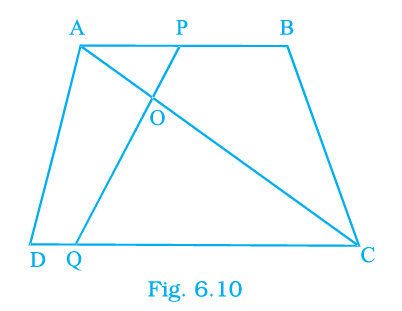
In figure, if AB || DC and AC, PQ intersect each other at the point O. Prove that OA.CQ = 0C.AP.

NCERT Exemplar Solutions Class 10 Maths Chapter 6 Ex. 6.3-9

Show solutionHide solution
Worked solution

According to the question,

AC and PQ intersect each other at the point O and AB||DC.

From ∆AOP and ∆COQ,

∠AOP = ∠COQ [Since they are vertically opposite angles]

∠APO = ∠CQO [since, AB||DC and PQ is transversal, the angles are alternate angles]

∴ ∆AOP ∼ ∆COQ [using AAA similarity criterion]

Then, since, corresponding sides are proportional

We have,

OA/OC = AP/CQ

OA × CQ = OC × AP

Hence Proved.

Q6Written answer

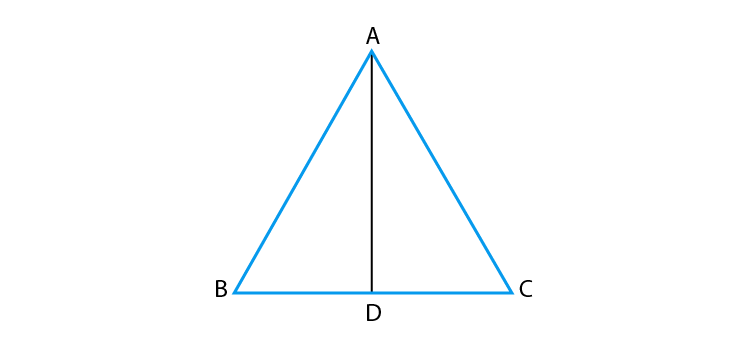
Find the altitude of an equilateral triangle of side 8 cm.

Show solutionHide solution
Worked solution

Let ABC be an equilateral triangle of side 8 cm

AB = BC = CA = 8 cm. (all sides of an equilateral triangle is equal)
NCERT Exemplar Solutions Class 10 Maths Chapter 6 Ex. 6.3-10

Draw altitude AD which is perpendicular to BC.

Then, D is the mid-point of BC.

∴ BD = CD = ½

BC = 8/2 = 4 cm

Now, by Pythagoras theorem

AB2 = AD2 + BD2

⇒ (8)2 = AD2 + (4)2

⇒ 64 = AD2 + 16

⇒ AD = √48 = 4√3 cm.

Hence, altitude of an equilateral triangle is 4√3 cm.

Q7Written answer

If ∆ABC ∼ ∆DEF, AB = 4 cm, DE = 6, EF = 9 cm and FD = 12 cm, then find the perimeter of ∆ABC.

Show solutionHide solution
Worked solution

According to the question,

AB = 4 cm,

DE = 6 cm

EF = 9 cm

FD = 12 cm

Also,

∆ABC ∼ ∆DEF

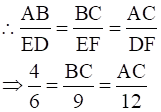
We have,

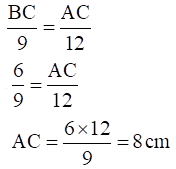
NCERT Exemplar Solutions Class 10 Maths Chapter 6 Ex. 6.3-11

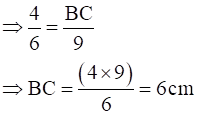
By taking first two terms, we have

NCERT Exemplar Solutions Class 10 Maths Chapter 6 Ex. 6.3-12

And by taking last two terms, we have,

NCERT Exemplar Solutions Class 10 Maths Chapter 6 Ex. 6.3-13

Now,

Perimeter of ∆ABC = AB + BC + AC

= 4 + 6 + 8 = 18 cm

Thus, the perimeter of the triangle is 18 cm.