My Cart
Your Cart 0

    Your cart is empty.

  • Total (Amount) ₹0.00
NCERT Exemplar · Class 10 · Maths

Chapter 6: Triangles

Practice each question, then open the answer or worked solution.

Exercise 6.1

5 questions
Q1Written answer

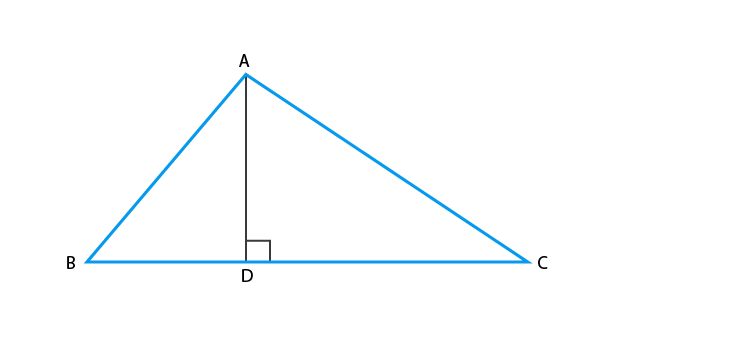
In figure, if ∠BAC =90° and AD⊥BC. Then,

(a) BD.CD = BZC² (b) AB.AC = BC² (c) BD.CD=AD² (d) AB.AC =AD²
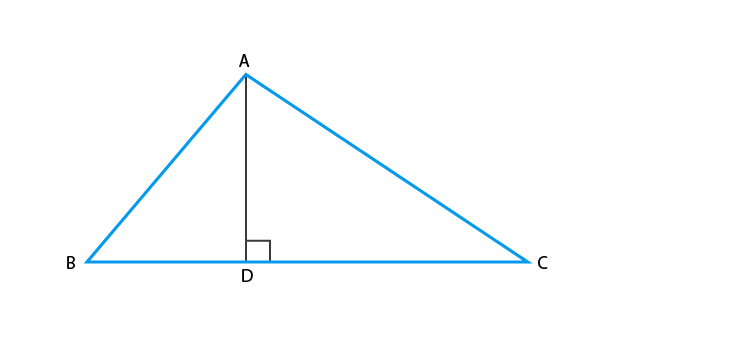
NCERT Exemplar Solutions Class 10 Maths Chapter 6 Ex. 6.1-1

Show solutionHide solution
Worked solution

c) BD.CD=AD²

Explanation:
NCERT Exemplar Solutions Class 10 Maths Chapter 6 Ex. 6.1-2

From ∆ADB and ∆ADC,

According to the question, we have,

∠D = ∠D = 90° (∵ AD ⊥ BC)

∠DBA = ∠DAC [each angle = 90°- ∠C]

Using AAA similarity criteria,

∆ADB ∼ ∆ADC

BD/AD = AD/CD

BD.CD = AD2
Q2Written answer

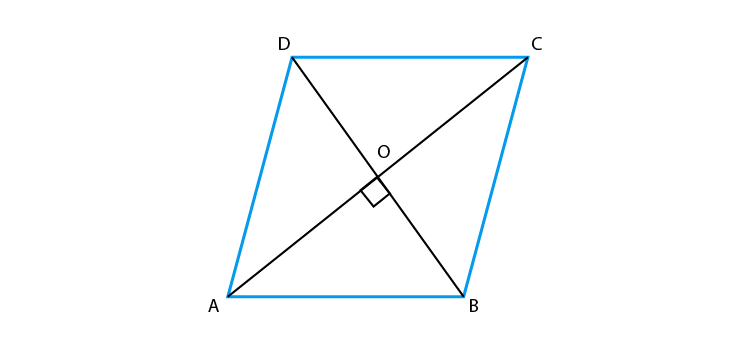
If the lengths of the diagonals of rhombus are 16 cm and 12 cm. Then, the length of the sides of the rhombus is

(a) 9 cm (b) 10 cm (c) 8 cm (d) 20 cm

Show solutionHide solution
Worked solution

(b) 10 cm

Explanation:

We know that,

A rhombus is a simple quadrilateral whose four sides are of same length and diagonals are perpendicular bisector of each other.

According to the question, we get,

NCERT Exemplar Solutions Class 10 Maths Chapter 6 Ex. 6.1-3

According to the question,

AC = 16 cm and BD = 12 cm

∠AOB = 90°

∵ AC and BD bisects each other

AO = ½ AC and BO = ½ BD

Then, we get,

AO = 8 cm and BO = 6 cm

Now, in right angled ∆AOB,

Using the Pythagoras theorem,

We have,

AB2 = AO2 + OB2

AB2 = 82 + 62 = 64 + 36 = 100

∴ AB = √100 = 10 cm

We know that the four sides of a rhombus are equal.

Therefore, we get,

one side of rhombus = 10 cm.

Q3Written answer

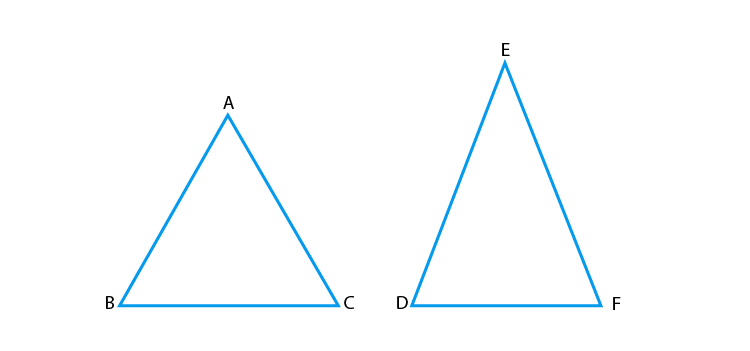
If ΔABC ~ ΔEDF and ΔABC is not similar to ΔDEF, then which of the following is not true?

(a) BC · EF = AC · FD (b) AB · EF = AC · DE

(c) BC · DE = AB · EF (d) BC · DE = AB · FD

Show solutionHide solution
Worked solution

(c) BC · DE = AB · EF

Explanation:

We know that,

If sides of one triangle are proportional to the side of the other triangle, and the corresponding angles are also equal, then the triangles are similar by SSS similarity.

NCERT Exemplar Solutions Class 10 Maths Chapter 6 Ex. 6.1-4

So, ∆ABC ∼ ∆EDF

Using similarity property,

AB/ED = BC/DF = AC/EF

Taking AB/ED = BC/DF, we get

AB/ED = BC/DF

AB.DF = ED.BC

So, option (d) BC · DE = AB · FD is true

Taking BC/DF = AC/EF, we get

BC/DF = AC/EF

⇒ BC.EF = AC.DF

So, option (a) BC · EF = AC · FD is true

Taking AB/ED = AC/EF, we get,

AB/ED = AC/EF

AB.EF = ED.AC

So, option (b) AB · EF = AC · DE is true.

Q4Written answer

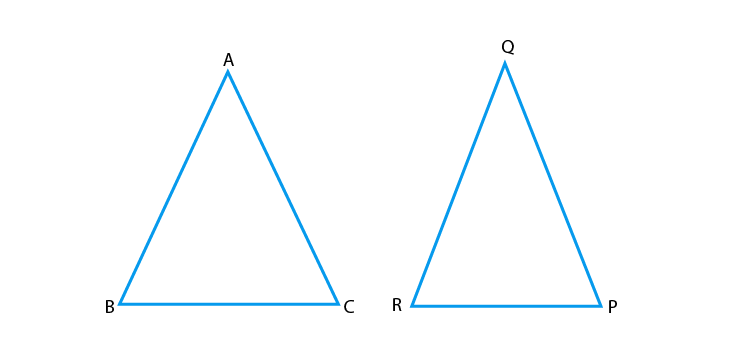
If in two Δ PQR,AB/QR = BC/PR = CA/PQ, then

(a)Δ PQR~Δ CAB (b) Δ PQR ~ Δ ABC

(c)Δ CBA ~ Δ PQR (d) Δ BCA ~ Δ PQR

Show solutionHide solution
Worked solution

(a)Δ PQR~Δ CAB

Explanation:

NCERT Exemplar Solutions Class 10 Maths Chapter 6 Ex. 6.1-5

From ∆ABC and ∆PQR, we have,

AB/QR = BC/PR = CA/PQ

If sides of one triangle are proportional to the side of the other triangle, and their corresponding angles are also equal, then both the triangles are similar by SSS similarity.

Therefore, we have,

Δ PQR~Δ CAB

Q5Written answer

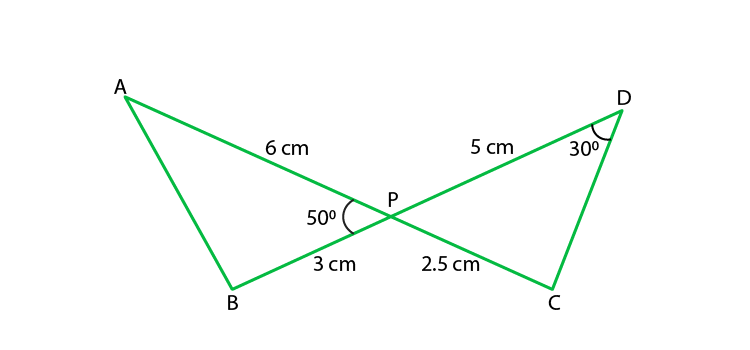
In figure, two line segments AC and BD intersect each other at the point P such that PA = 6 cm, PB = 3 cm, PC = 2.5 cm, PD = 5 cm, ∠APB = 50° and ∠CDP = 30°. Then, ∠PBA is equal to

(a) 50° (b) 30° (c) 60° (d) 100°

NCERT Exemplar Solutions Class 10 Maths Chapter 6 Ex. 6.1-6

Show solutionHide solution
Worked solution

(d) 100°

Explanation:

From ∆APB and ∆CPD,

∠APB = ∠CPD = 50° (since they are vertically opposite angles)

AP/PD = 6/5 … (i)

Also, BP/CP = 3/2.5

Or BP/CP = 6/5 … (ii)

From equations (i) and (ii),

We get,

AP/PD = BP/CP

So, ∆APB ∼ ∆DPC [using SAS similarity criterion]

∴ ∠A = ∠D = 30° [since, corresponding angles of similar triangles]

Since, Sum of angles of a triangle = 180°,

In ∆APB,

∠A + ∠B + ∠APB = 180°

So, 30° + ∠B + 50° = 180°

Then, ∠B = 180° – (50° + 30°)

∠B = 180 – 80° = 100°

Therefore, ∠PBA = 100°