My Cart
Your Cart 0

    Your cart is empty.

  • Total (Amount) ₹0.00
NCERT Exemplar · Class 10 · Maths

Chapter 6: Triangles

Practice each question, then open the answer or worked solution.

Exercise 6.2

6 questions
Q1Written answer

Is the triangle with sides 25 cm, 5 cm and 24 cm a right triangle? Give reason for your answer.

Show solutionHide solution
Worked solution

False

According to the question,

Let us assume that,

A = 25 cm

B = 5 cm

C = 24 cm

Now, Using Pythagoras Theorem,

We have,

A2 = B2 + C2

B2 + C2 = (5)2 + (24)2

B2 + C2 = 25 + 576

B2 + C2 = 601

A2 = 600

600 ≠ 601

A2 ≠ B2 + C2

Since the sides does not satisfy the property of Pythagoras theorem, triangle with sides 25cm, 5cm and 24cm is not a right triangle.
Q2Written answer

It is given that ΔDEF ~ ΔRPQ. Is it true to say that ∠D = ∠R and ∠F = ∠P ? Why?

Show solutionHide solution
Worked solution

False

We know that,

Corresponding angles are equal in similar triangles.

So, we get,

∠D = ∠R

∠E = ∠P

∠F = ∠Q

Q3Written answer

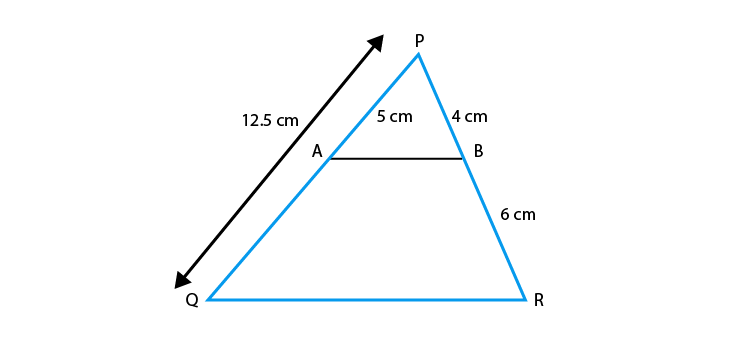
A and B are respectively the points on the sides PQ and PR of a ΔPQR such that PQ = 12.5 cm, PA = 5 cm, BR = 6 cm and PB = 4 cm. Is AB || QR? Give reason for your answer.

Show solutionHide solution
Worked solution

True

According to the question,

NCERT Exemplar Solutions Class 10 Maths Chapter 6 Ex. 6.2-1

PQ = 12.5 cm

PA = 5 cm

BR = 6 cm

PB = 4 cm

Then,

QA = QP – PA = 12.5 – 5 = 7.5 cm

So,

PA/AQ = 5/7.5 = 50/75 = 2/3 … (i)

PB/BR = 4/6 = 2/3 … (ii)

Form Equations (i) and (ii).

PA/AQ = PB/BR

We know that, if a line divides any two sides of a triangle in the same ratio, then the line is parallel to the third side.

Therefore,

AB || QR.

Q4Written answer

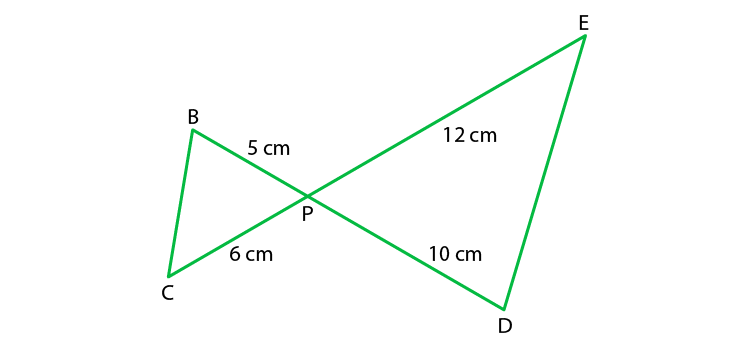
In figure, BD and CE intersect each other at the point P. Is ΔPBC ~ ΔPDE? Why?

NCERT Exemplar Solutions Class 10 Maths Chapter 6 Ex. 6.2-2

Show solutionHide solution
Worked solution

True

In ∆PBC and ∆PDE,

∠BPC = ∠EPD [vertically opposite angles]

PB/PD = 5/10 = ½ … (i)

PC/PE = 6/12 = ½ … (ii)

From equation (i) and (ii),

We get,

PB/PD = PC/PE

Since, ∠BPC of ∆PBC = ∠EPD of ∆PDE and the sides including these.

Then, by SAS similarity criteria

∆PBC ∼ ∆PDE

Q5Written answer

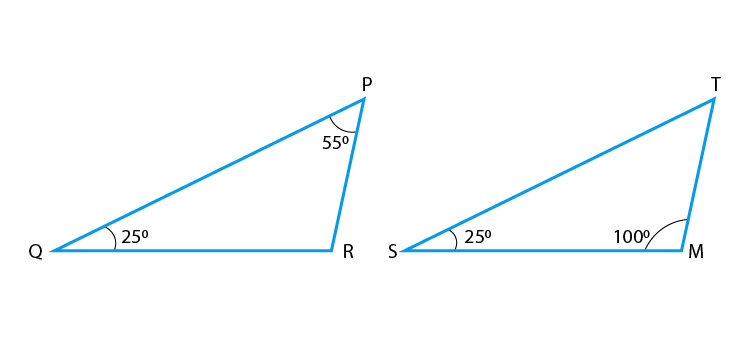
In ΔPQR and ΔMST, ∠P = 55°, ∠Q =25°, ∠M = 100° and ∠S = 25°. Is ΔQPR ~ ΔTSM? Why?

Show solutionHide solution
Worked solution

We know that,

Sum of the three angles of a triangle = 180°.

NCERT Exemplar Solutions Class 10 Maths Chapter 6 Ex. 6.2-3

Then, from ∆PQR,

∠P + ∠Q + ∠R = 180°

55° + 25° + ∠R = 180°

So, we get,

∠R = 180° – (55° + 25°) = 180°- 80° = 100°

Similarly, from ∆TSM,

∠T + ∠S + ∠M = 180°

∠T + ∠25° + 100° = 180°

So, we get,

∠T = 180°- (∠25° + 100°)

∠T = 180° – 125° = 55°

In ∆PQR and ∆TSM,

We have,

∠P = ∠T,

∠Q = ∠S

∠R = ∠M

Hence, ∆PQR ∼ ∆TSM

Since, all corresponding angles are equal,

∆QPR is similar to ∆TSM,

Q6Written answer

Is the following statement true? Why?

“Two quadrilaterals are similar, if their corresponding angles are equal”.

Show solutionHide solution
Worked solution

False

Two quadrilaterals cannot be similar, if only their corresponding angles are equal