My Cart
Your Cart 0

    Your cart is empty.

  • Total (Amount) ₹0.00
NCERT · Class 8 · Maths

Chapter 11: Mensuration

Practice each question, then open the answer or worked solution.

Exercise 11.4

7 questions
Q2Written answer

Diameter of cylinder A is 7 cm and the height is 14 cm. Diameter of cylinder B is 14 cm and height is 7 cm. Without doing any calculations can you suggest whose volume is greater? Verify it by finding the volume of both the cylinders. Check whether the cylinder with greater volume also has greater surface area.
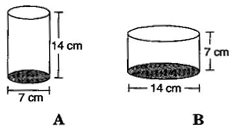
Ncert solution class 8 chapter 11-24

Show solutionHide solution
Worked solution

Yes, we can say that volume of cylinder B is greater, since radius of cylinder B is greater than that of cylinder A.

Find Volume for cylinders A and B

Diameter of cylinder A = 7 cm

Radius of cylinder A = 7/2  cm

And Height of cylinder A = 14 cm

Volume of cylinder A = πr2h

=  (22/7 )×(7/2)×(7/2)×14 = 539

Volume of cylinder A is 539  cm3

Now, Diameter of cylinder B = 14 cm

Radius of cylinder B =  14/2 = 7 cm

And Height of cylinder B = 7 cm

Volume of cylinder B = πr2h

= (22/7)×7×7×7 = 1078

Volume of cylinder B is 1078 cm3

Find the surface area of cylinders A and B

Surface area of cylinder A =  2πr(r+h )

= 2 x 22/7 x 7/2 x (7/2 + 14) = 385

Surface area of cylinder A is385 cm2

Surface area of cylinder B =  2πr(r+h)

= 2×(22/7)×7(7+7) = 616

Surface area of cylinder B is 616 cm2

Yes, the cylinder with greater volume also has a greater surface area.

Q3Written answer

Find the height of a cuboid whose base area is 180 cm2 and volume is 900 cm3?

Show solutionHide solution
Worked solution

Given, Base area of cuboid = 180 cm2 and Volume of cuboid = 900 cm3

We know that, Volume of cuboid = lbh

900 = 180×h (substituting the values)

h= 900/180 = 5

Hence the height of the cuboid is 5 cm.

Q4Written answer

A cuboid is of dimensions 60 cm×54 cm×30 cm. How many small cubes with side 6 cm can be placed in the given cuboid?

Show solutionHide solution
Worked solution

Given, Length of cuboid, l = 60 cm, Breadth of cuboid, b = 54 cm and

Height of cuboid, h = 30 cm

We know that, Volume of cuboid = lbh = 60 ×54×30  = 97200 cm3

And Volume of cube = (Side)3

= 6×6×6 = 216 cm3

Also, the Number of small cubes =  volume of cuboid / volume of cube

= 97200/216

= 450

Hence , the required number of cubes is 450.

Q5Written answer

Find the height of the cylinder whose volume if 1.54 m3 and diameter of the base is 140 cm.

Show solutionHide solution
Worked solution

Given: Volume of cylinder = 1.54 m3and Diameter of cylinder = 140 cm

Radius  ( r )=  d/2 = 140/2  = 70 cm

Volume of cylinder = πr2h

1.54 = (22/7)×0.7×0.7×h

After simplifying, we get the value of h, which is,

h = (1.54×7)/(22×0.7×0.7)

h = 1

Hence, the height of the cylinder is 1 m.

Q6Written answer

A milk tank is in the form of cylinder whose radius is 1.5 m and length is 7 m. Find the quantity of milk in liters that can be stored in the tank.

Ncert solution class 8 chapter 11-25

Show solutionHide solution
Worked solution

Given, Radius of cylindrical tank, r = 1.5 m and Height of cylindrical tank, h  = 7 m

Volume of cylindrical tank, V =  πr2h

= (22/7)×1.5×1.5 ×7

= 49.5  cm3

= 49.5×1000 liters = 49500 liters

3

Hence, the required quantity of milk is 49500 litres.

Q7Written answer

If each edge of a cube is doubled,

(i) how many times will its surface area increase?

(ii) how many times will its volume increase?

Show solutionHide solution
Worked solution

(i) Let the edge of the cube be “ l” .

Formula for Surface area of the cube, A =  6 l2

When the edge of the cube is doubled, then

Surface area of the cube, say A’ = 6(2l)2 = 6×4l2 = 4(6 l2)

A’ = 4A

Hence, the surface area will increase by four times.

(ii) Volume of a cube, V = l3

When the edge of the cube is doubled, then

Volume of the cube, say V’ = (2l)3 = 8( l3)

V’ = 8×V

Hence, the volume will increase 8 times.

Q8Written answer

Water is pouring into a cuboidal reservoir at the rate of 60 liters per minute. If the volume of reservoir is 108 m^3, find the number of hours it will take to fill the reservoir.

Show solutionHide solution
Worked solution

Given, the volume of the reservoir = 108 m3

Rate of pouring water into cuboidal reservoir = 60 litres/minute

=  60/1000  m3 per minute

Since 1 liter = (1/1000 )m3

=  (60×60)/1000 m3 per hour

Therefore, (60×60)/1000 m3 water filled in reservoir will take = 1 hour

Therefore 1 m3 water filled in reservoir will take =  1000/(60×60)  hours

Therefore, 108 m3 water filled in reservoir will take = (108×1000)/(60×60)  hours = 30 hours

Answer: It will take 30 hours to fill the reservoir.