My Cart
Your Cart 0

    Your cart is empty.

  • Total (Amount) ₹0.00
NCERT · Class 8 · Maths

Chapter 10: Visualising Solid Shapes

Practice each question, then open the answer or worked solution.

Exercise 10.3

8 questions
Q1Written answer

Can a polyhedron have for its faces:

(i) 3 Triangles?

(ii) 4 triangles?

(iii) A square and four triangles?

Show solutionHide solution
Worked solution

(i) No, such polyhedrons are not possible. A polyhedron should have a minimum of 4 faces.

(ii) Yes, a triangular pyramid has 4 triangular faces.

(iii) Yes, as a square pyramid has a square face and 4 triangular faces.
Q2Written answer

Is it possible to have a polyhedron with any given number of faces? (Hint: Think of a pyramid)

Show solutionHide solution
Worked solution

It is possible only if the number of faces is greater than or equal to 4.

Q3Written answer

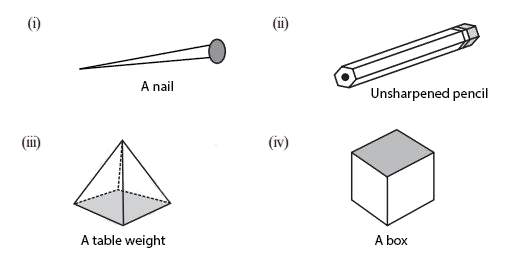
Which are prisms among the following:

NCERT Solutions for Class 8 Maths Chapter 10 - 13

Show solutionHide solution
Worked solution

(i) A nail: It is not a prism.

(ii) Unsharpened pencil: It is a prism.

(iii) A table weight: It is not a prism.

(iv) A box: It is a prism.

Q4Written answer

(i) How are prisms and cylinders alike?

(ii) How are pyramids and cones alike?

Show solutionHide solution
Worked solution

(i) A cylinder can look like a circular prism, a prism with a circular base.

(ii) A cone can be a circular pyramid, a pyramid with a circular base.

Q5Written answer

Is a square prism the same as a cube? Explain.

Show solutionHide solution
Worked solution

Yes, a square prism can also be a cube. A square prism has a square as its base. However, its height is not necessarily the same as the side of the square. Thus, a square prism can also be a cuboid.

Q6Written answer

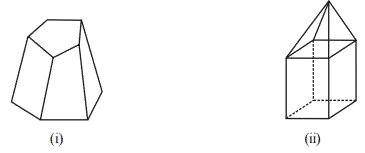
Verify Euler’s formula for the given solids.

NCERT Solutions for Class 8 Maths Chapter 10 - 14

Show solutionHide solution
Worked solution

(i) Number of faces, F = 7

Number of edges, E = 15

Number of vertices, V = 10

As per formula, F + V – E = 2

Substitute the values, we have

F + V – E = 7 + 10 – 15

= 2

Hence, verified.

(ii) Here, F = 9, V = 9 and E = 16

Using formula, F+ V – E = 2

F + V – E = 9 + 9 – 16 = 2

Hence, Euler’s formula is verified.

Q7Written answer

Using Euler’s formula, find the unknown:

Faces ? 5 20
Vertices 6 ? 12
Edges 12 9 ?
Show solutionHide solution
Worked solution

Euler’s formula: F + V – E = 2

Where, F = Faces, V = Vertices and E = Edges

(i) F + 6 – 12 = 2

F = 2 + 6

⇒ F = 8

(ii) 5 + V – 9 = 2

V – 4 = 2

⇒ V = 4 + 2

⇒ V = 6

(iii) 20 + 12 – E = 2

32 – E = 2

⇒ E = 32 – 2

⇒ E = 30

Q8Written answer

Can a polyhedron have 10 faces, 20 edges and 15 vertices?

Show solutionHide solution
Worked solution

From the given data, we have

F = 10

E = 20

V = 15

Every polyhedron satisfies Euler’s formula, which is stated as, F + V – E = 2

For the given polygon,

F + V – E = 10 + 15 – 20 = 25 – 20 = 5, which is not equal to 2.

Therefore, a polyhedron cannot have 10 faces, 20 edges and 15 vertices, as Euler’s formula is not satisfied.