Show how you would connect three resistors, each of resistance 6 Ω, so that the combination has a resistance of (i) 9 Ω, (ii) 4 Ω.
Show solutionHide solution
If we connect all the three resistors in series, their equivalent resistor would 6 Ω + 6 Ω + 6 Ω =18 Ω, which is not the desired value. Similarly, if we connect all the three resistors in parallel, their equivalent resistor would be

which is again not the desired value.
We can obtain the desired value by connecting any two of the resistors in either series or parallel.
Case (i)
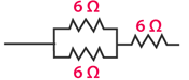
If two resistors are connected in parallel, then their equivalent resistance is
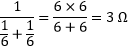
The third resistor is in series, hence the equivalent resistance is calculated as follows:
R = 6 Ω + 3 Ω = 9 Ω
Case (ii)
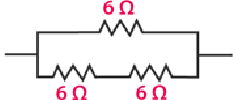
When two resistors are connected in series, their equivalent resistance is given by
R = 6 Ω + 6 Ω = 12 Ω
The third resistor is connected in parallel with 12 Ω. Hence the equivalent resistance is calculated as follows: