My Cart
Your Cart 0

    Your cart is empty.

  • Total (Amount) ₹0.00
NCERT · Class 10 · Science

Chapter 11: Electricity

Practice each question, then open the answer or worked solution.

Exercises · Page 221

Textbook page 221 · 18 questions
Q1Written answer

A piece of wire of resistance R is cut into five equal parts. These parts are then connected in parallel. If the equivalent resistance of this combination is R′, then the ratio R/R′ is _____.

(a) 1/25

(b) 1/5

(c) 5

(d) 25

Show solutionHide solution
Worked solution

Answer: d) 25

Explanation:

The resistance is cut into five equal parts, which means that the resistance of each part is R/5.

We know that each part is connected to each other in parallel, hence the equivalent resistance can be calculated as follows:
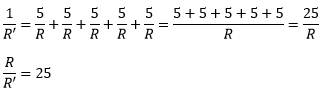
NCERT Solutions for Class 10 Chapter 12 Image 16

The ratio of R/R′ is 25.

Q2Multiple choice

Which of the following does not represent electrical power in a circuit?

Show answerHide answer
Correct option: B
Show solutionHide solution
Worked solution

Answer: b) IR2

Explanation:

Electrical power is given by the expression P = VI. (1)

According to Ohm’s law,

V = IR

Substituting the value of V in (1), we get

P = (IR) × I

P = I2R

Similarly, from Ohm’s law,

I = V/R

Substituting the value of I in (1), we get

P = V × V/R = V2/R

From this, it is clear that the equation IR2 does not represent electrical power in a circuit.

Q3Written answer

An electric bulb is rated 220 V and 100 W. When it is operated on 110 V, the power consumed will be _____.

(a) 100 W

(b) 75 W

(c) 50 W

(d) 25 W

Show solutionHide solution
Worked solution

Answer: 25 W

Explanation:

The energy consumed by the appliance is given by the expression

P = VI = V2/R

The resistance of the light bulb can be calculated as follows:

R = V2/P

Substituting the values, we get

R = (220)2/100 = 484 Ω

Even if the supply voltage is reduced, the resistance remains the same. Hence, the power consumed can be calculated as follows:

P = V2/R

Substituting the value, we get

P = (110)2 V/484 Ω = 25 W

Therefore, the power consumed when the electric bulb operates at 110 V is 25 W.

Q4Written answer

Two conducting wires of the same material and of equal lengths and equal diameters are first connected in series and then parallel in a circuit across the same potential difference. The ratio of heat produced in series and parallel combinations would be _____.

(a) 1:2

(b) 2:1

(c) 1:4

(d) 4:1

Show solutionHide solution
Worked solution

Let Rs and Rp be the equivalent resistance of the wires when connected in series and parallel respectively.

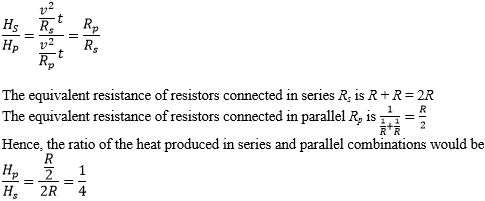
For the same potential difference V, the ratio of the heat produced in the circuit is given by

NCERT Solutions for Class 10 Chapter 12 Image 17

Hence, the ratio of the heat produced is 1:4.

Q5Written answer

How is a voltmeter connected in the circuit to measure the potential difference between two points?

Show solutionHide solution
Worked solution

To measure the voltage between any two points, the voltmeter should be connected in parallel between the two points.

Q6Written answer

A copper wire has diameter 0.5 mm and resistivity of 1.6 × 10⁻⁸ Ω m. What will be the length of this wire to make its resistance 10 Ω? How much does the resistance change if the diameter is doubled?

Show solutionHide solution
Worked solution

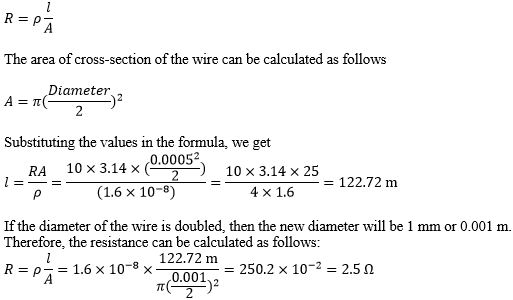
The resistance of the copper wire of length in meters and area of cross-section m2 is given by the formula

NCERT Solutions for Class 10 Chapter 12 Image 18

The length of the wire is 122.72 m and the new resistance is 2.5 Ω.

Q7Written answer

The values of current I flowing in a given resistor for the corresponding values of potential difference V across the resistor are given below –

I (Ampere) 0.5 1.0 2.0 3.0 4.0
V (Volts) 1.6 3.4 6.7 10.2 13.2

Plot a graph between V and I and calculate the resistance of that resistor.

Show solutionHide solution
Worked solution

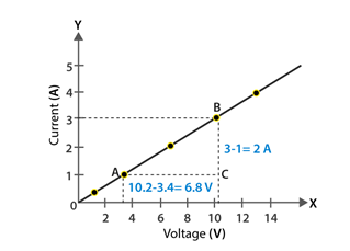
The plot between voltage and current is known as IV characteristic. The current is plotted in the y-axis while the voltage is plotted in the x-axis. The different values of current for different values of voltage are given in the table. The I V characteristics for the given resistor is shown below.

NCERT Solutions for Class 10 Chapter 12 Image 19

The slope of the line gives the value of resistance.

The slope can be calculated as follows:

Slope = 1/R = BC/AC = 2/6.8

To calculate R,

R = 6.8/2 = 3.4 Ω

The resistance of the resistor is 3.4 Ω.

Q8Written answer

When a 12 V battery is connected across an unknown resistor, there is a current of 2.5 mA in the circuit. Find the value of the resistance of the resistor

Show solutionHide solution
Worked solution

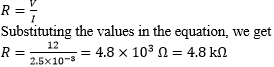
The value of the resistor can be calculated using Ohm’s Law as follows:

NCERT Solutions for Class 10 Chapter 12 Image 20

Q9Written answer

A battery of 9 V is connected in series with resistors of 0.2 Ω, 0.3 Ω, 0.4 Ω, 0.5 Ω and 12 Ω, respectively. How much current would flow through the 12 Ω resistor?

Show solutionHide solution
Worked solution

In series connection, there is no division of current. The current flowing across all the resistors is the same.

To calculate the amount of current flowing across the resistors, we use Ohm’s law.

But first, let us find out the equivalent resistance as follows:

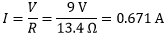
R = 0.2 Ω + 0.3 Ω + 0.4 Ω + 0.5 Ω + 12 Ω = 13.4 Ω

Now, using Ohm’s law,

NCERT Solutions for Class 10 Chapter 12 Image 21

The current flowing across the 12 Ω is 0.671 A.

Q10Written answer

How many 176 Ω resistors (in parallel) are required to carry 5 A on a 220 V line?

Show solutionHide solution
Worked solution

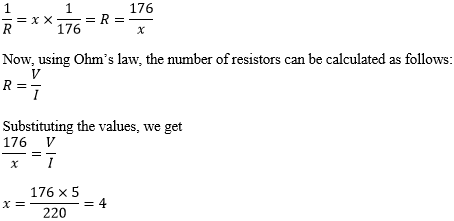
Let us consider the number of resistors required as ‘x.’

The equivalent resistance of the parallel combination of resistor R is given by

NCERT Solutions for Class 10 Chapter 12 Image 22

The number of resistors required is 4.